{"title":"铑介导的新杂环组装:从硼烯到氧硼烷","authors":"Shou-Jen Hsiang, Prof. Dr. Paul G. Hayes","doi":"10.1002/anie.202421302","DOIUrl":null,"url":null,"abstract":"<p>Base-stabilized rhodium borylene complex <i>κ</i><sup>2</sup>-<i>L</i>(CO)Rh(BMes), <b>2</b>; <i>κ</i><sup>2</sup>-<i>L</i>=<i>κ</i><sup>2</sup>-NN’-Rh,<i>κ</i><sup>1</sup>-N−B-(2,5-[<sup><i>i</i></sup>Pr<sub>2</sub>P=N(4-<sup><i>i</i></sup>PrC<sub>6</sub>H<sub>4</sub>)]<sub>2</sub>-N<b>’</b>(C<sub>4</sub>H<sub>2</sub>)<sup>−</sup>); Mes=mesityl, reacts with a series of alkynes (PhC≡C—R; R=Ph, Me, CO<sub>2</sub>Et, H) to yield unique structures whereby the alkyne has regioselectively added across boron and the carbon atom of a CO ligand. The resulting complexes, <i>L</i>Rh[C(O)C(Ph)C(R)B(Mes)], <b>3<sup>R</sup></b>, react with additional CO to afford cycle-containing products, <i>L</i>(CO)Rh<span></span><math></math>\n), <b>5<sup>R</sup></b>, that ultimately release highly functionalized organic heterocycles of the form <span></span><math></math>\n=NPipp (Pipp=4-<sup><i>i</i></sup>PrC<sub>6</sub>H<sub>4</sub>), <b>6</b>. These oxaboroles, which were assembled from a primary hydroborane, CO, an alkyne, and an azide-generated NPipp, are structurally analogous to two of the five boron-containing therapeutics approved by the FDA.</p>","PeriodicalId":125,"journal":{"name":"Angewandte Chemie International Edition","volume":"64 10","pages":""},"PeriodicalIF":16.9000,"publicationDate":"2025-01-14","publicationTypes":"Journal Article","fieldsOfStudy":null,"isOpenAccess":false,"openAccessPdf":"https://onlinelibrary.wiley.com/doi/epdf/10.1002/anie.202421302","citationCount":"0","resultStr":"{\"title\":\"Rhodium-mediated Assembly of New Heterocycles: From Borylenes to Oxaboroles\",\"authors\":\"Shou-Jen Hsiang, Prof. Dr. Paul G. Hayes\",\"doi\":\"10.1002/anie.202421302\",\"DOIUrl\":null,\"url\":null,\"abstract\":\"<p>Base-stabilized rhodium borylene complex <i>κ</i><sup>2</sup>-<i>L</i>(CO)Rh(BMes), <b>2</b>; <i>κ</i><sup>2</sup>-<i>L</i>=<i>κ</i><sup>2</sup>-NN’-Rh,<i>κ</i><sup>1</sup>-N−B-(2,5-[<sup><i>i</i></sup>Pr<sub>2</sub>P=N(4-<sup><i>i</i></sup>PrC<sub>6</sub>H<sub>4</sub>)]<sub>2</sub>-N<b>’</b>(C<sub>4</sub>H<sub>2</sub>)<sup>−</sup>); Mes=mesityl, reacts with a series of alkynes (PhC≡C—R; R=Ph, Me, CO<sub>2</sub>Et, H) to yield unique structures whereby the alkyne has regioselectively added across boron and the carbon atom of a CO ligand. The resulting complexes, <i>L</i>Rh[C(O)C(Ph)C(R)B(Mes)], <b>3<sup>R</sup></b>, react with additional CO to afford cycle-containing products, <i>L</i>(CO)Rh<span></span><math></math>\\n), <b>5<sup>R</sup></b>, that ultimately release highly functionalized organic heterocycles of the form <span></span><math></math>\\n=NPipp (Pipp=4-<sup><i>i</i></sup>PrC<sub>6</sub>H<sub>4</sub>), <b>6</b>. These oxaboroles, which were assembled from a primary hydroborane, CO, an alkyne, and an azide-generated NPipp, are structurally analogous to two of the five boron-containing therapeutics approved by the FDA.</p>\",\"PeriodicalId\":125,\"journal\":{\"name\":\"Angewandte Chemie International Edition\",\"volume\":\"64 10\",\"pages\":\"\"},\"PeriodicalIF\":16.9000,\"publicationDate\":\"2025-01-14\",\"publicationTypes\":\"Journal Article\",\"fieldsOfStudy\":null,\"isOpenAccess\":false,\"openAccessPdf\":\"https://onlinelibrary.wiley.com/doi/epdf/10.1002/anie.202421302\",\"citationCount\":\"0\",\"resultStr\":null,\"platform\":\"Semanticscholar\",\"paperid\":null,\"PeriodicalName\":\"Angewandte Chemie International Edition\",\"FirstCategoryId\":\"92\",\"ListUrlMain\":\"https://onlinelibrary.wiley.com/doi/10.1002/anie.202421302\",\"RegionNum\":1,\"RegionCategory\":\"化学\",\"ArticlePicture\":[],\"TitleCN\":null,\"AbstractTextCN\":null,\"PMCID\":null,\"EPubDate\":\"\",\"PubModel\":\"\",\"JCR\":\"Q1\",\"JCRName\":\"CHEMISTRY, MULTIDISCIPLINARY\",\"Score\":null,\"Total\":0}","platform":"Semanticscholar","paperid":null,"PeriodicalName":"Angewandte Chemie International Edition","FirstCategoryId":"92","ListUrlMain":"https://onlinelibrary.wiley.com/doi/10.1002/anie.202421302","RegionNum":1,"RegionCategory":"化学","ArticlePicture":[],"TitleCN":null,"AbstractTextCN":null,"PMCID":null,"EPubDate":"","PubModel":"","JCR":"Q1","JCRName":"CHEMISTRY, MULTIDISCIPLINARY","Score":null,"Total":0}
引用次数: 0
摘要
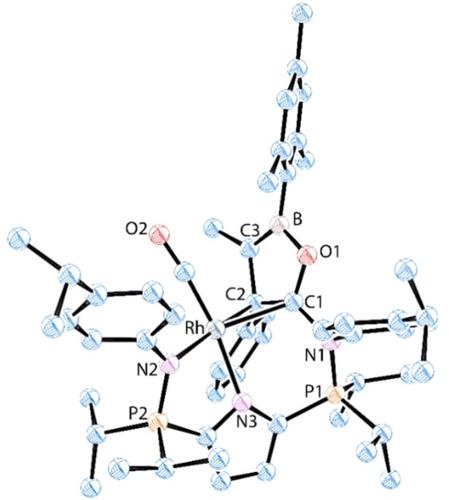
碱稳定的硼铑络合物 κ2-L(CO)Rh(BMes), 2; κ2-L = κ2-NN'-Rh, κ1-N-B-(2,5-[iPr2P=N(4-iPrC6H4)]2-N'(C4H2)-); Mes = 甲磺酰基,与一系列炔烃(PhC≡C-R;R=Ph、Me、CO2Et、H)发生反应,生成独特的结构,其中炔烃通过硼和 CO 配体的碳原子进行区域选择性添加。由此产生的配合物 LRh[C(O)C(Ph)C(R)B(Mes)],3R,与额外的 CO 反应生成含循环的产物 L(CO)Rh([[等式]]),5R,最终释放出高度官能化的有机杂环,其形式为[[等式]]=NPipp(Pipp = 4-iPrC6H4),6。这些氧硼烷是由伯羟基硼烷、CO、炔烃和叠氮化物生成的 NPipp 组合而成的,在结构上类似于美国 FDA 批准的五种含硼疗法中的两种。
Rhodium-mediated Assembly of New Heterocycles: From Borylenes to Oxaboroles
Base-stabilized rhodium borylene complex κ2-L(CO)Rh(BMes), 2; κ2-L=κ2-NN’-Rh,κ1-N−B-(2,5-[iPr2P=N(4-iPrC6H4)]2-N’(C4H2)−); Mes=mesityl, reacts with a series of alkynes (PhC≡C—R; R=Ph, Me, CO2Et, H) to yield unique structures whereby the alkyne has regioselectively added across boron and the carbon atom of a CO ligand. The resulting complexes, LRh[C(O)C(Ph)C(R)B(Mes)], 3R, react with additional CO to afford cycle-containing products, L(CO)Rh
), 5R, that ultimately release highly functionalized organic heterocycles of the form
=NPipp (Pipp=4-iPrC6H4), 6. These oxaboroles, which were assembled from a primary hydroborane, CO, an alkyne, and an azide-generated NPipp, are structurally analogous to two of the five boron-containing therapeutics approved by the FDA.
期刊介绍:
Angewandte Chemie, a journal of the German Chemical Society (GDCh), maintains a leading position among scholarly journals in general chemistry with an impressive Impact Factor of 16.6 (2022 Journal Citation Reports, Clarivate, 2023). Published weekly in a reader-friendly format, it features new articles almost every day. Established in 1887, Angewandte Chemie is a prominent chemistry journal, offering a dynamic blend of Review-type articles, Highlights, Communications, and Research Articles on a weekly basis, making it unique in the field.




 京公网安备 11010802042870号
京ICP备2023020795号-1
京公网安备 11010802042870号
京ICP备2023020795号-1

 分享
分享
 求助内容:
求助内容: 应助结果提醒方式:
 扫码关注我们
