M. I. Khan, Ali Mujtaba, Dhafer O. Alshahrani, Safa Ezzine and Ghalib Ul Islam
{"title":"以山茶提取物为还原剂和稳定剂,绿色合成用于储能的MnMoO4纳米颗粒的电化学性能","authors":"M. I. Khan, Ali Mujtaba, Dhafer O. Alshahrani, Safa Ezzine and Ghalib Ul Islam","doi":"10.1039/D4NJ04497E","DOIUrl":null,"url":null,"abstract":"<p >Flavonoid and polyphenol-rich <em>Camellia sinensis</em> (green tea) leaf extract was used to reduce and stabilize forming manganese molybdate (MnMoO<small><sub>4</sub></small>) nanoparticles, which were prepared by a green synthesis <em>via</em> a hydrothermal method. This approach promotes environmental sustainability by utilizing active components in green tea. The X-ray diffraction (XRD) technique revealed that the MnMoO<small><sub>4</sub></small> had a monoclinic crystal structure with a crystallite size of 24.50 nm and <em>d</em>-spacing of 3.51 Å. Nanospheres were observed using scanning electron microscopy (SEM). Also, Brunauer–Emmett–Teller (BET) analysis performed on the material showed that it was a mesoporous material. EIS studies after GCD showed low charge transfer resistance of 0.21 ohm, which showed that the charge transport was good. Cyclic voltammetry (CV) results showed two redox peaks at 0.44 V and 0.31 V signifying pseudo capacitance. Galvanostatic charge–discharge (GCD) tests were performed on MnMoO<small><sub>4</sub></small> nanoparticles confirming their high potential for use as supercapacitors with a capacitance of 2115 F g<small><sup>−1</sup></small> at a current density of 0.8 A g<small><sup>−1</sup></small>. So, MnMoO<small><sub>4</sub></small> played a significant role in energy storage applications as they exhibited favorable characteristics that were suitable for the applications.</p>","PeriodicalId":95,"journal":{"name":"New Journal of Chemistry","volume":" 3","pages":" 1053-1061"},"PeriodicalIF":2.6000,"publicationDate":"2024-12-12","publicationTypes":"Journal Article","fieldsOfStudy":null,"isOpenAccess":false,"openAccessPdf":"","citationCount":"0","resultStr":"{\"title\":\"Electrochemical properties of MnMoO4 nanoparticles for energy storage applications synthesized via a green approach using Camellia sinensis extract as a reducing and stabilizing agent\",\"authors\":\"M. I. Khan, Ali Mujtaba, Dhafer O. Alshahrani, Safa Ezzine and Ghalib Ul Islam\",\"doi\":\"10.1039/D4NJ04497E\",\"DOIUrl\":null,\"url\":null,\"abstract\":\"<p >Flavonoid and polyphenol-rich <em>Camellia sinensis</em> (green tea) leaf extract was used to reduce and stabilize forming manganese molybdate (MnMoO<small><sub>4</sub></small>) nanoparticles, which were prepared by a green synthesis <em>via</em> a hydrothermal method. This approach promotes environmental sustainability by utilizing active components in green tea. The X-ray diffraction (XRD) technique revealed that the MnMoO<small><sub>4</sub></small> had a monoclinic crystal structure with a crystallite size of 24.50 nm and <em>d</em>-spacing of 3.51 Å. Nanospheres were observed using scanning electron microscopy (SEM). Also, Brunauer–Emmett–Teller (BET) analysis performed on the material showed that it was a mesoporous material. EIS studies after GCD showed low charge transfer resistance of 0.21 ohm, which showed that the charge transport was good. Cyclic voltammetry (CV) results showed two redox peaks at 0.44 V and 0.31 V signifying pseudo capacitance. Galvanostatic charge–discharge (GCD) tests were performed on MnMoO<small><sub>4</sub></small> nanoparticles confirming their high potential for use as supercapacitors with a capacitance of 2115 F g<small><sup>−1</sup></small> at a current density of 0.8 A g<small><sup>−1</sup></small>. So, MnMoO<small><sub>4</sub></small> played a significant role in energy storage applications as they exhibited favorable characteristics that were suitable for the applications.</p>\",\"PeriodicalId\":95,\"journal\":{\"name\":\"New Journal of Chemistry\",\"volume\":\" 3\",\"pages\":\" 1053-1061\"},\"PeriodicalIF\":2.6000,\"publicationDate\":\"2024-12-12\",\"publicationTypes\":\"Journal Article\",\"fieldsOfStudy\":null,\"isOpenAccess\":false,\"openAccessPdf\":\"\",\"citationCount\":\"0\",\"resultStr\":null,\"platform\":\"Semanticscholar\",\"paperid\":null,\"PeriodicalName\":\"New Journal of Chemistry\",\"FirstCategoryId\":\"92\",\"ListUrlMain\":\"https://pubs.rsc.org/en/content/articlelanding/2025/nj/d4nj04497e\",\"RegionNum\":3,\"RegionCategory\":\"化学\",\"ArticlePicture\":[],\"TitleCN\":null,\"AbstractTextCN\":null,\"PMCID\":null,\"EPubDate\":\"\",\"PubModel\":\"\",\"JCR\":\"Q2\",\"JCRName\":\"CHEMISTRY, MULTIDISCIPLINARY\",\"Score\":null,\"Total\":0}","platform":"Semanticscholar","paperid":null,"PeriodicalName":"New Journal of Chemistry","FirstCategoryId":"92","ListUrlMain":"https://pubs.rsc.org/en/content/articlelanding/2025/nj/d4nj04497e","RegionNum":3,"RegionCategory":"化学","ArticlePicture":[],"TitleCN":null,"AbstractTextCN":null,"PMCID":null,"EPubDate":"","PubModel":"","JCR":"Q2","JCRName":"CHEMISTRY, MULTIDISCIPLINARY","Score":null,"Total":0}
引用次数: 0
摘要
利用富含黄酮类和多酚的茶树叶提取物还原和稳定钼酸锰纳米颗粒的形成,采用水热法绿色合成钼酸锰纳米颗粒。这种方法通过利用绿茶中的活性成分来促进环境的可持续性。x射线衍射(XRD)技术表明,MnMoO4具有单斜晶结构,晶粒尺寸为24.50 nm, d-间距为3.51 Å。利用扫描电子显微镜(SEM)对纳米球进行了观察。此外,对该材料进行了布鲁诺尔-埃米特-泰勒(BET)分析,表明它是一种介孔材料。GCD后的EIS研究显示电荷转移电阻较低,为0.21欧姆,表明电荷输运良好。循环伏安法(CV)结果显示,在0.44 V和0.31 V处有两个氧化还原峰,表示伪电容。通过恒流充放电(GCD)测试,证实了mmoo4纳米颗粒在0.8 a g−1电流密度下具有2115 F g−1电容的高潜力。因此,MnMoO4在储能应用中发挥了重要作用,因为它们具有适合应用的良好特性。
Electrochemical properties of MnMoO4 nanoparticles for energy storage applications synthesized via a green approach using Camellia sinensis extract as a reducing and stabilizing agent
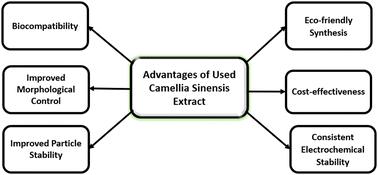
Flavonoid and polyphenol-rich Camellia sinensis (green tea) leaf extract was used to reduce and stabilize forming manganese molybdate (MnMoO4) nanoparticles, which were prepared by a green synthesis via a hydrothermal method. This approach promotes environmental sustainability by utilizing active components in green tea. The X-ray diffraction (XRD) technique revealed that the MnMoO4 had a monoclinic crystal structure with a crystallite size of 24.50 nm and d-spacing of 3.51 Å. Nanospheres were observed using scanning electron microscopy (SEM). Also, Brunauer–Emmett–Teller (BET) analysis performed on the material showed that it was a mesoporous material. EIS studies after GCD showed low charge transfer resistance of 0.21 ohm, which showed that the charge transport was good. Cyclic voltammetry (CV) results showed two redox peaks at 0.44 V and 0.31 V signifying pseudo capacitance. Galvanostatic charge–discharge (GCD) tests were performed on MnMoO4 nanoparticles confirming their high potential for use as supercapacitors with a capacitance of 2115 F g−1 at a current density of 0.8 A g−1. So, MnMoO4 played a significant role in energy storage applications as they exhibited favorable characteristics that were suitable for the applications.




 京公网安备 11010802042870号
京ICP备2023020795号-1
京公网安备 11010802042870号
京ICP备2023020795号-1

 分享
分享
 求助内容:
求助内容: 应助结果提醒方式:
 扫码关注我们
