{"title":"粒子轨迹模拟促进了单粒子ICP-MS分析的高效样品导入系统的开发","authors":"Dingyi Wang, Junhui Zhang, Changjun Fan, Xiaodong Li, Lihong Liu, Xueting Yan, Yingying Li, Bin He, Yongguang Yin, Ligang Hu, Guibin Jiang","doi":"10.1021/acs.analchem.4c05614","DOIUrl":null,"url":null,"abstract":"Inductively coupled plasma mass spectrometry (ICP-MS) has demonstrated significant capabilities in the analysis of single events, such as single cells and particles. Researchers have been actively pursuing innovations in ICP-MS sample introduction systems to enhance their transport efficiency, as this is critical for ensuring the accuracy of single-event analysis. However, the majority of prior studies have relied heavily on empirical approaches, with limited attention given to the individual characteristics of particles from a theoretical perspective and a lack of efficient manufacturing tools for optimizing related components. Herein, we developed a high-efficiency sample introduction system for single-event ICP-MS analysis by integrating the computational simulation-aided design, precise 3D printing manufacturing, and rapid experimental testing process. For the first time, we simulated the transport trajectories of individual particles passing through the spray chamber, providing theoretical guidance for the design and optimization process. The statistical analysis of particle trajectories revealed that under the absorption boundary condition, particles between 20 and 100 nm achieved transport efficiencies exceeding 18.8%. In comparison, particles larger than 100 nm exhibited 0% transport efficiency due to increased deposition within the spray chamber. The spray chamber was fabricated in-house using a range of 3D printing technologies and materials, streamlining the process and reducing the cost for both manufacturing and validation. Further optimization of the operating parameters, including an increase in temperature, resulted in a notable transport efficiency of 61.1%. The workflow introduced in this study has the potential to transform the research and development of critical mass spectrometry components moving forward.","PeriodicalId":27,"journal":{"name":"Analytical Chemistry","volume":"28 1","pages":""},"PeriodicalIF":7.3000,"publicationDate":"2025-01-14","publicationTypes":"Journal Article","fieldsOfStudy":null,"isOpenAccess":false,"openAccessPdf":"","citationCount":"0","resultStr":"{\"title\":\"Particle Trajectory Simulation Facilitates the Development of an Efficient Sample Introduction System for Single-Particle ICP-MS Analysis\",\"authors\":\"Dingyi Wang, Junhui Zhang, Changjun Fan, Xiaodong Li, Lihong Liu, Xueting Yan, Yingying Li, Bin He, Yongguang Yin, Ligang Hu, Guibin Jiang\",\"doi\":\"10.1021/acs.analchem.4c05614\",\"DOIUrl\":null,\"url\":null,\"abstract\":\"Inductively coupled plasma mass spectrometry (ICP-MS) has demonstrated significant capabilities in the analysis of single events, such as single cells and particles. Researchers have been actively pursuing innovations in ICP-MS sample introduction systems to enhance their transport efficiency, as this is critical for ensuring the accuracy of single-event analysis. However, the majority of prior studies have relied heavily on empirical approaches, with limited attention given to the individual characteristics of particles from a theoretical perspective and a lack of efficient manufacturing tools for optimizing related components. Herein, we developed a high-efficiency sample introduction system for single-event ICP-MS analysis by integrating the computational simulation-aided design, precise 3D printing manufacturing, and rapid experimental testing process. For the first time, we simulated the transport trajectories of individual particles passing through the spray chamber, providing theoretical guidance for the design and optimization process. The statistical analysis of particle trajectories revealed that under the absorption boundary condition, particles between 20 and 100 nm achieved transport efficiencies exceeding 18.8%. In comparison, particles larger than 100 nm exhibited 0% transport efficiency due to increased deposition within the spray chamber. The spray chamber was fabricated in-house using a range of 3D printing technologies and materials, streamlining the process and reducing the cost for both manufacturing and validation. Further optimization of the operating parameters, including an increase in temperature, resulted in a notable transport efficiency of 61.1%. The workflow introduced in this study has the potential to transform the research and development of critical mass spectrometry components moving forward.\",\"PeriodicalId\":27,\"journal\":{\"name\":\"Analytical Chemistry\",\"volume\":\"28 1\",\"pages\":\"\"},\"PeriodicalIF\":7.3000,\"publicationDate\":\"2025-01-14\",\"publicationTypes\":\"Journal Article\",\"fieldsOfStudy\":null,\"isOpenAccess\":false,\"openAccessPdf\":\"\",\"citationCount\":\"0\",\"resultStr\":null,\"platform\":\"Semanticscholar\",\"paperid\":null,\"PeriodicalName\":\"Analytical Chemistry\",\"FirstCategoryId\":\"92\",\"ListUrlMain\":\"https://doi.org/10.1021/acs.analchem.4c05614\",\"RegionNum\":1,\"RegionCategory\":\"化学\",\"ArticlePicture\":[],\"TitleCN\":null,\"AbstractTextCN\":null,\"PMCID\":null,\"EPubDate\":\"\",\"PubModel\":\"\",\"JCR\":\"Q1\",\"JCRName\":\"CHEMISTRY, ANALYTICAL\",\"Score\":null,\"Total\":0}","platform":"Semanticscholar","paperid":null,"PeriodicalName":"Analytical Chemistry","FirstCategoryId":"92","ListUrlMain":"https://doi.org/10.1021/acs.analchem.4c05614","RegionNum":1,"RegionCategory":"化学","ArticlePicture":[],"TitleCN":null,"AbstractTextCN":null,"PMCID":null,"EPubDate":"","PubModel":"","JCR":"Q1","JCRName":"CHEMISTRY, ANALYTICAL","Score":null,"Total":0}
Particle Trajectory Simulation Facilitates the Development of an Efficient Sample Introduction System for Single-Particle ICP-MS Analysis
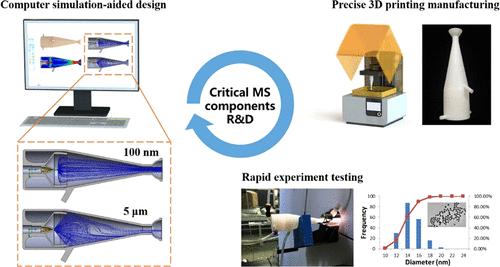
Inductively coupled plasma mass spectrometry (ICP-MS) has demonstrated significant capabilities in the analysis of single events, such as single cells and particles. Researchers have been actively pursuing innovations in ICP-MS sample introduction systems to enhance their transport efficiency, as this is critical for ensuring the accuracy of single-event analysis. However, the majority of prior studies have relied heavily on empirical approaches, with limited attention given to the individual characteristics of particles from a theoretical perspective and a lack of efficient manufacturing tools for optimizing related components. Herein, we developed a high-efficiency sample introduction system for single-event ICP-MS analysis by integrating the computational simulation-aided design, precise 3D printing manufacturing, and rapid experimental testing process. For the first time, we simulated the transport trajectories of individual particles passing through the spray chamber, providing theoretical guidance for the design and optimization process. The statistical analysis of particle trajectories revealed that under the absorption boundary condition, particles between 20 and 100 nm achieved transport efficiencies exceeding 18.8%. In comparison, particles larger than 100 nm exhibited 0% transport efficiency due to increased deposition within the spray chamber. The spray chamber was fabricated in-house using a range of 3D printing technologies and materials, streamlining the process and reducing the cost for both manufacturing and validation. Further optimization of the operating parameters, including an increase in temperature, resulted in a notable transport efficiency of 61.1%. The workflow introduced in this study has the potential to transform the research and development of critical mass spectrometry components moving forward.
期刊介绍:
Analytical Chemistry, a peer-reviewed research journal, focuses on disseminating new and original knowledge across all branches of analytical chemistry. Fundamental articles may explore general principles of chemical measurement science and need not directly address existing or potential analytical methodology. They can be entirely theoretical or report experimental results. Contributions may cover various phases of analytical operations, including sampling, bioanalysis, electrochemistry, mass spectrometry, microscale and nanoscale systems, environmental analysis, separations, spectroscopy, chemical reactions and selectivity, instrumentation, imaging, surface analysis, and data processing. Papers discussing known analytical methods should present a significant, original application of the method, a notable improvement, or results on an important analyte.




 京公网安备 11010802042870号
京ICP备2023020795号-1
京公网安备 11010802042870号
京ICP备2023020795号-1

 分享
分享
 求助内容:
求助内容: 应助结果提醒方式:
 扫码关注我们
