Zhenhua Li, Zhengli Liang, Jiahao Wan, Lehui Liu, Chunxiang Wu, Ping Wang, Xingxing Jiang, Zheshuai Lin and Hongming Liu
{"title":"不同p块元素诱导钛表面C3[111]八面体畸变产生强烈的非线性效应","authors":"Zhenhua Li, Zhengli Liang, Jiahao Wan, Lehui Liu, Chunxiang Wu, Ping Wang, Xingxing Jiang, Zheshuai Lin and Hongming Liu","doi":"10.1039/D4SC06620K","DOIUrl":null,"url":null,"abstract":"<p >Acentric crystalline materials are the cornerstone of numerous cutting-edge technologies and have been highly sought-after, but they are difficult to construct controllably. Herein, by introducing a new p-block element to break the symmetrical environment of the d<small><sup>0</sup></small> transition metal in the centric matrix TiTe<small><sub>3</sub></small>O<small><sub>8</sub></small>, a novel acentric tellurite sulfate, namely Ti(TeO<small><sub>3</sub></small>)(SO<small><sub>4</sub></small>), was successfully constructed. In its structure, two types of p-block element-centered oxo-anionic groups, <em>i.e.</em> [TeO<small><sub>3</sub></small>] and [SO<small><sub>4</sub></small>], endow [TiO<small><sub>6</sub></small>] with an out-of-center distortion along the local C<small><sub>3</sub></small>[111] direction, which is rare in titanium oxides containing a lone-pair cation. The synergy of the distorted [TiO<small><sub>6</sub></small>] octahedron, lone-pair [TeO<small><sub>3</sub></small>] pyramid and rigid [SO<small><sub>4</sub></small>] tetrahedron within its structure induces a strong second harmonic generation (SHG) response of 11.6 × KDP (KH<small><sub>2</sub></small>PO<small><sub>4</sub></small>), the largest value among mercury-free sulfates. Additionally, Ti(TeO<small><sub>3</sub></small>)(SO<small><sub>4</sub></small>) also shows the largest birefringence (0.145) among sulfates possessing an SHG response that is more than ten times that of KDP, showing huge potential as a nonlinear optical material. The successful implementation of the strategy of inducing intra-octahedral distortion in a d<small><sup>0</sup></small> transition metal by different p-block elements provides new opportunities for constructing acentric structures and exploiting outstanding nonlinear optically active sulfates.</p>","PeriodicalId":9909,"journal":{"name":"Chemical Science","volume":" 7","pages":" 3329-3335"},"PeriodicalIF":8.1000,"publicationDate":"2025-01-15","publicationTypes":"Journal Article","fieldsOfStudy":null,"isOpenAccess":false,"openAccessPdf":"https://pubs.rsc.org/en/content/articlepdf/2025/sc/d4sc06620k?page=search","citationCount":"0","resultStr":"{\"title\":\"Different p-block elements induce C3[111] octahedral distortion in titanium to generate an intense nonlinear effect†\",\"authors\":\"Zhenhua Li, Zhengli Liang, Jiahao Wan, Lehui Liu, Chunxiang Wu, Ping Wang, Xingxing Jiang, Zheshuai Lin and Hongming Liu\",\"doi\":\"10.1039/D4SC06620K\",\"DOIUrl\":null,\"url\":null,\"abstract\":\"<p >Acentric crystalline materials are the cornerstone of numerous cutting-edge technologies and have been highly sought-after, but they are difficult to construct controllably. Herein, by introducing a new p-block element to break the symmetrical environment of the d<small><sup>0</sup></small> transition metal in the centric matrix TiTe<small><sub>3</sub></small>O<small><sub>8</sub></small>, a novel acentric tellurite sulfate, namely Ti(TeO<small><sub>3</sub></small>)(SO<small><sub>4</sub></small>), was successfully constructed. In its structure, two types of p-block element-centered oxo-anionic groups, <em>i.e.</em> [TeO<small><sub>3</sub></small>] and [SO<small><sub>4</sub></small>], endow [TiO<small><sub>6</sub></small>] with an out-of-center distortion along the local C<small><sub>3</sub></small>[111] direction, which is rare in titanium oxides containing a lone-pair cation. The synergy of the distorted [TiO<small><sub>6</sub></small>] octahedron, lone-pair [TeO<small><sub>3</sub></small>] pyramid and rigid [SO<small><sub>4</sub></small>] tetrahedron within its structure induces a strong second harmonic generation (SHG) response of 11.6 × KDP (KH<small><sub>2</sub></small>PO<small><sub>4</sub></small>), the largest value among mercury-free sulfates. Additionally, Ti(TeO<small><sub>3</sub></small>)(SO<small><sub>4</sub></small>) also shows the largest birefringence (0.145) among sulfates possessing an SHG response that is more than ten times that of KDP, showing huge potential as a nonlinear optical material. The successful implementation of the strategy of inducing intra-octahedral distortion in a d<small><sup>0</sup></small> transition metal by different p-block elements provides new opportunities for constructing acentric structures and exploiting outstanding nonlinear optically active sulfates.</p>\",\"PeriodicalId\":9909,\"journal\":{\"name\":\"Chemical Science\",\"volume\":\" 7\",\"pages\":\" 3329-3335\"},\"PeriodicalIF\":8.1000,\"publicationDate\":\"2025-01-15\",\"publicationTypes\":\"Journal Article\",\"fieldsOfStudy\":null,\"isOpenAccess\":false,\"openAccessPdf\":\"https://pubs.rsc.org/en/content/articlepdf/2025/sc/d4sc06620k?page=search\",\"citationCount\":\"0\",\"resultStr\":null,\"platform\":\"Semanticscholar\",\"paperid\":null,\"PeriodicalName\":\"Chemical Science\",\"FirstCategoryId\":\"92\",\"ListUrlMain\":\"https://pubs.rsc.org/en/content/articlelanding/2025/sc/d4sc06620k\",\"RegionNum\":1,\"RegionCategory\":\"化学\",\"ArticlePicture\":[],\"TitleCN\":null,\"AbstractTextCN\":null,\"PMCID\":null,\"EPubDate\":\"\",\"PubModel\":\"\",\"JCR\":\"Q1\",\"JCRName\":\"CHEMISTRY, MULTIDISCIPLINARY\",\"Score\":null,\"Total\":0}","platform":"Semanticscholar","paperid":null,"PeriodicalName":"Chemical Science","FirstCategoryId":"92","ListUrlMain":"https://pubs.rsc.org/en/content/articlelanding/2025/sc/d4sc06620k","RegionNum":1,"RegionCategory":"化学","ArticlePicture":[],"TitleCN":null,"AbstractTextCN":null,"PMCID":null,"EPubDate":"","PubModel":"","JCR":"Q1","JCRName":"CHEMISTRY, MULTIDISCIPLINARY","Score":null,"Total":0}
Different p-block elements induce C3[111] octahedral distortion in titanium to generate an intense nonlinear effect†
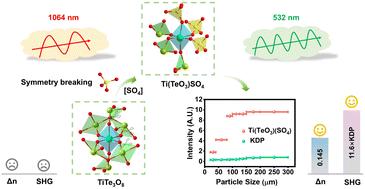
Acentric crystalline materials are the cornerstone of numerous cutting-edge technologies and have been highly sought-after, but they are difficult to construct controllably. Herein, by introducing a new p-block element to break the symmetrical environment of the d0 transition metal in the centric matrix TiTe3O8, a novel acentric tellurite sulfate, namely Ti(TeO3)(SO4), was successfully constructed. In its structure, two types of p-block element-centered oxo-anionic groups, i.e. [TeO3] and [SO4], endow [TiO6] with an out-of-center distortion along the local C3[111] direction, which is rare in titanium oxides containing a lone-pair cation. The synergy of the distorted [TiO6] octahedron, lone-pair [TeO3] pyramid and rigid [SO4] tetrahedron within its structure induces a strong second harmonic generation (SHG) response of 11.6 × KDP (KH2PO4), the largest value among mercury-free sulfates. Additionally, Ti(TeO3)(SO4) also shows the largest birefringence (0.145) among sulfates possessing an SHG response that is more than ten times that of KDP, showing huge potential as a nonlinear optical material. The successful implementation of the strategy of inducing intra-octahedral distortion in a d0 transition metal by different p-block elements provides new opportunities for constructing acentric structures and exploiting outstanding nonlinear optically active sulfates.
期刊介绍:
Chemical Science is a journal that encompasses various disciplines within the chemical sciences. Its scope includes publishing ground-breaking research with significant implications for its respective field, as well as appealing to a wider audience in related areas. To be considered for publication, articles must showcase innovative and original advances in their field of study and be presented in a manner that is understandable to scientists from diverse backgrounds. However, the journal generally does not publish highly specialized research.





 京公网安备 11010802042870号
京ICP备2023020795号-1
京公网安备 11010802042870号
京ICP备2023020795号-1

 分享
分享
 求助内容:
求助内容: 应助结果提醒方式:
 扫码关注我们
