{"title":"在羧甲基纤维素的多孔磁性生物聚合物Fe3O4/CMC-Ag NPs上控制银离子的生物还原成纳米粒子,作为可持续的纳米催化剂。","authors":"Mojtaba Azizi, Mahdi Jafari and Sadegh Rostamnia","doi":"10.1039/D4NA00866A","DOIUrl":null,"url":null,"abstract":"<p >A magnetic-biopolymer composite of carboxymethyl cellulose (CMC), designated as Fe<small><sub>3</sub></small>O<small><sub>4</sub></small>@CMC, was synthesized featuring remarkable stability and an active surface with a green biosynthetic method. This composite was engineered to serve as a substrate for stabilizing silver nanoparticles (Ag NPs) with enhanced functional properties. The catalytic efficacy of the nanocatalyst, incorporating Ag NPs at concentrations of 3%, 7%, and 10%, was evaluated for the reduction of the toxic compound 4-nitrophenol to the beneficial 4-aminophenol. Among the tested configurations, the formulation containing 10% silver nanoparticles, in conjunction with Euphorbia plant extract as a bioreducing agent, exhibited the highest reduction efficiency and favorable reaction kinetics, rendering it the optimal choice. The apparent rate constant (<em>K</em><small><sub>app</sub></small>) was assessed by fine-tuning the catalyst parameters, while the reaction mechanism was further elucidated by adjusting the concentrations of NaBH<small><sub>4</sub></small> and 4-nitrophenol. Notably, the catalyst demonstrated good stability over five consecutive reduction cycles and could be easily retrieved from the reaction mixture using an external magnet.</p>","PeriodicalId":18806,"journal":{"name":"Nanoscale Advances","volume":" 5","pages":" 1318-1325"},"PeriodicalIF":4.6000,"publicationDate":"2024-12-11","publicationTypes":"Journal Article","fieldsOfStudy":null,"isOpenAccess":false,"openAccessPdf":"https://www.ncbi.nlm.nih.gov/pmc/articles/PMC11726232/pdf/","citationCount":"0","resultStr":"{\"title\":\"Controlled bioreduction of silver ions to nanosized particles on a porous magnetic-biopolymer of carboxymethyl cellulose, Fe3O4/CMC-Ag NPs, serving as a sustainable nanocatalyst\",\"authors\":\"Mojtaba Azizi, Mahdi Jafari and Sadegh Rostamnia\",\"doi\":\"10.1039/D4NA00866A\",\"DOIUrl\":null,\"url\":null,\"abstract\":\"<p >A magnetic-biopolymer composite of carboxymethyl cellulose (CMC), designated as Fe<small><sub>3</sub></small>O<small><sub>4</sub></small>@CMC, was synthesized featuring remarkable stability and an active surface with a green biosynthetic method. This composite was engineered to serve as a substrate for stabilizing silver nanoparticles (Ag NPs) with enhanced functional properties. The catalytic efficacy of the nanocatalyst, incorporating Ag NPs at concentrations of 3%, 7%, and 10%, was evaluated for the reduction of the toxic compound 4-nitrophenol to the beneficial 4-aminophenol. Among the tested configurations, the formulation containing 10% silver nanoparticles, in conjunction with Euphorbia plant extract as a bioreducing agent, exhibited the highest reduction efficiency and favorable reaction kinetics, rendering it the optimal choice. The apparent rate constant (<em>K</em><small><sub>app</sub></small>) was assessed by fine-tuning the catalyst parameters, while the reaction mechanism was further elucidated by adjusting the concentrations of NaBH<small><sub>4</sub></small> and 4-nitrophenol. Notably, the catalyst demonstrated good stability over five consecutive reduction cycles and could be easily retrieved from the reaction mixture using an external magnet.</p>\",\"PeriodicalId\":18806,\"journal\":{\"name\":\"Nanoscale Advances\",\"volume\":\" 5\",\"pages\":\" 1318-1325\"},\"PeriodicalIF\":4.6000,\"publicationDate\":\"2024-12-11\",\"publicationTypes\":\"Journal Article\",\"fieldsOfStudy\":null,\"isOpenAccess\":false,\"openAccessPdf\":\"https://www.ncbi.nlm.nih.gov/pmc/articles/PMC11726232/pdf/\",\"citationCount\":\"0\",\"resultStr\":null,\"platform\":\"Semanticscholar\",\"paperid\":null,\"PeriodicalName\":\"Nanoscale Advances\",\"FirstCategoryId\":\"88\",\"ListUrlMain\":\"https://pubs.rsc.org/en/content/articlelanding/2025/na/d4na00866a\",\"RegionNum\":3,\"RegionCategory\":\"材料科学\",\"ArticlePicture\":[],\"TitleCN\":null,\"AbstractTextCN\":null,\"PMCID\":null,\"EPubDate\":\"\",\"PubModel\":\"\",\"JCR\":\"Q2\",\"JCRName\":\"CHEMISTRY, MULTIDISCIPLINARY\",\"Score\":null,\"Total\":0}","platform":"Semanticscholar","paperid":null,"PeriodicalName":"Nanoscale Advances","FirstCategoryId":"88","ListUrlMain":"https://pubs.rsc.org/en/content/articlelanding/2025/na/d4na00866a","RegionNum":3,"RegionCategory":"材料科学","ArticlePicture":[],"TitleCN":null,"AbstractTextCN":null,"PMCID":null,"EPubDate":"","PubModel":"","JCR":"Q2","JCRName":"CHEMISTRY, MULTIDISCIPLINARY","Score":null,"Total":0}
Controlled bioreduction of silver ions to nanosized particles on a porous magnetic-biopolymer of carboxymethyl cellulose, Fe3O4/CMC-Ag NPs, serving as a sustainable nanocatalyst
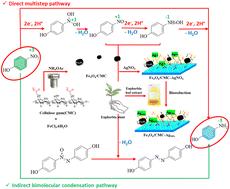
A magnetic-biopolymer composite of carboxymethyl cellulose (CMC), designated as Fe3O4@CMC, was synthesized featuring remarkable stability and an active surface with a green biosynthetic method. This composite was engineered to serve as a substrate for stabilizing silver nanoparticles (Ag NPs) with enhanced functional properties. The catalytic efficacy of the nanocatalyst, incorporating Ag NPs at concentrations of 3%, 7%, and 10%, was evaluated for the reduction of the toxic compound 4-nitrophenol to the beneficial 4-aminophenol. Among the tested configurations, the formulation containing 10% silver nanoparticles, in conjunction with Euphorbia plant extract as a bioreducing agent, exhibited the highest reduction efficiency and favorable reaction kinetics, rendering it the optimal choice. The apparent rate constant (Kapp) was assessed by fine-tuning the catalyst parameters, while the reaction mechanism was further elucidated by adjusting the concentrations of NaBH4 and 4-nitrophenol. Notably, the catalyst demonstrated good stability over five consecutive reduction cycles and could be easily retrieved from the reaction mixture using an external magnet.




 京公网安备 11010802042870号
京ICP备2023020795号-1
京公网安备 11010802042870号
京ICP备2023020795号-1

 分享
分享
 求助内容:
求助内容: 应助结果提醒方式:
 扫码关注我们
