Anna Thorén , Mikael Andersson Franko , Eva Joelsson-Alm , Araz Rawshani , Thomas Kahan , Johan Engdahl , Martin Jonsson , Therese Djärv , Martin Spångfors
{"title":"探索年龄对国家早期预警评分(NEWS)预测能力的影响,以及快速反应小组对患者长期预后的影响:一项前瞻性、多中心研究。","authors":"Anna Thorén , Mikael Andersson Franko , Eva Joelsson-Alm , Araz Rawshani , Thomas Kahan , Johan Engdahl , Martin Jonsson , Therese Djärv , Martin Spångfors","doi":"10.1016/j.resplu.2024.100839","DOIUrl":null,"url":null,"abstract":"<div><h3>Aim</h3><div>To explore the impact of age on the discriminative ability of the National Early Warning Score (NEWS) 2 in prediction of unanticipated Intensive Care Unit (ICU) admission, in-hospital cardiac arrest (IHCA) and mortality within 24 hours of Rapid Response Team (RRT) review. Furthermore, to investigate 30- and 90-day mortality, and the discriminative ability of NEWS 2 in prediction of long-term mortality among RRT-reviewed patients.</div></div><div><h3>Methods</h3><div>Prospective, multi-centre study based on 830 complete cases. Data was collected by RRTs in 24 hospitals between October 2019, and January 2020. All NEWS 2 scores were uniformly calculated by the study team. Age was analysed as a continuous variable, in a spline regression model, and categorized into five different models, subsequently explored as additive variables to NEWS 2. The discriminative ability of NEWS 2 was evaluated using the Area under the receiver operating characteristics (AUROC).</div></div><div><h3>Results</h3><div>The discriminative ability of NEWS 2 alone in predicting 30-day mortality was weak. Adding age as a covariate improved the predictive performance (AUROC 0.66, 0.62–0.70 to 0.70, 0.65–0.73, <em>p</em> = 0.01, 95 % Confidence Interval). There were differences across age groups, with the best discriminative ability identified among patients aged 45-54 years. The 30- and 90-day mortality was 31% and 33% respectively.</div></div><div><h3>Results</h3><div>Adding age as a covariate improved the discriminative ability of NEWS 2 in the prediction of 30-day mortality among RRT-reviewed patients, with variations observed across age categories. The long- term prognosis of RRT-reviewed patients was poor.</div></div>","PeriodicalId":94192,"journal":{"name":"Resuscitation plus","volume":"21 ","pages":"Article 100839"},"PeriodicalIF":3.1000,"publicationDate":"2025-01-01","publicationTypes":"Journal Article","fieldsOfStudy":null,"isOpenAccess":false,"openAccessPdf":"https://www.ncbi.nlm.nih.gov/pmc/articles/PMC11732060/pdf/","citationCount":"0","resultStr":"{\"title\":\"Exploring the impact of age on the predictive power of the National Early Warning score (NEWS) 2, and long-term prognosis among patients reviewed by a Rapid Response Team: A prospective, multi-centre study\",\"authors\":\"Anna Thorén , Mikael Andersson Franko , Eva Joelsson-Alm , Araz Rawshani , Thomas Kahan , Johan Engdahl , Martin Jonsson , Therese Djärv , Martin Spångfors\",\"doi\":\"10.1016/j.resplu.2024.100839\",\"DOIUrl\":null,\"url\":null,\"abstract\":\"<div><h3>Aim</h3><div>To explore the impact of age on the discriminative ability of the National Early Warning Score (NEWS) 2 in prediction of unanticipated Intensive Care Unit (ICU) admission, in-hospital cardiac arrest (IHCA) and mortality within 24 hours of Rapid Response Team (RRT) review. Furthermore, to investigate 30- and 90-day mortality, and the discriminative ability of NEWS 2 in prediction of long-term mortality among RRT-reviewed patients.</div></div><div><h3>Methods</h3><div>Prospective, multi-centre study based on 830 complete cases. Data was collected by RRTs in 24 hospitals between October 2019, and January 2020. All NEWS 2 scores were uniformly calculated by the study team. Age was analysed as a continuous variable, in a spline regression model, and categorized into five different models, subsequently explored as additive variables to NEWS 2. The discriminative ability of NEWS 2 was evaluated using the Area under the receiver operating characteristics (AUROC).</div></div><div><h3>Results</h3><div>The discriminative ability of NEWS 2 alone in predicting 30-day mortality was weak. Adding age as a covariate improved the predictive performance (AUROC 0.66, 0.62–0.70 to 0.70, 0.65–0.73, <em>p</em> = 0.01, 95 % Confidence Interval). There were differences across age groups, with the best discriminative ability identified among patients aged 45-54 years. The 30- and 90-day mortality was 31% and 33% respectively.</div></div><div><h3>Results</h3><div>Adding age as a covariate improved the discriminative ability of NEWS 2 in the prediction of 30-day mortality among RRT-reviewed patients, with variations observed across age categories. The long- term prognosis of RRT-reviewed patients was poor.</div></div>\",\"PeriodicalId\":94192,\"journal\":{\"name\":\"Resuscitation plus\",\"volume\":\"21 \",\"pages\":\"Article 100839\"},\"PeriodicalIF\":3.1000,\"publicationDate\":\"2025-01-01\",\"publicationTypes\":\"Journal Article\",\"fieldsOfStudy\":null,\"isOpenAccess\":false,\"openAccessPdf\":\"https://www.ncbi.nlm.nih.gov/pmc/articles/PMC11732060/pdf/\",\"citationCount\":\"0\",\"resultStr\":null,\"platform\":\"Semanticscholar\",\"paperid\":null,\"PeriodicalName\":\"Resuscitation plus\",\"FirstCategoryId\":\"1085\",\"ListUrlMain\":\"https://www.sciencedirect.com/science/article/pii/S266652042400290X\",\"RegionNum\":0,\"RegionCategory\":null,\"ArticlePicture\":[],\"TitleCN\":null,\"AbstractTextCN\":null,\"PMCID\":null,\"EPubDate\":\"2024/12/10 0:00:00\",\"PubModel\":\"Epub\",\"JCR\":\"Q3\",\"JCRName\":\"CRITICAL CARE MEDICINE\",\"Score\":null,\"Total\":0}","platform":"Semanticscholar","paperid":null,"PeriodicalName":"Resuscitation plus","FirstCategoryId":"1085","ListUrlMain":"https://www.sciencedirect.com/science/article/pii/S266652042400290X","RegionNum":0,"RegionCategory":null,"ArticlePicture":[],"TitleCN":null,"AbstractTextCN":null,"PMCID":null,"EPubDate":"2024/12/10 0:00:00","PubModel":"Epub","JCR":"Q3","JCRName":"CRITICAL CARE MEDICINE","Score":null,"Total":0}
Exploring the impact of age on the predictive power of the National Early Warning score (NEWS) 2, and long-term prognosis among patients reviewed by a Rapid Response Team: A prospective, multi-centre study
Aim
To explore the impact of age on the discriminative ability of the National Early Warning Score (NEWS) 2 in prediction of unanticipated Intensive Care Unit (ICU) admission, in-hospital cardiac arrest (IHCA) and mortality within 24 hours of Rapid Response Team (RRT) review. Furthermore, to investigate 30- and 90-day mortality, and the discriminative ability of NEWS 2 in prediction of long-term mortality among RRT-reviewed patients.
Methods
Prospective, multi-centre study based on 830 complete cases. Data was collected by RRTs in 24 hospitals between October 2019, and January 2020. All NEWS 2 scores were uniformly calculated by the study team. Age was analysed as a continuous variable, in a spline regression model, and categorized into five different models, subsequently explored as additive variables to NEWS 2. The discriminative ability of NEWS 2 was evaluated using the Area under the receiver operating characteristics (AUROC).
Results
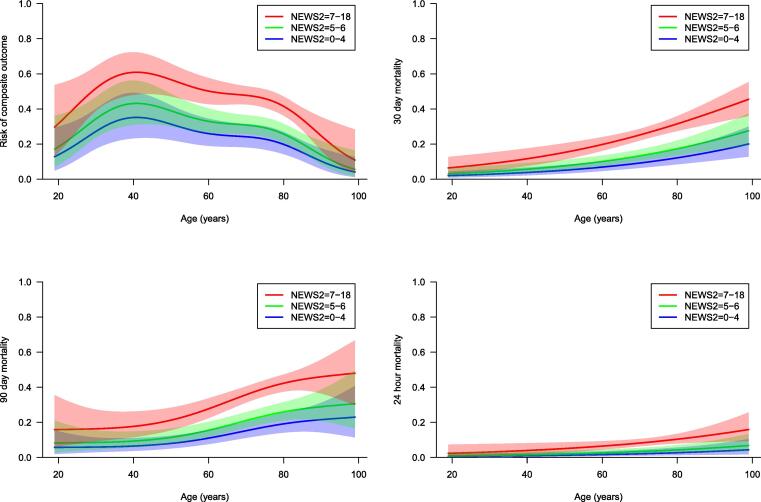
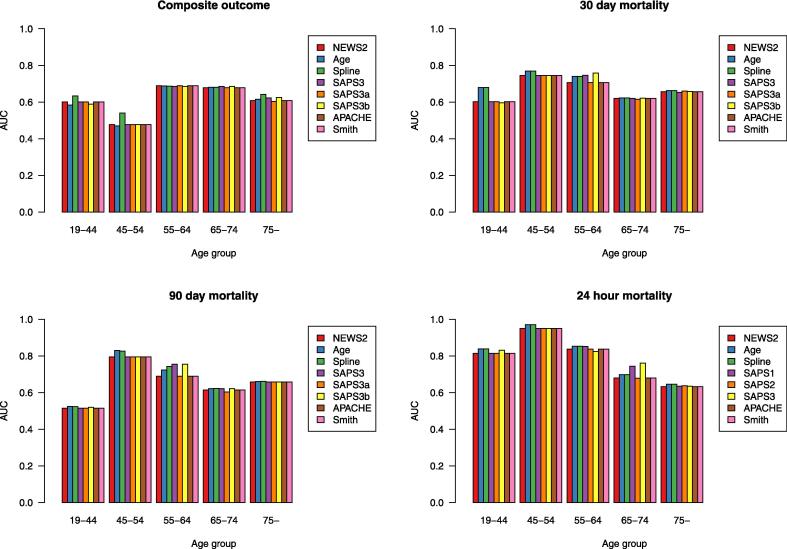
The discriminative ability of NEWS 2 alone in predicting 30-day mortality was weak. Adding age as a covariate improved the predictive performance (AUROC 0.66, 0.62–0.70 to 0.70, 0.65–0.73, p = 0.01, 95 % Confidence Interval). There were differences across age groups, with the best discriminative ability identified among patients aged 45-54 years. The 30- and 90-day mortality was 31% and 33% respectively.
Results
Adding age as a covariate improved the discriminative ability of NEWS 2 in the prediction of 30-day mortality among RRT-reviewed patients, with variations observed across age categories. The long- term prognosis of RRT-reviewed patients was poor.






 京公网安备 11010802042870号
京ICP备2023020795号-1
京公网安备 11010802042870号
京ICP备2023020795号-1

 分享
分享
 求助内容:
求助内容: 应助结果提醒方式:
 扫码关注我们
