Ankita Bora, Ningyuan Fu, Avijit Saha, Anatol Prudnikau, René Hübner, Houman Bahmani Jalali, Francesco Di Stasio, Nikolai Gaponik and Vladimir Lesnyak
{"title":"具有窄近红外光致发光的三角形cu - zn - in - se基纳米晶体","authors":"Ankita Bora, Ningyuan Fu, Avijit Saha, Anatol Prudnikau, René Hübner, Houman Bahmani Jalali, Francesco Di Stasio, Nikolai Gaponik and Vladimir Lesnyak","doi":"10.1039/D4NR04499A","DOIUrl":null,"url":null,"abstract":"<p >Tunable optical properties exhibited by semiconductor nanocrystals (NCs) in the near infrared (NIR) spectral region are of particular interest in various applications, such as telecommunications, bioimaging, photodetection, photovoltaics, <em>etc</em>. While lead and mercury chalcogenide NCs do exhibit exemplary optical properties in the NIR, Cu–In–Se (CISe)-based NCs are a suitable environment-friendly alternative to these toxic materials. Several reports of NIR-emitting (quasi)spherical CISe NCs have been published, but their more complex-shaped counterparts remain rather less explored. The emerging anisotropic nanomaterials have gained significant interest owing to their unique optical properties arising due to their specific shape. While several examples of non-spherical Cu–In–S-based NCs have been reported, examples of CISe-based anisotropic NCs are rather scarce, and those with intensive photoluminescence (PL) are not yet developed. In this work, we present a one-pot approach to synthesize quaternary Cu–Zn–In–Se (CZISe) triangular NCs with intensive PL in the NIR region. The NCs synthesized exhibit tetragonal crystal structure and, depending on the reaction conditions, are single triangular particles or stacks of triangular blocks of varied lateral sizes but rather uniform thickness. The synthesis involves the formation of In<small><sub>2</sub></small>Se<small><sub>3</sub></small> seeds with subsequent incorporation of copper and growth of triangular CISe NCs, followed by the incorporation of zinc and the growth of a ZnS shell. Importantly, the PL band widths of the final core/shell heterostructured NCs are narrow, down to 102 meV, which is a rarely observed characteristic for this class of materials and can be attributed to their anisotropic shape and the absence of thickness and compositional inhomogeneities of their building blocks. The PL of the CZISe/ZnS NCs can be tuned in the range of 1082–1218 nm reaching a quantum yield of up to 40% by varying their size and composition. To the best of our knowledge, this is the farthest and the narrowest PL achieved for CISe-based NCs so far, which widens application perspectives of this material in NIR LEDs, bioimaging, and photovoltaics.</p>","PeriodicalId":92,"journal":{"name":"Nanoscale","volume":" 5","pages":" 2577-2588"},"PeriodicalIF":5.2000,"publicationDate":"2025-01-16","publicationTypes":"Journal Article","fieldsOfStudy":null,"isOpenAccess":false,"openAccessPdf":"https://pubs.rsc.org/en/content/articlepdf/2025/nr/d4nr04499a?page=search","citationCount":"0","resultStr":"{\"title\":\"Triangular-shaped Cu–Zn–In–Se-based nanocrystals with narrow near infrared photoluminescence†\",\"authors\":\"Ankita Bora, Ningyuan Fu, Avijit Saha, Anatol Prudnikau, René Hübner, Houman Bahmani Jalali, Francesco Di Stasio, Nikolai Gaponik and Vladimir Lesnyak\",\"doi\":\"10.1039/D4NR04499A\",\"DOIUrl\":null,\"url\":null,\"abstract\":\"<p >Tunable optical properties exhibited by semiconductor nanocrystals (NCs) in the near infrared (NIR) spectral region are of particular interest in various applications, such as telecommunications, bioimaging, photodetection, photovoltaics, <em>etc</em>. While lead and mercury chalcogenide NCs do exhibit exemplary optical properties in the NIR, Cu–In–Se (CISe)-based NCs are a suitable environment-friendly alternative to these toxic materials. Several reports of NIR-emitting (quasi)spherical CISe NCs have been published, but their more complex-shaped counterparts remain rather less explored. The emerging anisotropic nanomaterials have gained significant interest owing to their unique optical properties arising due to their specific shape. While several examples of non-spherical Cu–In–S-based NCs have been reported, examples of CISe-based anisotropic NCs are rather scarce, and those with intensive photoluminescence (PL) are not yet developed. In this work, we present a one-pot approach to synthesize quaternary Cu–Zn–In–Se (CZISe) triangular NCs with intensive PL in the NIR region. The NCs synthesized exhibit tetragonal crystal structure and, depending on the reaction conditions, are single triangular particles or stacks of triangular blocks of varied lateral sizes but rather uniform thickness. The synthesis involves the formation of In<small><sub>2</sub></small>Se<small><sub>3</sub></small> seeds with subsequent incorporation of copper and growth of triangular CISe NCs, followed by the incorporation of zinc and the growth of a ZnS shell. Importantly, the PL band widths of the final core/shell heterostructured NCs are narrow, down to 102 meV, which is a rarely observed characteristic for this class of materials and can be attributed to their anisotropic shape and the absence of thickness and compositional inhomogeneities of their building blocks. The PL of the CZISe/ZnS NCs can be tuned in the range of 1082–1218 nm reaching a quantum yield of up to 40% by varying their size and composition. To the best of our knowledge, this is the farthest and the narrowest PL achieved for CISe-based NCs so far, which widens application perspectives of this material in NIR LEDs, bioimaging, and photovoltaics.</p>\",\"PeriodicalId\":92,\"journal\":{\"name\":\"Nanoscale\",\"volume\":\" 5\",\"pages\":\" 2577-2588\"},\"PeriodicalIF\":5.2000,\"publicationDate\":\"2025-01-16\",\"publicationTypes\":\"Journal Article\",\"fieldsOfStudy\":null,\"isOpenAccess\":false,\"openAccessPdf\":\"https://pubs.rsc.org/en/content/articlepdf/2025/nr/d4nr04499a?page=search\",\"citationCount\":\"0\",\"resultStr\":null,\"platform\":\"Semanticscholar\",\"paperid\":null,\"PeriodicalName\":\"Nanoscale\",\"FirstCategoryId\":\"88\",\"ListUrlMain\":\"https://pubs.rsc.org/en/content/articlelanding/2025/nr/d4nr04499a\",\"RegionNum\":3,\"RegionCategory\":\"材料科学\",\"ArticlePicture\":[],\"TitleCN\":null,\"AbstractTextCN\":null,\"PMCID\":null,\"EPubDate\":\"\",\"PubModel\":\"\",\"JCR\":\"Q1\",\"JCRName\":\"CHEMISTRY, MULTIDISCIPLINARY\",\"Score\":null,\"Total\":0}","platform":"Semanticscholar","paperid":null,"PeriodicalName":"Nanoscale","FirstCategoryId":"88","ListUrlMain":"https://pubs.rsc.org/en/content/articlelanding/2025/nr/d4nr04499a","RegionNum":3,"RegionCategory":"材料科学","ArticlePicture":[],"TitleCN":null,"AbstractTextCN":null,"PMCID":null,"EPubDate":"","PubModel":"","JCR":"Q1","JCRName":"CHEMISTRY, MULTIDISCIPLINARY","Score":null,"Total":0}
Triangular-shaped Cu–Zn–In–Se-based nanocrystals with narrow near infrared photoluminescence†
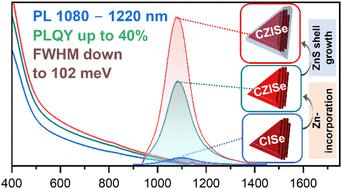
Tunable optical properties exhibited by semiconductor nanocrystals (NCs) in the near infrared (NIR) spectral region are of particular interest in various applications, such as telecommunications, bioimaging, photodetection, photovoltaics, etc. While lead and mercury chalcogenide NCs do exhibit exemplary optical properties in the NIR, Cu–In–Se (CISe)-based NCs are a suitable environment-friendly alternative to these toxic materials. Several reports of NIR-emitting (quasi)spherical CISe NCs have been published, but their more complex-shaped counterparts remain rather less explored. The emerging anisotropic nanomaterials have gained significant interest owing to their unique optical properties arising due to their specific shape. While several examples of non-spherical Cu–In–S-based NCs have been reported, examples of CISe-based anisotropic NCs are rather scarce, and those with intensive photoluminescence (PL) are not yet developed. In this work, we present a one-pot approach to synthesize quaternary Cu–Zn–In–Se (CZISe) triangular NCs with intensive PL in the NIR region. The NCs synthesized exhibit tetragonal crystal structure and, depending on the reaction conditions, are single triangular particles or stacks of triangular blocks of varied lateral sizes but rather uniform thickness. The synthesis involves the formation of In2Se3 seeds with subsequent incorporation of copper and growth of triangular CISe NCs, followed by the incorporation of zinc and the growth of a ZnS shell. Importantly, the PL band widths of the final core/shell heterostructured NCs are narrow, down to 102 meV, which is a rarely observed characteristic for this class of materials and can be attributed to their anisotropic shape and the absence of thickness and compositional inhomogeneities of their building blocks. The PL of the CZISe/ZnS NCs can be tuned in the range of 1082–1218 nm reaching a quantum yield of up to 40% by varying their size and composition. To the best of our knowledge, this is the farthest and the narrowest PL achieved for CISe-based NCs so far, which widens application perspectives of this material in NIR LEDs, bioimaging, and photovoltaics.
期刊介绍:
Nanoscale is a high-impact international journal, publishing high-quality research across nanoscience and nanotechnology. Nanoscale publishes a full mix of research articles on experimental and theoretical work, including reviews, communications, and full papers.Highly interdisciplinary, this journal appeals to scientists, researchers and professionals interested in nanoscience and nanotechnology, quantum materials and quantum technology, including the areas of physics, chemistry, biology, medicine, materials, energy/environment, information technology, detection science, healthcare and drug discovery, and electronics.




 京公网安备 11010802042870号
京ICP备2023020795号-1
京公网安备 11010802042870号
京ICP备2023020795号-1

 分享
分享
 求助内容:
求助内容: 应助结果提醒方式:
 扫码关注我们
