Huan Zhang, Meijun Yin, Shuangli Du, Yitao Li, Jialiang Bai, Haonan Chai, Jun Ren and Mingji Ding
{"title":"锐钛矿TiO2(101)表面CO2和H2O吸附的第一线原理研究:Au掺杂的影响","authors":"Huan Zhang, Meijun Yin, Shuangli Du, Yitao Li, Jialiang Bai, Haonan Chai, Jun Ren and Mingji Ding","doi":"10.1039/D4CP03511A","DOIUrl":null,"url":null,"abstract":"<p >Photocatalytic reduction of CO<small><sub>2</sub></small> will play a major role in future energy and environmental crisis. To investigate the adsorption mechanisms of CO<small><sub>2</sub></small> and H<small><sub>2</sub></small>O molecules involved in the catalytic process on the surface of anatase titanium dioxide 101 (TiO<small><sub>2</sub></small>(101)) and the influence of Au atom doping on their adsorption, first-principles density functional theory calculations were used. The results show that 1. Au atom doping stabilizes the structure of the catalyst system and reduces the band gap, facilitating the reaction of CO<small><sub>2</sub></small> and H<small><sub>2</sub></small>O molecules. 2. The O site is the most stable adsorption site for the CO<small><sub>2</sub></small> molecule on the surface, and chemical adsorption occurs, leading to structural deformation during the adsorption process. The adsorption energy is the highest when the H<small><sub>2</sub></small>O molecule is adsorbed parallel to the surface, and there is a bonding trend between H<small><sub>2</sub></small>O and the surface. 3. The adsorption performances of CO<small><sub>2</sub></small> and H<small><sub>2</sub></small>O molecules improve after Au atom doping. 4. Au atom doping creates stronger adsorption sites on the catalyst surface, with the two-coordinated O atoms near the Au atom becoming the preferred adsorption sites for both molecules. The revealed microscopic mechanism provides theoretical support for the design and manufacture of photocatalytic CO<small><sub>2</sub></small> reduction catalysts.</p>","PeriodicalId":99,"journal":{"name":"Physical Chemistry Chemical Physics","volume":" 5","pages":" 2802-2816"},"PeriodicalIF":2.9000,"publicationDate":"2025-01-16","publicationTypes":"Journal Article","fieldsOfStudy":null,"isOpenAccess":false,"openAccessPdf":"","citationCount":"0","resultStr":"{\"title\":\"First-principles study of CO2 and H2O adsorption on the anatase TiO2(101) surface: effect of Au doping†\",\"authors\":\"Huan Zhang, Meijun Yin, Shuangli Du, Yitao Li, Jialiang Bai, Haonan Chai, Jun Ren and Mingji Ding\",\"doi\":\"10.1039/D4CP03511A\",\"DOIUrl\":null,\"url\":null,\"abstract\":\"<p >Photocatalytic reduction of CO<small><sub>2</sub></small> will play a major role in future energy and environmental crisis. To investigate the adsorption mechanisms of CO<small><sub>2</sub></small> and H<small><sub>2</sub></small>O molecules involved in the catalytic process on the surface of anatase titanium dioxide 101 (TiO<small><sub>2</sub></small>(101)) and the influence of Au atom doping on their adsorption, first-principles density functional theory calculations were used. The results show that 1. Au atom doping stabilizes the structure of the catalyst system and reduces the band gap, facilitating the reaction of CO<small><sub>2</sub></small> and H<small><sub>2</sub></small>O molecules. 2. The O site is the most stable adsorption site for the CO<small><sub>2</sub></small> molecule on the surface, and chemical adsorption occurs, leading to structural deformation during the adsorption process. The adsorption energy is the highest when the H<small><sub>2</sub></small>O molecule is adsorbed parallel to the surface, and there is a bonding trend between H<small><sub>2</sub></small>O and the surface. 3. The adsorption performances of CO<small><sub>2</sub></small> and H<small><sub>2</sub></small>O molecules improve after Au atom doping. 4. Au atom doping creates stronger adsorption sites on the catalyst surface, with the two-coordinated O atoms near the Au atom becoming the preferred adsorption sites for both molecules. The revealed microscopic mechanism provides theoretical support for the design and manufacture of photocatalytic CO<small><sub>2</sub></small> reduction catalysts.</p>\",\"PeriodicalId\":99,\"journal\":{\"name\":\"Physical Chemistry Chemical Physics\",\"volume\":\" 5\",\"pages\":\" 2802-2816\"},\"PeriodicalIF\":2.9000,\"publicationDate\":\"2025-01-16\",\"publicationTypes\":\"Journal Article\",\"fieldsOfStudy\":null,\"isOpenAccess\":false,\"openAccessPdf\":\"\",\"citationCount\":\"0\",\"resultStr\":null,\"platform\":\"Semanticscholar\",\"paperid\":null,\"PeriodicalName\":\"Physical Chemistry Chemical Physics\",\"FirstCategoryId\":\"92\",\"ListUrlMain\":\"https://pubs.rsc.org/en/content/articlelanding/2025/cp/d4cp03511a\",\"RegionNum\":3,\"RegionCategory\":\"化学\",\"ArticlePicture\":[],\"TitleCN\":null,\"AbstractTextCN\":null,\"PMCID\":null,\"EPubDate\":\"\",\"PubModel\":\"\",\"JCR\":\"Q3\",\"JCRName\":\"CHEMISTRY, PHYSICAL\",\"Score\":null,\"Total\":0}","platform":"Semanticscholar","paperid":null,"PeriodicalName":"Physical Chemistry Chemical Physics","FirstCategoryId":"92","ListUrlMain":"https://pubs.rsc.org/en/content/articlelanding/2025/cp/d4cp03511a","RegionNum":3,"RegionCategory":"化学","ArticlePicture":[],"TitleCN":null,"AbstractTextCN":null,"PMCID":null,"EPubDate":"","PubModel":"","JCR":"Q3","JCRName":"CHEMISTRY, PHYSICAL","Score":null,"Total":0}
引用次数: 0
摘要
光催化还原二氧化碳将在未来的能源和环境危机中发挥重要作用。为了研究参与催化过程的 CO2 和 H2O 分子在锐钛矿二氧化钛 101(TiO2(101))表面的吸附机理以及掺杂金原子对其吸附的影响,采用第一原理密度泛函理论进行了计算。结果表明:1. 金原子的掺杂稳定了催化剂体系的结构,降低了带隙,促进了 CO2 和 H2O 分子的反应。2.O 位点是 CO2 分子在表面最稳定的吸附位点,在吸附过程中会发生化学吸附,导致结构变形。当 H2O 分子平行于表面吸附时,吸附能最高,且 H2O 与表面之间有成键趋势。3.掺杂金原子后,CO2 和 H2O 分子的吸附性能得到改善。4.4. Au 原子掺杂在催化剂表面产生了更强的吸附位点,Au 原子附近的双配位 O 原子成为两种分子的首选吸附位点。所揭示的微观机理为光催化二氧化碳还原催化剂的设计和制造提供了理论支持。
First-principles study of CO2 and H2O adsorption on the anatase TiO2(101) surface: effect of Au doping†
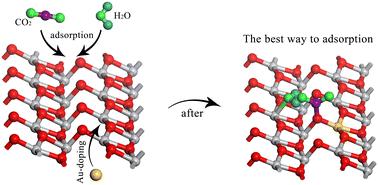
Photocatalytic reduction of CO2 will play a major role in future energy and environmental crisis. To investigate the adsorption mechanisms of CO2 and H2O molecules involved in the catalytic process on the surface of anatase titanium dioxide 101 (TiO2(101)) and the influence of Au atom doping on their adsorption, first-principles density functional theory calculations were used. The results show that 1. Au atom doping stabilizes the structure of the catalyst system and reduces the band gap, facilitating the reaction of CO2 and H2O molecules. 2. The O site is the most stable adsorption site for the CO2 molecule on the surface, and chemical adsorption occurs, leading to structural deformation during the adsorption process. The adsorption energy is the highest when the H2O molecule is adsorbed parallel to the surface, and there is a bonding trend between H2O and the surface. 3. The adsorption performances of CO2 and H2O molecules improve after Au atom doping. 4. Au atom doping creates stronger adsorption sites on the catalyst surface, with the two-coordinated O atoms near the Au atom becoming the preferred adsorption sites for both molecules. The revealed microscopic mechanism provides theoretical support for the design and manufacture of photocatalytic CO2 reduction catalysts.
期刊介绍:
Physical Chemistry Chemical Physics (PCCP) is an international journal co-owned by 19 physical chemistry and physics societies from around the world. This journal publishes original, cutting-edge research in physical chemistry, chemical physics and biophysical chemistry. To be suitable for publication in PCCP, articles must include significant innovation and/or insight into physical chemistry; this is the most important criterion that reviewers and Editors will judge against when evaluating submissions.
The journal has a broad scope and welcomes contributions spanning experiment, theory, computation and data science. Topical coverage includes spectroscopy, dynamics, kinetics, statistical mechanics, thermodynamics, electrochemistry, catalysis, surface science, quantum mechanics, quantum computing and machine learning. Interdisciplinary research areas such as polymers and soft matter, materials, nanoscience, energy, surfaces/interfaces, and biophysical chemistry are welcomed if they demonstrate significant innovation and/or insight into physical chemistry. Joined experimental/theoretical studies are particularly appreciated when complementary and based on up-to-date approaches.





 京公网安备 11010802042870号
京ICP备2023020795号-1
京公网安备 11010802042870号
京ICP备2023020795号-1

 分享
分享
 求助内容:
求助内容: 应助结果提醒方式:
 扫码关注我们
