Steven D. Tran, Noah J. Forrest, Vijeeth Guggilla, Geovanni M. Perottino, Jodi L. Johnson, Jeffrey Sosman, Ishan Roy, Theresa L. Walunas
{"title":"体重和基于血液的恶病质标志物预测癌症免疫治疗患者的残疾、住院和更差的生存","authors":"Steven D. Tran, Noah J. Forrest, Vijeeth Guggilla, Geovanni M. Perottino, Jodi L. Johnson, Jeffrey Sosman, Ishan Roy, Theresa L. Walunas","doi":"10.1002/jcsm.13685","DOIUrl":null,"url":null,"abstract":"<div>\n \n \n <section>\n \n <h3> Background</h3>\n \n <p>Cancer-associated cachexia can inhibit immune checkpoint inhibitor (ICI) therapy efficacy. Cachexia's effect on ICI therapy has not been studied in large cohorts of cancer patients aside from lung cancer. We studied associations between real-world routinely collected clinical cachexia markers and disability-free, hospitalization-free and overall survival of cancer patients.</p>\n </section>\n \n <section>\n \n <h3> Methods</h3>\n \n <p>A retrospective study was conducted of electronic health records (EHR) of patients with lung, renal cell, melanoma and other cancers treated with ICI therapy at Northwestern Medicine of Chicago, IL, United States, between March 2011 and January 2022. Weight, body mass index, absolute neutrophil and lymphocyte counts, albumin and C-reactive protein (CRP) measures were analysed to calculate the Fearon consensus criteria for cachexia, weight loss grading system (WLGS) score, neutrophil-lymphocyte ratio (NLR), Prognostic Nutritional Index (PNI) and modified Glasgow Prognostic Score (mGPS) at ICI therapy initiation. Kaplan–Meier and Cox proportional hazards analyses were used to determine associations between these metrics and disability-free, hospitalization-free and overall survival.</p>\n </section>\n \n <section>\n \n <h3> Results</h3>\n \n <p>EHR analysis uncovered 3285 cancer patients on ICI therapy (54% > 65 years of age, 50.7% male, 77.7% White). At ICI therapy initiation, 1282 (39.0%) patients had cachexia (consensus criteria), 1641 (50.0%) had a WLGS score ≥ 2, 1806 (55.0%) had an NLR > 3, 1087 (33.1%) had albumin < 3.5 g/dL and 1318 (40.1%) had a PNI < 44. Missing measurements included CRP missing for 98.2% and mGPS missing for 98.6% of patients. Disability-free (<i>n</i> = 1373), hospitalization-free (<i>n</i> = 2374) and overall survival (<i>n</i> = 1599) events were analysed with 1-year rates of 65% (64%–67%), 35% (34%–37%) and 65% (63%–66%), respectively. Multivariate Cox model analyses showed hazard ratios (HR) for cachexia at 1.58 (95% CI 1.38–1.80), 1.47 (95% CI 1.33–1.63) and 1.97 (95% CI 1.75–2.23) for disability, hospitalization and death, respectively. HRs for WLGS ≥ 2 were 1.45 (95% CI 1.28–1.66), 1.37 (95% CI 1.24–1.51) and 1.91 (95% CI 1.69–2.17). HRs for NLR > 3 were 1.57 (95% CI 1.35–1.83), 1.40 (95% CI 1.25–1.58) and 1.95 (95% CI 1.67–2.27). HRs for albumin < 3.5 g/dL were 1.33 (95% CI 1.15–1.54), 1.67 (95% CI 1.50–1.86) and 2.09 (95% CI 1.84–2.36). HRs for PNI < 44 were 1.60 (95% CI 1.39–1.84), 1.46 (95% CI 1.31–1.63) and 2.07 (95% CI 1.80–2.37).</p>\n </section>\n \n <section>\n \n <h3> Conclusions</h3>\n \n <p>Fearon consensus criteria, WLGS, NLR, albumin and PNI were routinely collected at ICI initiation in regular clinical practice and predictive of worse disability-free, hospitalization-free and overall survival in cancer patients receiving ICI therapy. These routine clinical measures may aid prognostication and decision-making in cancer patients with cachexia.</p>\n </section>\n </div>","PeriodicalId":48911,"journal":{"name":"Journal of Cachexia Sarcopenia and Muscle","volume":"16 1","pages":""},"PeriodicalIF":9.1000,"publicationDate":"2025-01-16","publicationTypes":"Journal Article","fieldsOfStudy":null,"isOpenAccess":false,"openAccessPdf":"https://onlinelibrary.wiley.com/doi/epdf/10.1002/jcsm.13685","citationCount":"0","resultStr":"{\"title\":\"Weight and Blood-Based Markers of Cachexia Predict Disability, Hospitalization and Worse Survival in Cancer Immunotherapy Patients\",\"authors\":\"Steven D. Tran, Noah J. Forrest, Vijeeth Guggilla, Geovanni M. Perottino, Jodi L. Johnson, Jeffrey Sosman, Ishan Roy, Theresa L. Walunas\",\"doi\":\"10.1002/jcsm.13685\",\"DOIUrl\":null,\"url\":null,\"abstract\":\"<div>\\n \\n \\n <section>\\n \\n <h3> Background</h3>\\n \\n <p>Cancer-associated cachexia can inhibit immune checkpoint inhibitor (ICI) therapy efficacy. Cachexia's effect on ICI therapy has not been studied in large cohorts of cancer patients aside from lung cancer. We studied associations between real-world routinely collected clinical cachexia markers and disability-free, hospitalization-free and overall survival of cancer patients.</p>\\n </section>\\n \\n <section>\\n \\n <h3> Methods</h3>\\n \\n <p>A retrospective study was conducted of electronic health records (EHR) of patients with lung, renal cell, melanoma and other cancers treated with ICI therapy at Northwestern Medicine of Chicago, IL, United States, between March 2011 and January 2022. Weight, body mass index, absolute neutrophil and lymphocyte counts, albumin and C-reactive protein (CRP) measures were analysed to calculate the Fearon consensus criteria for cachexia, weight loss grading system (WLGS) score, neutrophil-lymphocyte ratio (NLR), Prognostic Nutritional Index (PNI) and modified Glasgow Prognostic Score (mGPS) at ICI therapy initiation. Kaplan–Meier and Cox proportional hazards analyses were used to determine associations between these metrics and disability-free, hospitalization-free and overall survival.</p>\\n </section>\\n \\n <section>\\n \\n <h3> Results</h3>\\n \\n <p>EHR analysis uncovered 3285 cancer patients on ICI therapy (54% > 65 years of age, 50.7% male, 77.7% White). At ICI therapy initiation, 1282 (39.0%) patients had cachexia (consensus criteria), 1641 (50.0%) had a WLGS score ≥ 2, 1806 (55.0%) had an NLR > 3, 1087 (33.1%) had albumin < 3.5 g/dL and 1318 (40.1%) had a PNI < 44. Missing measurements included CRP missing for 98.2% and mGPS missing for 98.6% of patients. Disability-free (<i>n</i> = 1373), hospitalization-free (<i>n</i> = 2374) and overall survival (<i>n</i> = 1599) events were analysed with 1-year rates of 65% (64%–67%), 35% (34%–37%) and 65% (63%–66%), respectively. Multivariate Cox model analyses showed hazard ratios (HR) for cachexia at 1.58 (95% CI 1.38–1.80), 1.47 (95% CI 1.33–1.63) and 1.97 (95% CI 1.75–2.23) for disability, hospitalization and death, respectively. HRs for WLGS ≥ 2 were 1.45 (95% CI 1.28–1.66), 1.37 (95% CI 1.24–1.51) and 1.91 (95% CI 1.69–2.17). HRs for NLR > 3 were 1.57 (95% CI 1.35–1.83), 1.40 (95% CI 1.25–1.58) and 1.95 (95% CI 1.67–2.27). HRs for albumin < 3.5 g/dL were 1.33 (95% CI 1.15–1.54), 1.67 (95% CI 1.50–1.86) and 2.09 (95% CI 1.84–2.36). HRs for PNI < 44 were 1.60 (95% CI 1.39–1.84), 1.46 (95% CI 1.31–1.63) and 2.07 (95% CI 1.80–2.37).</p>\\n </section>\\n \\n <section>\\n \\n <h3> Conclusions</h3>\\n \\n <p>Fearon consensus criteria, WLGS, NLR, albumin and PNI were routinely collected at ICI initiation in regular clinical practice and predictive of worse disability-free, hospitalization-free and overall survival in cancer patients receiving ICI therapy. These routine clinical measures may aid prognostication and decision-making in cancer patients with cachexia.</p>\\n </section>\\n </div>\",\"PeriodicalId\":48911,\"journal\":{\"name\":\"Journal of Cachexia Sarcopenia and Muscle\",\"volume\":\"16 1\",\"pages\":\"\"},\"PeriodicalIF\":9.1000,\"publicationDate\":\"2025-01-16\",\"publicationTypes\":\"Journal Article\",\"fieldsOfStudy\":null,\"isOpenAccess\":false,\"openAccessPdf\":\"https://onlinelibrary.wiley.com/doi/epdf/10.1002/jcsm.13685\",\"citationCount\":\"0\",\"resultStr\":null,\"platform\":\"Semanticscholar\",\"paperid\":null,\"PeriodicalName\":\"Journal of Cachexia Sarcopenia and Muscle\",\"FirstCategoryId\":\"3\",\"ListUrlMain\":\"https://onlinelibrary.wiley.com/doi/10.1002/jcsm.13685\",\"RegionNum\":1,\"RegionCategory\":\"医学\",\"ArticlePicture\":[],\"TitleCN\":null,\"AbstractTextCN\":null,\"PMCID\":null,\"EPubDate\":\"\",\"PubModel\":\"\",\"JCR\":\"Q1\",\"JCRName\":\"GERIATRICS & GERONTOLOGY\",\"Score\":null,\"Total\":0}","platform":"Semanticscholar","paperid":null,"PeriodicalName":"Journal of Cachexia Sarcopenia and Muscle","FirstCategoryId":"3","ListUrlMain":"https://onlinelibrary.wiley.com/doi/10.1002/jcsm.13685","RegionNum":1,"RegionCategory":"医学","ArticlePicture":[],"TitleCN":null,"AbstractTextCN":null,"PMCID":null,"EPubDate":"","PubModel":"","JCR":"Q1","JCRName":"GERIATRICS & GERONTOLOGY","Score":null,"Total":0}
Weight and Blood-Based Markers of Cachexia Predict Disability, Hospitalization and Worse Survival in Cancer Immunotherapy Patients
Background
Cancer-associated cachexia can inhibit immune checkpoint inhibitor (ICI) therapy efficacy. Cachexia's effect on ICI therapy has not been studied in large cohorts of cancer patients aside from lung cancer. We studied associations between real-world routinely collected clinical cachexia markers and disability-free, hospitalization-free and overall survival of cancer patients.
Methods
A retrospective study was conducted of electronic health records (EHR) of patients with lung, renal cell, melanoma and other cancers treated with ICI therapy at Northwestern Medicine of Chicago, IL, United States, between March 2011 and January 2022. Weight, body mass index, absolute neutrophil and lymphocyte counts, albumin and C-reactive protein (CRP) measures were analysed to calculate the Fearon consensus criteria for cachexia, weight loss grading system (WLGS) score, neutrophil-lymphocyte ratio (NLR), Prognostic Nutritional Index (PNI) and modified Glasgow Prognostic Score (mGPS) at ICI therapy initiation. Kaplan–Meier and Cox proportional hazards analyses were used to determine associations between these metrics and disability-free, hospitalization-free and overall survival.
Results
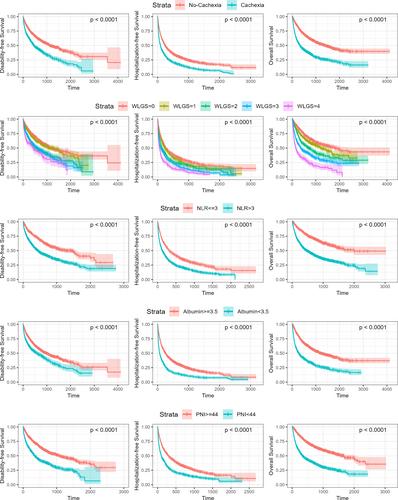
EHR analysis uncovered 3285 cancer patients on ICI therapy (54% > 65 years of age, 50.7% male, 77.7% White). At ICI therapy initiation, 1282 (39.0%) patients had cachexia (consensus criteria), 1641 (50.0%) had a WLGS score ≥ 2, 1806 (55.0%) had an NLR > 3, 1087 (33.1%) had albumin < 3.5 g/dL and 1318 (40.1%) had a PNI < 44. Missing measurements included CRP missing for 98.2% and mGPS missing for 98.6% of patients. Disability-free (n = 1373), hospitalization-free (n = 2374) and overall survival (n = 1599) events were analysed with 1-year rates of 65% (64%–67%), 35% (34%–37%) and 65% (63%–66%), respectively. Multivariate Cox model analyses showed hazard ratios (HR) for cachexia at 1.58 (95% CI 1.38–1.80), 1.47 (95% CI 1.33–1.63) and 1.97 (95% CI 1.75–2.23) for disability, hospitalization and death, respectively. HRs for WLGS ≥ 2 were 1.45 (95% CI 1.28–1.66), 1.37 (95% CI 1.24–1.51) and 1.91 (95% CI 1.69–2.17). HRs for NLR > 3 were 1.57 (95% CI 1.35–1.83), 1.40 (95% CI 1.25–1.58) and 1.95 (95% CI 1.67–2.27). HRs for albumin < 3.5 g/dL were 1.33 (95% CI 1.15–1.54), 1.67 (95% CI 1.50–1.86) and 2.09 (95% CI 1.84–2.36). HRs for PNI < 44 were 1.60 (95% CI 1.39–1.84), 1.46 (95% CI 1.31–1.63) and 2.07 (95% CI 1.80–2.37).
Conclusions
Fearon consensus criteria, WLGS, NLR, albumin and PNI were routinely collected at ICI initiation in regular clinical practice and predictive of worse disability-free, hospitalization-free and overall survival in cancer patients receiving ICI therapy. These routine clinical measures may aid prognostication and decision-making in cancer patients with cachexia.
期刊介绍:
The Journal of Cachexia, Sarcopenia and Muscle is a peer-reviewed international journal dedicated to publishing materials related to cachexia and sarcopenia, as well as body composition and its physiological and pathophysiological changes across the lifespan and in response to various illnesses from all fields of life sciences. The journal aims to provide a reliable resource for professionals interested in related research or involved in the clinical care of affected patients, such as those suffering from AIDS, cancer, chronic heart failure, chronic lung disease, liver cirrhosis, chronic kidney failure, rheumatoid arthritis, or sepsis.




 京公网安备 11010802042870号
京ICP备2023020795号-1
京公网安备 11010802042870号
京ICP备2023020795号-1

 分享
分享
 求助内容:
求助内容: 应助结果提醒方式:
 扫码关注我们
