{"title":"采用原子层沉积方法制备纤维素衍生的石墨碳/ZnO复合材料作为超宽带微波吸收剂","authors":"Guangguang Guan, Xiaoqiang Li, Jiebai Li, Meng Chen, Hongpeng Liu, Wenbo Zhang, Jingyuan Wei and Yangtao Zhou","doi":"10.1039/D4CP04707A","DOIUrl":null,"url":null,"abstract":"<p >It is a major challenge to obtain broadband microwave absorption (MA) properties using low dielectric or magnetic nanoparticle-decorated carbon composites due to the limited single conductive loss or polarization loss of the carbon materials used as substrates. Novel pure cellulose-derived graphite carbon (CGC) materials can be used as an exceptional substrate option due to their special defective graphitic carbon structure, which provides both conduction and polarization loss. Herein, CGC@ZnO composites were first synthesized by atomic layer deposition (ALD) for use as microwave absorbents. Thanks to the multiple interfaces composed of graphitic carbon, defective carbon, and polar ZnO molecules, the CGC@ZnO composites exhibited superior MA properties. Specifically, the CZ-3 achieved a minimum reflection loss (RL<small><sub>min</sub></small>) of −50.5 dB (over 99.999% MA) at 6.16 GHz in 2.98 mm. Amazingly, the maximum effective absorption bandwidth (RL < 10 dB, EAB<small><sub>max</sub></small>) could reach up to 6.48 GHz at only 1.59 mm. The ultra-broadband absorption property is mainly attributed to its strong electromagnetic attenuation capability and excellent impedance matching, making it one of the most promising materials for MA applications.</p>","PeriodicalId":99,"journal":{"name":"Physical Chemistry Chemical Physics","volume":" 7","pages":" 3715-3721"},"PeriodicalIF":2.9000,"publicationDate":"2025-01-17","publicationTypes":"Journal Article","fieldsOfStudy":null,"isOpenAccess":false,"openAccessPdf":"","citationCount":"0","resultStr":"{\"title\":\"A novel cellulose-derived graphite carbon/ZnO composite by atomic layer deposition as an over-wideband microwave absorbent†\",\"authors\":\"Guangguang Guan, Xiaoqiang Li, Jiebai Li, Meng Chen, Hongpeng Liu, Wenbo Zhang, Jingyuan Wei and Yangtao Zhou\",\"doi\":\"10.1039/D4CP04707A\",\"DOIUrl\":null,\"url\":null,\"abstract\":\"<p >It is a major challenge to obtain broadband microwave absorption (MA) properties using low dielectric or magnetic nanoparticle-decorated carbon composites due to the limited single conductive loss or polarization loss of the carbon materials used as substrates. Novel pure cellulose-derived graphite carbon (CGC) materials can be used as an exceptional substrate option due to their special defective graphitic carbon structure, which provides both conduction and polarization loss. Herein, CGC@ZnO composites were first synthesized by atomic layer deposition (ALD) for use as microwave absorbents. Thanks to the multiple interfaces composed of graphitic carbon, defective carbon, and polar ZnO molecules, the CGC@ZnO composites exhibited superior MA properties. Specifically, the CZ-3 achieved a minimum reflection loss (RL<small><sub>min</sub></small>) of −50.5 dB (over 99.999% MA) at 6.16 GHz in 2.98 mm. Amazingly, the maximum effective absorption bandwidth (RL < 10 dB, EAB<small><sub>max</sub></small>) could reach up to 6.48 GHz at only 1.59 mm. The ultra-broadband absorption property is mainly attributed to its strong electromagnetic attenuation capability and excellent impedance matching, making it one of the most promising materials for MA applications.</p>\",\"PeriodicalId\":99,\"journal\":{\"name\":\"Physical Chemistry Chemical Physics\",\"volume\":\" 7\",\"pages\":\" 3715-3721\"},\"PeriodicalIF\":2.9000,\"publicationDate\":\"2025-01-17\",\"publicationTypes\":\"Journal Article\",\"fieldsOfStudy\":null,\"isOpenAccess\":false,\"openAccessPdf\":\"\",\"citationCount\":\"0\",\"resultStr\":null,\"platform\":\"Semanticscholar\",\"paperid\":null,\"PeriodicalName\":\"Physical Chemistry Chemical Physics\",\"FirstCategoryId\":\"92\",\"ListUrlMain\":\"https://pubs.rsc.org/en/content/articlelanding/2025/cp/d4cp04707a\",\"RegionNum\":3,\"RegionCategory\":\"化学\",\"ArticlePicture\":[],\"TitleCN\":null,\"AbstractTextCN\":null,\"PMCID\":null,\"EPubDate\":\"\",\"PubModel\":\"\",\"JCR\":\"Q3\",\"JCRName\":\"CHEMISTRY, PHYSICAL\",\"Score\":null,\"Total\":0}","platform":"Semanticscholar","paperid":null,"PeriodicalName":"Physical Chemistry Chemical Physics","FirstCategoryId":"92","ListUrlMain":"https://pubs.rsc.org/en/content/articlelanding/2025/cp/d4cp04707a","RegionNum":3,"RegionCategory":"化学","ArticlePicture":[],"TitleCN":null,"AbstractTextCN":null,"PMCID":null,"EPubDate":"","PubModel":"","JCR":"Q3","JCRName":"CHEMISTRY, PHYSICAL","Score":null,"Total":0}
引用次数: 0
摘要
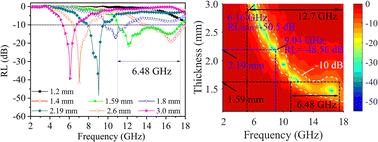
由于用作基底的碳材料的单一传导损耗或极化损耗有限,使用低介电或磁性纳米粒子装饰的碳复合材料获得宽带微波吸收(MA)特性是一项重大挑战。新型纯纤维素衍生石墨碳材料(CGC)因其具有传导和极化损耗的特殊缺陷石墨碳结构,可作为一种特殊的基底选择。本文首先通过原子层沉积(ALD)合成了用于微波吸收剂的 CGC@ZnO 复合材料。由于由石墨碳、缺陷碳和极性氧化锌分子组成的多重界面,CGC@ZnO 复合材料表现出优异的 MA 性能。具体来说,CZ-3 在 2.98 毫米的 6.16 GHz 频率下实现了 -50.5 dB 的最小反射损耗 (RLmin)(超过 99.999% 的 MA)。令人惊讶的是,仅在 1.59 毫米的条件下,最大有效吸收带宽(RL < 10 dB,EABmax)可达 6.48 GHz。此外,当厚度在 1.0-3.0 mm 范围内变化时,EAB 的频率范围甚至可以扩展到 12.7 GHz。这种超宽带吸收特性主要归功于其强大的电磁衰减能力和出色的阻抗匹配,使其成为最有前景的 MA 应用材料之一。
A novel cellulose-derived graphite carbon/ZnO composite by atomic layer deposition as an over-wideband microwave absorbent†
It is a major challenge to obtain broadband microwave absorption (MA) properties using low dielectric or magnetic nanoparticle-decorated carbon composites due to the limited single conductive loss or polarization loss of the carbon materials used as substrates. Novel pure cellulose-derived graphite carbon (CGC) materials can be used as an exceptional substrate option due to their special defective graphitic carbon structure, which provides both conduction and polarization loss. Herein, CGC@ZnO composites were first synthesized by atomic layer deposition (ALD) for use as microwave absorbents. Thanks to the multiple interfaces composed of graphitic carbon, defective carbon, and polar ZnO molecules, the CGC@ZnO composites exhibited superior MA properties. Specifically, the CZ-3 achieved a minimum reflection loss (RLmin) of −50.5 dB (over 99.999% MA) at 6.16 GHz in 2.98 mm. Amazingly, the maximum effective absorption bandwidth (RL < 10 dB, EABmax) could reach up to 6.48 GHz at only 1.59 mm. The ultra-broadband absorption property is mainly attributed to its strong electromagnetic attenuation capability and excellent impedance matching, making it one of the most promising materials for MA applications.
期刊介绍:
Physical Chemistry Chemical Physics (PCCP) is an international journal co-owned by 19 physical chemistry and physics societies from around the world. This journal publishes original, cutting-edge research in physical chemistry, chemical physics and biophysical chemistry. To be suitable for publication in PCCP, articles must include significant innovation and/or insight into physical chemistry; this is the most important criterion that reviewers and Editors will judge against when evaluating submissions.
The journal has a broad scope and welcomes contributions spanning experiment, theory, computation and data science. Topical coverage includes spectroscopy, dynamics, kinetics, statistical mechanics, thermodynamics, electrochemistry, catalysis, surface science, quantum mechanics, quantum computing and machine learning. Interdisciplinary research areas such as polymers and soft matter, materials, nanoscience, energy, surfaces/interfaces, and biophysical chemistry are welcomed if they demonstrate significant innovation and/or insight into physical chemistry. Joined experimental/theoretical studies are particularly appreciated when complementary and based on up-to-date approaches.





 京公网安备 11010802042870号
京ICP备2023020795号-1
京公网安备 11010802042870号
京ICP备2023020795号-1

 分享
分享
 求助内容:
求助内容: 应助结果提醒方式:
 扫码关注我们
