{"title":"通过神经网络辅助分子动力学模拟重温室温下固态电解质中锂离子的平面内和通道内扩散","authors":"Yao Huang, Dan Zhao, Mingsen Deng and Hujun Shen","doi":"10.1039/D4CP04472J","DOIUrl":null,"url":null,"abstract":"<p >Developing superionic conductor (SIC) materials offers a promising pathway to achieving high ionic conductivity in solid-state electrolytes (SSEs). The Li<small><sub>10</sub></small>GeP<small><sub>2</sub></small>S<small><sub>12</sub></small> (LGPS) family has received significant attention due to its remarkable ionic conductivity among various SIC materials. <em>Ab initio</em> molecular dynamics (AIMD) simulations have been extensively used to explore the diffusion behavior of Li<small><sup>+</sup></small> ions in Li<small><sub>10</sub></small>GeP<small><sub>2</sub></small>S<small><sub>12</sub></small>. These simulations indicate that Li<small><sup>+</sup></small> ions diffuse rapidly along a one-dimensional (1D) chain direction, specifically along the <em>c</em>-axis, a process known as in-channel diffusion. In addition, these computational studies have identified additional diffusion pathways within the <em>ab</em> planes, referred to as in-plane diffusion. However, there are still notable limitations in the time scale associated with AIMD simulation techniques for studying the dynamic behavior of Li<small><sub>10</sub></small>GeP<small><sub>2</sub></small>S<small><sub>12</sub></small> at room temperature. In this study, we trained a deep potential (DP) model for the LGPS system and performed a 300-nanosecond DeePMD simulation to investigate the diffusion behavior of Li<small><sub>10</sub></small>GeP<small><sub>2</sub></small>S<small><sub>12</sub></small> at room temperature. The neural network (NN) assisted simulation showed that the framework structure of LGPS remained remarkably stable over the entire 300-nanosecond period. Following this, our investigation focused on the two-dimensional (2D) diffusion pathways within the <em>ab</em> plane (in-plane diffusion mechanism) and the 1D diffusion channel along the <em>c</em>-axis (in-channel diffusion mechanism). Upon analyzing the DeePMD simulation results, we identified two distinct pathways for in-plane Li<small><sup>+</sup></small> diffusion within the ab plane: the Li-2 and Li-4 pathways. We determined the energy barriers for the two diffusion pathways to be 0.23 eV and 0.34 eV, respectively, in qualitative agreement with recent experimental and theoretical results. For the in-channel diffusion along the <em>c</em>-axis, our calculated energy barrier was approximately 0.083 eV, closely matching the previous one-particle potential (OPP) analysis. Our results confirm experimental and theoretical studies, indicating that lithium ions experience significantly less resistance when diffusing through the in-channel pathway compared to the in-plane migration mechanism. However, our findings suggest that despite having a higher energy barrier than the Li-4 pathway, the Li-2 pathway remains a viable option for in-plane lithium-ion migration.</p>","PeriodicalId":99,"journal":{"name":"Physical Chemistry Chemical Physics","volume":" 6","pages":" 3243-3252"},"PeriodicalIF":3.0000,"publicationDate":"2025-01-17","publicationTypes":"Journal Article","fieldsOfStudy":null,"isOpenAccess":false,"openAccessPdf":"","citationCount":"0","resultStr":"{\"title\":\"Revisiting the in-plane and in-channel diffusion of lithium ions in a solid-state electrolyte at room temperature through neural network-assisted molecular dynamics simulations†\",\"authors\":\"Yao Huang, Dan Zhao, Mingsen Deng and Hujun Shen\",\"doi\":\"10.1039/D4CP04472J\",\"DOIUrl\":null,\"url\":null,\"abstract\":\"<p >Developing superionic conductor (SIC) materials offers a promising pathway to achieving high ionic conductivity in solid-state electrolytes (SSEs). The Li<small><sub>10</sub></small>GeP<small><sub>2</sub></small>S<small><sub>12</sub></small> (LGPS) family has received significant attention due to its remarkable ionic conductivity among various SIC materials. <em>Ab initio</em> molecular dynamics (AIMD) simulations have been extensively used to explore the diffusion behavior of Li<small><sup>+</sup></small> ions in Li<small><sub>10</sub></small>GeP<small><sub>2</sub></small>S<small><sub>12</sub></small>. These simulations indicate that Li<small><sup>+</sup></small> ions diffuse rapidly along a one-dimensional (1D) chain direction, specifically along the <em>c</em>-axis, a process known as in-channel diffusion. In addition, these computational studies have identified additional diffusion pathways within the <em>ab</em> planes, referred to as in-plane diffusion. However, there are still notable limitations in the time scale associated with AIMD simulation techniques for studying the dynamic behavior of Li<small><sub>10</sub></small>GeP<small><sub>2</sub></small>S<small><sub>12</sub></small> at room temperature. In this study, we trained a deep potential (DP) model for the LGPS system and performed a 300-nanosecond DeePMD simulation to investigate the diffusion behavior of Li<small><sub>10</sub></small>GeP<small><sub>2</sub></small>S<small><sub>12</sub></small> at room temperature. The neural network (NN) assisted simulation showed that the framework structure of LGPS remained remarkably stable over the entire 300-nanosecond period. Following this, our investigation focused on the two-dimensional (2D) diffusion pathways within the <em>ab</em> plane (in-plane diffusion mechanism) and the 1D diffusion channel along the <em>c</em>-axis (in-channel diffusion mechanism). Upon analyzing the DeePMD simulation results, we identified two distinct pathways for in-plane Li<small><sup>+</sup></small> diffusion within the ab plane: the Li-2 and Li-4 pathways. We determined the energy barriers for the two diffusion pathways to be 0.23 eV and 0.34 eV, respectively, in qualitative agreement with recent experimental and theoretical results. For the in-channel diffusion along the <em>c</em>-axis, our calculated energy barrier was approximately 0.083 eV, closely matching the previous one-particle potential (OPP) analysis. Our results confirm experimental and theoretical studies, indicating that lithium ions experience significantly less resistance when diffusing through the in-channel pathway compared to the in-plane migration mechanism. However, our findings suggest that despite having a higher energy barrier than the Li-4 pathway, the Li-2 pathway remains a viable option for in-plane lithium-ion migration.</p>\",\"PeriodicalId\":99,\"journal\":{\"name\":\"Physical Chemistry Chemical Physics\",\"volume\":\" 6\",\"pages\":\" 3243-3252\"},\"PeriodicalIF\":3.0000,\"publicationDate\":\"2025-01-17\",\"publicationTypes\":\"Journal Article\",\"fieldsOfStudy\":null,\"isOpenAccess\":false,\"openAccessPdf\":\"\",\"citationCount\":\"0\",\"resultStr\":null,\"platform\":\"Semanticscholar\",\"paperid\":null,\"PeriodicalName\":\"Physical Chemistry Chemical Physics\",\"FirstCategoryId\":\"92\",\"ListUrlMain\":\"https://pubs.rsc.org/en/content/articlelanding/2025/cp/d4cp04472j\",\"RegionNum\":3,\"RegionCategory\":\"化学\",\"ArticlePicture\":[],\"TitleCN\":null,\"AbstractTextCN\":null,\"PMCID\":null,\"EPubDate\":\"\",\"PubModel\":\"\",\"JCR\":\"Q3\",\"JCRName\":\"CHEMISTRY, PHYSICAL\",\"Score\":null,\"Total\":0}","platform":"Semanticscholar","paperid":null,"PeriodicalName":"Physical Chemistry Chemical Physics","FirstCategoryId":"92","ListUrlMain":"https://pubs.rsc.org/en/content/articlelanding/2025/cp/d4cp04472j","RegionNum":3,"RegionCategory":"化学","ArticlePicture":[],"TitleCN":null,"AbstractTextCN":null,"PMCID":null,"EPubDate":"","PubModel":"","JCR":"Q3","JCRName":"CHEMISTRY, PHYSICAL","Score":null,"Total":0}
Revisiting the in-plane and in-channel diffusion of lithium ions in a solid-state electrolyte at room temperature through neural network-assisted molecular dynamics simulations†
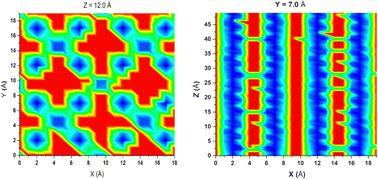
Developing superionic conductor (SIC) materials offers a promising pathway to achieving high ionic conductivity in solid-state electrolytes (SSEs). The Li10GeP2S12 (LGPS) family has received significant attention due to its remarkable ionic conductivity among various SIC materials. Ab initio molecular dynamics (AIMD) simulations have been extensively used to explore the diffusion behavior of Li+ ions in Li10GeP2S12. These simulations indicate that Li+ ions diffuse rapidly along a one-dimensional (1D) chain direction, specifically along the c-axis, a process known as in-channel diffusion. In addition, these computational studies have identified additional diffusion pathways within the ab planes, referred to as in-plane diffusion. However, there are still notable limitations in the time scale associated with AIMD simulation techniques for studying the dynamic behavior of Li10GeP2S12 at room temperature. In this study, we trained a deep potential (DP) model for the LGPS system and performed a 300-nanosecond DeePMD simulation to investigate the diffusion behavior of Li10GeP2S12 at room temperature. The neural network (NN) assisted simulation showed that the framework structure of LGPS remained remarkably stable over the entire 300-nanosecond period. Following this, our investigation focused on the two-dimensional (2D) diffusion pathways within the ab plane (in-plane diffusion mechanism) and the 1D diffusion channel along the c-axis (in-channel diffusion mechanism). Upon analyzing the DeePMD simulation results, we identified two distinct pathways for in-plane Li+ diffusion within the ab plane: the Li-2 and Li-4 pathways. We determined the energy barriers for the two diffusion pathways to be 0.23 eV and 0.34 eV, respectively, in qualitative agreement with recent experimental and theoretical results. For the in-channel diffusion along the c-axis, our calculated energy barrier was approximately 0.083 eV, closely matching the previous one-particle potential (OPP) analysis. Our results confirm experimental and theoretical studies, indicating that lithium ions experience significantly less resistance when diffusing through the in-channel pathway compared to the in-plane migration mechanism. However, our findings suggest that despite having a higher energy barrier than the Li-4 pathway, the Li-2 pathway remains a viable option for in-plane lithium-ion migration.
期刊介绍:
Physical Chemistry Chemical Physics (PCCP) is an international journal co-owned by 19 physical chemistry and physics societies from around the world. This journal publishes original, cutting-edge research in physical chemistry, chemical physics and biophysical chemistry. To be suitable for publication in PCCP, articles must include significant innovation and/or insight into physical chemistry; this is the most important criterion that reviewers and Editors will judge against when evaluating submissions.
The journal has a broad scope and welcomes contributions spanning experiment, theory, computation and data science. Topical coverage includes spectroscopy, dynamics, kinetics, statistical mechanics, thermodynamics, electrochemistry, catalysis, surface science, quantum mechanics, quantum computing and machine learning. Interdisciplinary research areas such as polymers and soft matter, materials, nanoscience, energy, surfaces/interfaces, and biophysical chemistry are welcomed if they demonstrate significant innovation and/or insight into physical chemistry. Joined experimental/theoretical studies are particularly appreciated when complementary and based on up-to-date approaches.





 京公网安备 11010802042870号
京ICP备2023020795号-1
京公网安备 11010802042870号
京ICP备2023020795号-1

 分享
分享
 求助内容:
求助内容: 应助结果提醒方式:
 扫码关注我们
