Jiancheng An;Chau Yuen;Marco Di Renzo;Mérouane Debbah;H. Vincent Poor;Lajos Hanzo
{"title":"下行链路多用户MISO通信的灵活智能元表面","authors":"Jiancheng An;Chau Yuen;Marco Di Renzo;Mérouane Debbah;H. Vincent Poor;Lajos Hanzo","doi":"10.1109/TWC.2025.3526843","DOIUrl":null,"url":null,"abstract":"Flexible intelligent metasurface (FIM) technology shows promise in terms of enhancing both the spectral and energy efficiency of wireless networks. An FIM is composed of an array of low-cost radiating elements, each of which can independently radiate electromagnetic signals, while flexibly adjusting its position along the direction perpendicular to the surface by a process termed as “morphing”. This is of particular interest for wireless communication systems operating at millimeter-wave and terahertz frequencies, where deep fading generally occurs within a few millimeters. Hence, in contrast to conventional rigid 2D antenna arrays, the FIM surface shape may be reconfigured to improve the channel quality by beneficial 3D morphing. In this paper, we investigate the multiuser downlink, where an FIM deployed at a base station (BS) communicates with multiple single-antenna users. We formulate an optimization problem for minimizing the total downlink transmit power at the BS, by jointly optimizing the transmit beamforming and FIM surface shape, subject to an individual signal-to-interference-plus-noise ratio (SINR) constraint of each user as well as a constraint on the maximum FIM morphing range. To solve this problem, we first consider a simple single-user scenario and show that the optimal 3D surface shape is achieved by independently adjusting each FIM element to the position having the strongest channel gain. However, in realistic multiuser scenarios, FIM surface-shape morphing involves complex tradeoffs. To address this issue, an efficient alternating optimization method is proposed to iteratively update the FIM surface shape and the transmit beamformer to gradually reduce the transmit power. Additionally, we analyze the performance gain of the FIM, showcasing a logarithmic received power scaling law versus its maximum morphing range. Finally, simulation results show that the FIM reduces the transmit power by about 3 dB compared to conventional rigid 2D arrays at a given data rate. The code for this paper is available at <uri>https://github.com/JianchengAn</uri>.","PeriodicalId":13431,"journal":{"name":"IEEE Transactions on Wireless Communications","volume":"24 4","pages":"2940-2955"},"PeriodicalIF":10.7000,"publicationDate":"2025-01-22","publicationTypes":"Journal Article","fieldsOfStudy":null,"isOpenAccess":false,"openAccessPdf":"","citationCount":"0","resultStr":"{\"title\":\"Flexible Intelligent Metasurfaces for Downlink Multiuser MISO Communications\",\"authors\":\"Jiancheng An;Chau Yuen;Marco Di Renzo;Mérouane Debbah;H. Vincent Poor;Lajos Hanzo\",\"doi\":\"10.1109/TWC.2025.3526843\",\"DOIUrl\":null,\"url\":null,\"abstract\":\"Flexible intelligent metasurface (FIM) technology shows promise in terms of enhancing both the spectral and energy efficiency of wireless networks. An FIM is composed of an array of low-cost radiating elements, each of which can independently radiate electromagnetic signals, while flexibly adjusting its position along the direction perpendicular to the surface by a process termed as “morphing”. This is of particular interest for wireless communication systems operating at millimeter-wave and terahertz frequencies, where deep fading generally occurs within a few millimeters. Hence, in contrast to conventional rigid 2D antenna arrays, the FIM surface shape may be reconfigured to improve the channel quality by beneficial 3D morphing. In this paper, we investigate the multiuser downlink, where an FIM deployed at a base station (BS) communicates with multiple single-antenna users. We formulate an optimization problem for minimizing the total downlink transmit power at the BS, by jointly optimizing the transmit beamforming and FIM surface shape, subject to an individual signal-to-interference-plus-noise ratio (SINR) constraint of each user as well as a constraint on the maximum FIM morphing range. To solve this problem, we first consider a simple single-user scenario and show that the optimal 3D surface shape is achieved by independently adjusting each FIM element to the position having the strongest channel gain. However, in realistic multiuser scenarios, FIM surface-shape morphing involves complex tradeoffs. To address this issue, an efficient alternating optimization method is proposed to iteratively update the FIM surface shape and the transmit beamformer to gradually reduce the transmit power. Additionally, we analyze the performance gain of the FIM, showcasing a logarithmic received power scaling law versus its maximum morphing range. Finally, simulation results show that the FIM reduces the transmit power by about 3 dB compared to conventional rigid 2D arrays at a given data rate. The code for this paper is available at <uri>https://github.com/JianchengAn</uri>.\",\"PeriodicalId\":13431,\"journal\":{\"name\":\"IEEE Transactions on Wireless Communications\",\"volume\":\"24 4\",\"pages\":\"2940-2955\"},\"PeriodicalIF\":10.7000,\"publicationDate\":\"2025-01-22\",\"publicationTypes\":\"Journal Article\",\"fieldsOfStudy\":null,\"isOpenAccess\":false,\"openAccessPdf\":\"\",\"citationCount\":\"0\",\"resultStr\":null,\"platform\":\"Semanticscholar\",\"paperid\":null,\"PeriodicalName\":\"IEEE Transactions on Wireless Communications\",\"FirstCategoryId\":\"94\",\"ListUrlMain\":\"https://ieeexplore.ieee.org/document/10850658/\",\"RegionNum\":1,\"RegionCategory\":\"计算机科学\",\"ArticlePicture\":[],\"TitleCN\":null,\"AbstractTextCN\":null,\"PMCID\":null,\"EPubDate\":\"\",\"PubModel\":\"\",\"JCR\":\"Q1\",\"JCRName\":\"ENGINEERING, ELECTRICAL & ELECTRONIC\",\"Score\":null,\"Total\":0}","platform":"Semanticscholar","paperid":null,"PeriodicalName":"IEEE Transactions on Wireless Communications","FirstCategoryId":"94","ListUrlMain":"https://ieeexplore.ieee.org/document/10850658/","RegionNum":1,"RegionCategory":"计算机科学","ArticlePicture":[],"TitleCN":null,"AbstractTextCN":null,"PMCID":null,"EPubDate":"","PubModel":"","JCR":"Q1","JCRName":"ENGINEERING, ELECTRICAL & ELECTRONIC","Score":null,"Total":0}
Flexible Intelligent Metasurfaces for Downlink Multiuser MISO Communications
Flexible intelligent metasurface (FIM) technology shows promise in terms of enhancing both the spectral and energy efficiency of wireless networks. An FIM is composed of an array of low-cost radiating elements, each of which can independently radiate electromagnetic signals, while flexibly adjusting its position along the direction perpendicular to the surface by a process termed as “morphing”. This is of particular interest for wireless communication systems operating at millimeter-wave and terahertz frequencies, where deep fading generally occurs within a few millimeters. Hence, in contrast to conventional rigid 2D antenna arrays, the FIM surface shape may be reconfigured to improve the channel quality by beneficial 3D morphing. In this paper, we investigate the multiuser downlink, where an FIM deployed at a base station (BS) communicates with multiple single-antenna users. We formulate an optimization problem for minimizing the total downlink transmit power at the BS, by jointly optimizing the transmit beamforming and FIM surface shape, subject to an individual signal-to-interference-plus-noise ratio (SINR) constraint of each user as well as a constraint on the maximum FIM morphing range. To solve this problem, we first consider a simple single-user scenario and show that the optimal 3D surface shape is achieved by independently adjusting each FIM element to the position having the strongest channel gain. However, in realistic multiuser scenarios, FIM surface-shape morphing involves complex tradeoffs. To address this issue, an efficient alternating optimization method is proposed to iteratively update the FIM surface shape and the transmit beamformer to gradually reduce the transmit power. Additionally, we analyze the performance gain of the FIM, showcasing a logarithmic received power scaling law versus its maximum morphing range. Finally, simulation results show that the FIM reduces the transmit power by about 3 dB compared to conventional rigid 2D arrays at a given data rate. The code for this paper is available at https://github.com/JianchengAn.
期刊介绍:
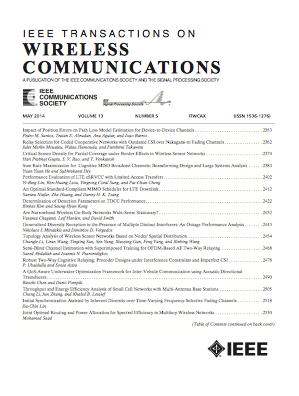
The IEEE Transactions on Wireless Communications is a prestigious publication that showcases cutting-edge advancements in wireless communications. It welcomes both theoretical and practical contributions in various areas. The scope of the Transactions encompasses a wide range of topics, including modulation and coding, detection and estimation, propagation and channel characterization, and diversity techniques. The journal also emphasizes the physical and link layer communication aspects of network architectures and protocols.
The journal is open to papers on specific topics or non-traditional topics related to specific application areas. This includes simulation tools and methodologies, orthogonal frequency division multiplexing, MIMO systems, and wireless over optical technologies.
Overall, the IEEE Transactions on Wireless Communications serves as a platform for high-quality manuscripts that push the boundaries of wireless communications and contribute to advancements in the field.




 京公网安备 11010802042870号
京ICP备2023020795号-1
京公网安备 11010802042870号
京ICP备2023020795号-1

 分享
分享
 求助内容:
求助内容: 应助结果提醒方式:
 扫码关注我们
