{"title":"胆汁酸-三氯生缀合物的合成及生物学评价:抗菌、抗生物膜及分子对接研究。","authors":"Neha V Rathod, Satyendra Mishra","doi":"10.1021/acs.bioconjchem.4c00539","DOIUrl":null,"url":null,"abstract":"<p><p>This work describes the synthesis, characterization, and antibacterial properties of four bile acid-triclosan conjugates. The in vitro antibacterial activity of synthetic bile acid-triclosan conjugates was investigated against a panel of Gram-positive and Gram-negative bacteria. Conjugates <b>3</b> and <b>4</b> show high activity against <i>Escherichia coli</i> (ATCC25922), with IC<sub>50</sub> values of 2.94 ± 0.7 and 1.51 ± 0.05 μM, respectively. Conjugate <b>4</b> demonstrated 9 times the activity of triclosan (6.77 μM) and 18 times the potency of kanamycin, a well-known antibiotic. Compound <b>3</b> showed higher potential activity against all evaluated strains, including <i>Bacillus megaterium</i> (IC<sub>50</sub>: 3.05 ± 0.02), <i>Bacillus amyloquefaciens</i> (IC<sub>50</sub>: 8.79 ± 0.01), <i>Serratia marcescens</i> (IC<sub>50</sub>: 6.77 ± 0.4), and <i>E. coli</i> (IC<sub>50</sub>: 1.51 ± 0.05 μM). These findings indicate that it has broad-spectrum antibacterial activity. Bile acid-triclosan conjugates prevent biofilms by up to 99% at low doses (conjugates <b>4</b>; 4.16 ± 0.8 μM), compared to triclosan. Conjugate <b>5</b> was most potent against <i>B. amyloquefaciens</i> (IC<sub>50</sub> = 5.23 ± 0.2 μM), while conjugate <b>4</b> was most effective against <i>B. megaterium</i> (IC<sub>50</sub> = 4.16 ± 0.8 μM) in biofilm formation. These conjugates inhibit biofilm formation by limiting the extracellular polymeric substance generation. The in vitro antibacterial study revealed that bile acid-triclosan conjugates were more effective than the parent molecule triclosan at inhibiting bacterial growth and biofilm formation against both Gram-positive and Gram-negative bacteria.</p>","PeriodicalId":29,"journal":{"name":"Bioconjugate Chemistry","volume":" ","pages":"276-290"},"PeriodicalIF":3.9000,"publicationDate":"2025-02-19","publicationTypes":"Journal Article","fieldsOfStudy":null,"isOpenAccess":false,"openAccessPdf":"","citationCount":"0","resultStr":"{\"title\":\"Synthesis and Biological Evaluation of Bile Acid-Triclosan Conjugates: A Study on Antibacterial, Antibiofilm, and Molecular Docking.\",\"authors\":\"Neha V Rathod, Satyendra Mishra\",\"doi\":\"10.1021/acs.bioconjchem.4c00539\",\"DOIUrl\":null,\"url\":null,\"abstract\":\"<p><p>This work describes the synthesis, characterization, and antibacterial properties of four bile acid-triclosan conjugates. The in vitro antibacterial activity of synthetic bile acid-triclosan conjugates was investigated against a panel of Gram-positive and Gram-negative bacteria. Conjugates <b>3</b> and <b>4</b> show high activity against <i>Escherichia coli</i> (ATCC25922), with IC<sub>50</sub> values of 2.94 ± 0.7 and 1.51 ± 0.05 μM, respectively. Conjugate <b>4</b> demonstrated 9 times the activity of triclosan (6.77 μM) and 18 times the potency of kanamycin, a well-known antibiotic. Compound <b>3</b> showed higher potential activity against all evaluated strains, including <i>Bacillus megaterium</i> (IC<sub>50</sub>: 3.05 ± 0.02), <i>Bacillus amyloquefaciens</i> (IC<sub>50</sub>: 8.79 ± 0.01), <i>Serratia marcescens</i> (IC<sub>50</sub>: 6.77 ± 0.4), and <i>E. coli</i> (IC<sub>50</sub>: 1.51 ± 0.05 μM). These findings indicate that it has broad-spectrum antibacterial activity. Bile acid-triclosan conjugates prevent biofilms by up to 99% at low doses (conjugates <b>4</b>; 4.16 ± 0.8 μM), compared to triclosan. Conjugate <b>5</b> was most potent against <i>B. amyloquefaciens</i> (IC<sub>50</sub> = 5.23 ± 0.2 μM), while conjugate <b>4</b> was most effective against <i>B. megaterium</i> (IC<sub>50</sub> = 4.16 ± 0.8 μM) in biofilm formation. These conjugates inhibit biofilm formation by limiting the extracellular polymeric substance generation. The in vitro antibacterial study revealed that bile acid-triclosan conjugates were more effective than the parent molecule triclosan at inhibiting bacterial growth and biofilm formation against both Gram-positive and Gram-negative bacteria.</p>\",\"PeriodicalId\":29,\"journal\":{\"name\":\"Bioconjugate Chemistry\",\"volume\":\" \",\"pages\":\"276-290\"},\"PeriodicalIF\":3.9000,\"publicationDate\":\"2025-02-19\",\"publicationTypes\":\"Journal Article\",\"fieldsOfStudy\":null,\"isOpenAccess\":false,\"openAccessPdf\":\"\",\"citationCount\":\"0\",\"resultStr\":null,\"platform\":\"Semanticscholar\",\"paperid\":null,\"PeriodicalName\":\"Bioconjugate Chemistry\",\"FirstCategoryId\":\"1\",\"ListUrlMain\":\"https://doi.org/10.1021/acs.bioconjchem.4c00539\",\"RegionNum\":2,\"RegionCategory\":\"化学\",\"ArticlePicture\":[],\"TitleCN\":null,\"AbstractTextCN\":null,\"PMCID\":null,\"EPubDate\":\"2025/1/22 0:00:00\",\"PubModel\":\"Epub\",\"JCR\":\"Q1\",\"JCRName\":\"BIOCHEMICAL RESEARCH METHODS\",\"Score\":null,\"Total\":0}","platform":"Semanticscholar","paperid":null,"PeriodicalName":"Bioconjugate Chemistry","FirstCategoryId":"1","ListUrlMain":"https://doi.org/10.1021/acs.bioconjchem.4c00539","RegionNum":2,"RegionCategory":"化学","ArticlePicture":[],"TitleCN":null,"AbstractTextCN":null,"PMCID":null,"EPubDate":"2025/1/22 0:00:00","PubModel":"Epub","JCR":"Q1","JCRName":"BIOCHEMICAL RESEARCH METHODS","Score":null,"Total":0}
Synthesis and Biological Evaluation of Bile Acid-Triclosan Conjugates: A Study on Antibacterial, Antibiofilm, and Molecular Docking.
This work describes the synthesis, characterization, and antibacterial properties of four bile acid-triclosan conjugates. The in vitro antibacterial activity of synthetic bile acid-triclosan conjugates was investigated against a panel of Gram-positive and Gram-negative bacteria. Conjugates 3 and 4 show high activity against Escherichia coli (ATCC25922), with IC50 values of 2.94 ± 0.7 and 1.51 ± 0.05 μM, respectively. Conjugate 4 demonstrated 9 times the activity of triclosan (6.77 μM) and 18 times the potency of kanamycin, a well-known antibiotic. Compound 3 showed higher potential activity against all evaluated strains, including Bacillus megaterium (IC50: 3.05 ± 0.02), Bacillus amyloquefaciens (IC50: 8.79 ± 0.01), Serratia marcescens (IC50: 6.77 ± 0.4), and E. coli (IC50: 1.51 ± 0.05 μM). These findings indicate that it has broad-spectrum antibacterial activity. Bile acid-triclosan conjugates prevent biofilms by up to 99% at low doses (conjugates 4; 4.16 ± 0.8 μM), compared to triclosan. Conjugate 5 was most potent against B. amyloquefaciens (IC50 = 5.23 ± 0.2 μM), while conjugate 4 was most effective against B. megaterium (IC50 = 4.16 ± 0.8 μM) in biofilm formation. These conjugates inhibit biofilm formation by limiting the extracellular polymeric substance generation. The in vitro antibacterial study revealed that bile acid-triclosan conjugates were more effective than the parent molecule triclosan at inhibiting bacterial growth and biofilm formation against both Gram-positive and Gram-negative bacteria.
期刊介绍:
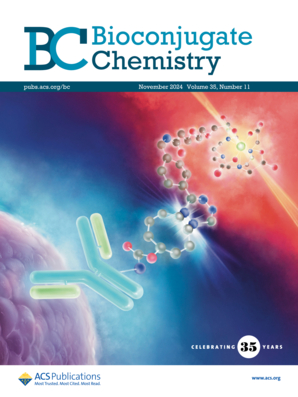
Bioconjugate Chemistry invites original contributions on all research at the interface between man-made and biological materials. The mission of the journal is to communicate to advances in fields including therapeutic delivery, imaging, bionanotechnology, and synthetic biology. Bioconjugate Chemistry is intended to provide a forum for presentation of research relevant to all aspects of bioconjugates, including the preparation, properties and applications of biomolecular conjugates.




 京公网安备 11010802042870号
京ICP备2023020795号-1
京公网安备 11010802042870号
京ICP备2023020795号-1

 分享
分享
 求助内容:
求助内容: 应助结果提醒方式:
 扫码关注我们
