Yuqi Ren, Shengnan Lan, Yuan-Hao Zhu, Ruoxuan Peng, Hongbin He, Yitao Si, Prof. Kai Huang, Prof. Naixu Li
{"title":"聚光太阳能催化二氧化碳还原:从基础研究到实际应用。","authors":"Yuqi Ren, Shengnan Lan, Yuan-Hao Zhu, Ruoxuan Peng, Hongbin He, Yitao Si, Prof. Kai Huang, Prof. Naixu Li","doi":"10.1002/cssc.202402485","DOIUrl":null,"url":null,"abstract":"<p>Concentrated solar-driven CO<sub>2</sub> reduction is a breakthrough approach to combat climate crisis. Harnessing the in-situ coupling of high photon flux density and high thermal energy flow initiates multiple energy conversion pathways, such as photothermal, photoelectric, and thermoelectric processes, thereby enhancing the efficient activation of CO<sub>2</sub>. This review systematically presents the fundamental principles of concentrated solar systems, the design and classification of solar-concentrating devices, and industrial application case studies. Meanwhile, key technological advances–from theoretical foundations to practical applications–are also discussed. At the microscopic level, a comprehensive analysis of multiscale reaction kinetics within the domain of photothermal synergistic catalysis has been conducted. This analysis elucidates the significance of catalyst design, further detailing the intricate regulatory mechanisms governing reaction pathways and active sites through nanostructured catalysts, single-atom catalysts, and metal-support interactions. However, the transition from laboratory research to industrial-scale application still faces challenges, including the complexity of system integration, energy density optimization, and economic feasibility. This review provides a theoretical framework and practical guidance through a complete investigation of current technological bottlenecks and future development directions, with the aim of driving key advances in concentrated solar-driven CO<sub>2</sub> reduction catalysis.</p>","PeriodicalId":149,"journal":{"name":"ChemSusChem","volume":"18 10","pages":""},"PeriodicalIF":5.9000,"publicationDate":"2025-01-23","publicationTypes":"Journal Article","fieldsOfStudy":null,"isOpenAccess":false,"openAccessPdf":"","citationCount":"0","resultStr":"{\"title\":\"Concentrated Solar-Driven Catalytic CO2 Reduction: From Fundamental Research to Practical Applications\",\"authors\":\"Yuqi Ren, Shengnan Lan, Yuan-Hao Zhu, Ruoxuan Peng, Hongbin He, Yitao Si, Prof. Kai Huang, Prof. Naixu Li\",\"doi\":\"10.1002/cssc.202402485\",\"DOIUrl\":null,\"url\":null,\"abstract\":\"<p>Concentrated solar-driven CO<sub>2</sub> reduction is a breakthrough approach to combat climate crisis. Harnessing the in-situ coupling of high photon flux density and high thermal energy flow initiates multiple energy conversion pathways, such as photothermal, photoelectric, and thermoelectric processes, thereby enhancing the efficient activation of CO<sub>2</sub>. This review systematically presents the fundamental principles of concentrated solar systems, the design and classification of solar-concentrating devices, and industrial application case studies. Meanwhile, key technological advances–from theoretical foundations to practical applications–are also discussed. At the microscopic level, a comprehensive analysis of multiscale reaction kinetics within the domain of photothermal synergistic catalysis has been conducted. This analysis elucidates the significance of catalyst design, further detailing the intricate regulatory mechanisms governing reaction pathways and active sites through nanostructured catalysts, single-atom catalysts, and metal-support interactions. However, the transition from laboratory research to industrial-scale application still faces challenges, including the complexity of system integration, energy density optimization, and economic feasibility. This review provides a theoretical framework and practical guidance through a complete investigation of current technological bottlenecks and future development directions, with the aim of driving key advances in concentrated solar-driven CO<sub>2</sub> reduction catalysis.</p>\",\"PeriodicalId\":149,\"journal\":{\"name\":\"ChemSusChem\",\"volume\":\"18 10\",\"pages\":\"\"},\"PeriodicalIF\":5.9000,\"publicationDate\":\"2025-01-23\",\"publicationTypes\":\"Journal Article\",\"fieldsOfStudy\":null,\"isOpenAccess\":false,\"openAccessPdf\":\"\",\"citationCount\":\"0\",\"resultStr\":null,\"platform\":\"Semanticscholar\",\"paperid\":null,\"PeriodicalName\":\"ChemSusChem\",\"FirstCategoryId\":\"92\",\"ListUrlMain\":\"https://chemistry-europe.onlinelibrary.wiley.com/doi/10.1002/cssc.202402485\",\"RegionNum\":2,\"RegionCategory\":\"化学\",\"ArticlePicture\":[],\"TitleCN\":null,\"AbstractTextCN\":null,\"PMCID\":null,\"EPubDate\":\"\",\"PubModel\":\"\",\"JCR\":\"Q1\",\"JCRName\":\"CHEMISTRY, MULTIDISCIPLINARY\",\"Score\":null,\"Total\":0}","platform":"Semanticscholar","paperid":null,"PeriodicalName":"ChemSusChem","FirstCategoryId":"92","ListUrlMain":"https://chemistry-europe.onlinelibrary.wiley.com/doi/10.1002/cssc.202402485","RegionNum":2,"RegionCategory":"化学","ArticlePicture":[],"TitleCN":null,"AbstractTextCN":null,"PMCID":null,"EPubDate":"","PubModel":"","JCR":"Q1","JCRName":"CHEMISTRY, MULTIDISCIPLINARY","Score":null,"Total":0}
Concentrated Solar-Driven Catalytic CO2 Reduction: From Fundamental Research to Practical Applications
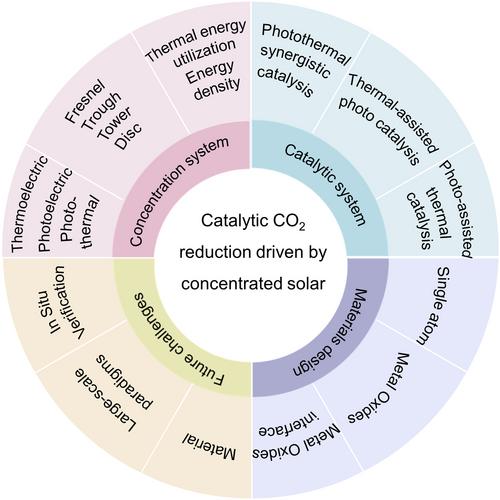
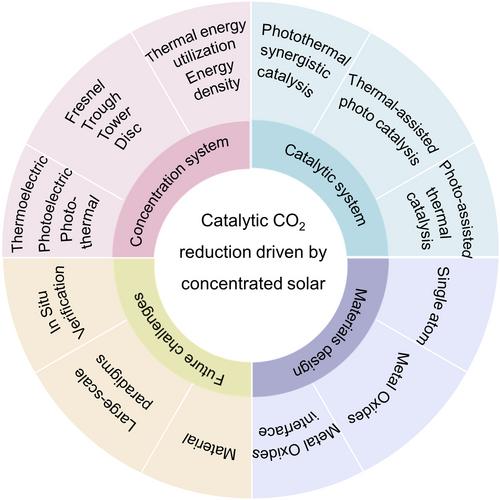
Concentrated solar-driven CO2 reduction is a breakthrough approach to combat climate crisis. Harnessing the in-situ coupling of high photon flux density and high thermal energy flow initiates multiple energy conversion pathways, such as photothermal, photoelectric, and thermoelectric processes, thereby enhancing the efficient activation of CO2. This review systematically presents the fundamental principles of concentrated solar systems, the design and classification of solar-concentrating devices, and industrial application case studies. Meanwhile, key technological advances–from theoretical foundations to practical applications–are also discussed. At the microscopic level, a comprehensive analysis of multiscale reaction kinetics within the domain of photothermal synergistic catalysis has been conducted. This analysis elucidates the significance of catalyst design, further detailing the intricate regulatory mechanisms governing reaction pathways and active sites through nanostructured catalysts, single-atom catalysts, and metal-support interactions. However, the transition from laboratory research to industrial-scale application still faces challenges, including the complexity of system integration, energy density optimization, and economic feasibility. This review provides a theoretical framework and practical guidance through a complete investigation of current technological bottlenecks and future development directions, with the aim of driving key advances in concentrated solar-driven CO2 reduction catalysis.
期刊介绍:
ChemSusChem
Impact Factor (2016): 7.226
Scope:
Interdisciplinary journal
Focuses on research at the interface of chemistry and sustainability
Features the best research on sustainability and energy
Areas Covered:
Chemistry
Materials Science
Chemical Engineering
Biotechnology






 京公网安备 11010802042870号
京ICP备2023020795号-1
京公网安备 11010802042870号
京ICP备2023020795号-1

 分享
分享
 求助内容:
求助内容: 应助结果提醒方式:
 扫码关注我们
