{"title":"手术与同步放化疗治疗III期非小细胞肺癌:倾向评分匹配的回顾性研究","authors":"Takao Shigenobu, Yuri Taniguchi, Takahiro Suzuki, Yuya Tabuchi, Mizuki Sato, Kazumasa Odagiri, Yukiko Nakamura, Tsuneo Shimokawa, Hiroaki Okamoto, Akira Yoshizu","doi":"10.1186/s12885-025-13550-0","DOIUrl":null,"url":null,"abstract":"<p><strong>Background: </strong>No study has directly compared the outcomes of surgery and concurrent chemoradiotherapy (cCRT) in patients with stage III non-small cell lung cancer (NSCLC) to date. This study aimed to compare the treatment efficacy of complete resection and definitive cCRT.</p><p><strong>Methods: </strong>Patients were recruited in this retrospective study from Yokohama Municipal Citizens' Hospital between January 2013 and December 2022. We analyzed patients with pathological stage III NSCLC who underwent complete surgical resection and those with clinical stage III NSCLC who underwent definitive cCRT. Propensity score matching was performed to balance baseline clinicopathological factors, and the prognoses of patients in each treatment group were examined using Cox proportional hazards regression.</p><p><strong>Results: </strong>Of the 923 patients with NSCLC who underwent surgery, 97 with pathologic stage III NSCLC underwent complete resection (surgery group) and 125 with clinical stage III NSCLC underwent cCRT (cCRT group), of whom 54 (43.2%) received consolidation therapy with durvalumab. Overall survival (OS) was significantly higher in the surgery group than in the cCRT group (5-year OS: 60.5% versus 43.0%), hazard ratio [HR] = 0.585, 95% confidence interval [CI]: 0.390-0.877, p = 0.010). However, no significant difference in OS was found between the two groups after propensity score matching (5-year OS: 59.8% versus 48.1%, HR = 0.728, 95% CI: 0.416-1.277, p = 0.268).</p><p><strong>Conclusions: </strong>The outcomes of the surgery and cCRT groups did not significantly differ in the treatment of stage III NSCLC. Appropriate evaluation of the treatment required should be reviewed on a case-by-case basis.</p>","PeriodicalId":9131,"journal":{"name":"BMC Cancer","volume":"25 1","pages":"121"},"PeriodicalIF":4.1000,"publicationDate":"2025-01-22","publicationTypes":"Journal Article","fieldsOfStudy":null,"isOpenAccess":false,"openAccessPdf":"https://www.ncbi.nlm.nih.gov/pmc/articles/PMC11753074/pdf/","citationCount":"0","resultStr":"{\"title\":\"Surgery versus concurrent chemoradiotherapy for stage III non-small cell lung cancer: a retrospective study with propensity score matching.\",\"authors\":\"Takao Shigenobu, Yuri Taniguchi, Takahiro Suzuki, Yuya Tabuchi, Mizuki Sato, Kazumasa Odagiri, Yukiko Nakamura, Tsuneo Shimokawa, Hiroaki Okamoto, Akira Yoshizu\",\"doi\":\"10.1186/s12885-025-13550-0\",\"DOIUrl\":null,\"url\":null,\"abstract\":\"<p><strong>Background: </strong>No study has directly compared the outcomes of surgery and concurrent chemoradiotherapy (cCRT) in patients with stage III non-small cell lung cancer (NSCLC) to date. This study aimed to compare the treatment efficacy of complete resection and definitive cCRT.</p><p><strong>Methods: </strong>Patients were recruited in this retrospective study from Yokohama Municipal Citizens' Hospital between January 2013 and December 2022. We analyzed patients with pathological stage III NSCLC who underwent complete surgical resection and those with clinical stage III NSCLC who underwent definitive cCRT. Propensity score matching was performed to balance baseline clinicopathological factors, and the prognoses of patients in each treatment group were examined using Cox proportional hazards regression.</p><p><strong>Results: </strong>Of the 923 patients with NSCLC who underwent surgery, 97 with pathologic stage III NSCLC underwent complete resection (surgery group) and 125 with clinical stage III NSCLC underwent cCRT (cCRT group), of whom 54 (43.2%) received consolidation therapy with durvalumab. Overall survival (OS) was significantly higher in the surgery group than in the cCRT group (5-year OS: 60.5% versus 43.0%), hazard ratio [HR] = 0.585, 95% confidence interval [CI]: 0.390-0.877, p = 0.010). However, no significant difference in OS was found between the two groups after propensity score matching (5-year OS: 59.8% versus 48.1%, HR = 0.728, 95% CI: 0.416-1.277, p = 0.268).</p><p><strong>Conclusions: </strong>The outcomes of the surgery and cCRT groups did not significantly differ in the treatment of stage III NSCLC. Appropriate evaluation of the treatment required should be reviewed on a case-by-case basis.</p>\",\"PeriodicalId\":9131,\"journal\":{\"name\":\"BMC Cancer\",\"volume\":\"25 1\",\"pages\":\"121\"},\"PeriodicalIF\":4.1000,\"publicationDate\":\"2025-01-22\",\"publicationTypes\":\"Journal Article\",\"fieldsOfStudy\":null,\"isOpenAccess\":false,\"openAccessPdf\":\"https://www.ncbi.nlm.nih.gov/pmc/articles/PMC11753074/pdf/\",\"citationCount\":\"0\",\"resultStr\":null,\"platform\":\"Semanticscholar\",\"paperid\":null,\"PeriodicalName\":\"BMC Cancer\",\"FirstCategoryId\":\"3\",\"ListUrlMain\":\"https://doi.org/10.1186/s12885-025-13550-0\",\"RegionNum\":2,\"RegionCategory\":\"医学\",\"ArticlePicture\":[],\"TitleCN\":null,\"AbstractTextCN\":null,\"PMCID\":null,\"EPubDate\":\"\",\"PubModel\":\"\",\"JCR\":\"Q2\",\"JCRName\":\"ONCOLOGY\",\"Score\":null,\"Total\":0}","platform":"Semanticscholar","paperid":null,"PeriodicalName":"BMC Cancer","FirstCategoryId":"3","ListUrlMain":"https://doi.org/10.1186/s12885-025-13550-0","RegionNum":2,"RegionCategory":"医学","ArticlePicture":[],"TitleCN":null,"AbstractTextCN":null,"PMCID":null,"EPubDate":"","PubModel":"","JCR":"Q2","JCRName":"ONCOLOGY","Score":null,"Total":0}
引用次数: 0
摘要
背景:迄今为止,没有研究直接比较III期非小细胞肺癌(NSCLC)患者手术和同步放化疗(cCRT)的结果。本研究旨在比较完全切除和最终cCRT的治疗效果。方法:2013年1月至2022年12月在横滨市立市民医院招募患者进行回顾性研究。我们分析了病理性III期非小细胞肺癌患者接受完全手术切除和临床III期非小细胞肺癌患者接受最终cCRT。进行倾向评分匹配以平衡基线临床病理因素,并使用Cox比例风险回归检查每个治疗组患者的预后。结果:923例接受手术治疗的NSCLC患者中,病理III期NSCLC有97例接受了完全切除(手术组),临床III期NSCLC有125例接受了cCRT (cCRT组),其中54例(43.2%)接受了durvalumab的巩固治疗。总生存率(OS)手术组明显高于cCRT组(5年OS: 60.5% vs 43.0%),风险比[HR] = 0.585, 95%可信区间[CI]: 0.390-0.877, p = 0.010)。然而,经倾向评分匹配后,两组间的OS无显著差异(5年OS: 59.8% vs 48.1%, HR = 0.728, 95% CI: 0.416-1.277, p = 0.268)。结论:手术组和cCRT组治疗III期NSCLC的结果无显著差异。对所需治疗的适当评估应逐案审查。
Surgery versus concurrent chemoradiotherapy for stage III non-small cell lung cancer: a retrospective study with propensity score matching.
Background: No study has directly compared the outcomes of surgery and concurrent chemoradiotherapy (cCRT) in patients with stage III non-small cell lung cancer (NSCLC) to date. This study aimed to compare the treatment efficacy of complete resection and definitive cCRT.
Methods: Patients were recruited in this retrospective study from Yokohama Municipal Citizens' Hospital between January 2013 and December 2022. We analyzed patients with pathological stage III NSCLC who underwent complete surgical resection and those with clinical stage III NSCLC who underwent definitive cCRT. Propensity score matching was performed to balance baseline clinicopathological factors, and the prognoses of patients in each treatment group were examined using Cox proportional hazards regression.
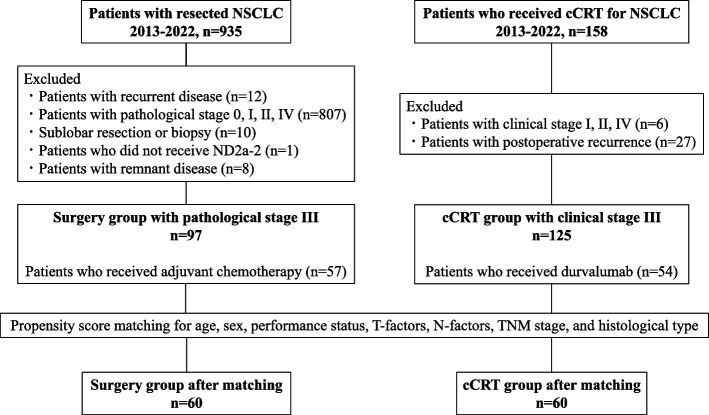
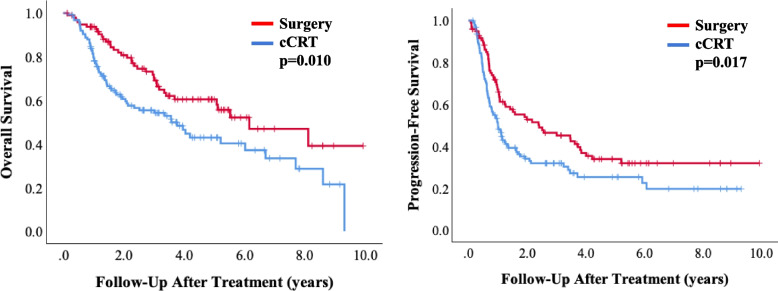
Results: Of the 923 patients with NSCLC who underwent surgery, 97 with pathologic stage III NSCLC underwent complete resection (surgery group) and 125 with clinical stage III NSCLC underwent cCRT (cCRT group), of whom 54 (43.2%) received consolidation therapy with durvalumab. Overall survival (OS) was significantly higher in the surgery group than in the cCRT group (5-year OS: 60.5% versus 43.0%), hazard ratio [HR] = 0.585, 95% confidence interval [CI]: 0.390-0.877, p = 0.010). However, no significant difference in OS was found between the two groups after propensity score matching (5-year OS: 59.8% versus 48.1%, HR = 0.728, 95% CI: 0.416-1.277, p = 0.268).
Conclusions: The outcomes of the surgery and cCRT groups did not significantly differ in the treatment of stage III NSCLC. Appropriate evaluation of the treatment required should be reviewed on a case-by-case basis.
期刊介绍:
BMC Cancer is an open access, peer-reviewed journal that considers articles on all aspects of cancer research, including the pathophysiology, prevention, diagnosis and treatment of cancers. The journal welcomes submissions concerning molecular and cellular biology, genetics, epidemiology, and clinical trials.





 京公网安备 11010802042870号
京ICP备2023020795号-1
京公网安备 11010802042870号
京ICP备2023020795号-1

 分享
分享
 求助内容:
求助内容: 应助结果提醒方式:
 扫码关注我们
