Yufeng Huang, Wenyue Deng, Hui Huang, Xiankai Zhang, Xiaohong Chen, Jian Ye, Sukun Luo, Ting Yu, Hui Yao, Hao Du, Xuelian He
{"title":"通过全基因组测序检测ARSB引起MPS VI的断点倒置:经验教训和最佳实践。","authors":"Yufeng Huang, Wenyue Deng, Hui Huang, Xiankai Zhang, Xiaohong Chen, Jian Ye, Sukun Luo, Ting Yu, Hui Yao, Hao Du, Xuelian He","doi":"10.3389/fgene.2024.1452498","DOIUrl":null,"url":null,"abstract":"<p><strong>Introduction: </strong>Mucopolysaccharidosis type VI (MPSVI), an autosomal recessive lysosomal storage disorder caused by pathogenic variants in <i>ARSB</i> gene. Usually, whole exome sequencing (WES) can identify these variants, and if WES failed to detect causative variants, whole-genome sequencing (WGS) may be considered to investigate deep intronic variations and structural alterations in patients.</p><p><strong>Methods: </strong>Whole-exome sequencing (WES) and whole genome sequencing (WGS) were performed in a Chinese family having a boy with suspected diagnosis of MPS with macrocephaly, coarse facial features, broad forehead, thick lips, frontal bossing, craniosynostosis, blue spots, frequent upper respiratory infections, inguinal hernia, and dysostosis multiplex. Lysosomal enzymatic assays for leucocytes were used to assess the activity of arylsulfatase B of the boy's leucocytes. Sanger sequencing and karyotyping analysis were used to validate the variants identified in the boy and his parents.</p><p><strong>Results: </strong>This boy diagnosed with MPSVI based on clinical phenotypes and laboratory biochemical assays, and WES identified only a maternally inherited missense variant, c.908G>T (p.Gly303Val), in the <i>ARSB</i> gene. By performing WGS, we found a paracentric inversion involving chromosome 5q14.1q13.2 (78180730-138771424 inv), disrupting the <i>ARSB</i> gene on the proband and his father. The inversion was confirmed through karyotyping analysis, and the breakpoints were validated by agarose gel electrophoresis and Sanger sequencing.</p><p><strong>Disscussion: </strong>This study reminds us that WGS should be done when WES failed to achieve a molecular diagonosis, and it also underscores the importance of WGS especially in cases of high clinical suspicion.</p>","PeriodicalId":12750,"journal":{"name":"Frontiers in Genetics","volume":"15 ","pages":"1452498"},"PeriodicalIF":2.8000,"publicationDate":"2025-01-08","publicationTypes":"Journal Article","fieldsOfStudy":null,"isOpenAccess":false,"openAccessPdf":"https://www.ncbi.nlm.nih.gov/pmc/articles/PMC11750778/pdf/","citationCount":"0","resultStr":"{\"title\":\"Detection of inversion with breakpoints in <i>ARSB</i> causing MPS VI by whole-genome sequencing: lessons learned and best practices.\",\"authors\":\"Yufeng Huang, Wenyue Deng, Hui Huang, Xiankai Zhang, Xiaohong Chen, Jian Ye, Sukun Luo, Ting Yu, Hui Yao, Hao Du, Xuelian He\",\"doi\":\"10.3389/fgene.2024.1452498\",\"DOIUrl\":null,\"url\":null,\"abstract\":\"<p><strong>Introduction: </strong>Mucopolysaccharidosis type VI (MPSVI), an autosomal recessive lysosomal storage disorder caused by pathogenic variants in <i>ARSB</i> gene. Usually, whole exome sequencing (WES) can identify these variants, and if WES failed to detect causative variants, whole-genome sequencing (WGS) may be considered to investigate deep intronic variations and structural alterations in patients.</p><p><strong>Methods: </strong>Whole-exome sequencing (WES) and whole genome sequencing (WGS) were performed in a Chinese family having a boy with suspected diagnosis of MPS with macrocephaly, coarse facial features, broad forehead, thick lips, frontal bossing, craniosynostosis, blue spots, frequent upper respiratory infections, inguinal hernia, and dysostosis multiplex. Lysosomal enzymatic assays for leucocytes were used to assess the activity of arylsulfatase B of the boy's leucocytes. Sanger sequencing and karyotyping analysis were used to validate the variants identified in the boy and his parents.</p><p><strong>Results: </strong>This boy diagnosed with MPSVI based on clinical phenotypes and laboratory biochemical assays, and WES identified only a maternally inherited missense variant, c.908G>T (p.Gly303Val), in the <i>ARSB</i> gene. By performing WGS, we found a paracentric inversion involving chromosome 5q14.1q13.2 (78180730-138771424 inv), disrupting the <i>ARSB</i> gene on the proband and his father. The inversion was confirmed through karyotyping analysis, and the breakpoints were validated by agarose gel electrophoresis and Sanger sequencing.</p><p><strong>Disscussion: </strong>This study reminds us that WGS should be done when WES failed to achieve a molecular diagonosis, and it also underscores the importance of WGS especially in cases of high clinical suspicion.</p>\",\"PeriodicalId\":12750,\"journal\":{\"name\":\"Frontiers in Genetics\",\"volume\":\"15 \",\"pages\":\"1452498\"},\"PeriodicalIF\":2.8000,\"publicationDate\":\"2025-01-08\",\"publicationTypes\":\"Journal Article\",\"fieldsOfStudy\":null,\"isOpenAccess\":false,\"openAccessPdf\":\"https://www.ncbi.nlm.nih.gov/pmc/articles/PMC11750778/pdf/\",\"citationCount\":\"0\",\"resultStr\":null,\"platform\":\"Semanticscholar\",\"paperid\":null,\"PeriodicalName\":\"Frontiers in Genetics\",\"FirstCategoryId\":\"99\",\"ListUrlMain\":\"https://doi.org/10.3389/fgene.2024.1452498\",\"RegionNum\":3,\"RegionCategory\":\"生物学\",\"ArticlePicture\":[],\"TitleCN\":null,\"AbstractTextCN\":null,\"PMCID\":null,\"EPubDate\":\"2024/1/1 0:00:00\",\"PubModel\":\"eCollection\",\"JCR\":\"Q2\",\"JCRName\":\"GENETICS & HEREDITY\",\"Score\":null,\"Total\":0}","platform":"Semanticscholar","paperid":null,"PeriodicalName":"Frontiers in Genetics","FirstCategoryId":"99","ListUrlMain":"https://doi.org/10.3389/fgene.2024.1452498","RegionNum":3,"RegionCategory":"生物学","ArticlePicture":[],"TitleCN":null,"AbstractTextCN":null,"PMCID":null,"EPubDate":"2024/1/1 0:00:00","PubModel":"eCollection","JCR":"Q2","JCRName":"GENETICS & HEREDITY","Score":null,"Total":0}
引用次数: 0
摘要
简介:粘多糖病(Mucopolysaccharidosis type VI,简称MPSVI)是由ARSB基因致病性变异引起的常染色体隐性溶酶体贮积症。通常,全外显子组测序(WES)可以识别这些变异,如果WES不能检测到致病变异,可以考虑使用全基因组测序(WGS)来研究患者的深层内含子变异和结构改变。方法:采用全外显子组测序(WES)和全基因组测序(WGS)对中国1例疑似MPS患儿家庭进行分析,该患儿表现为头大、面部特征粗大、前额宽、嘴唇厚、额部隆起、颅缝闭锁、蓝斑、频繁上呼吸道感染、腹股沟疝、多发性口瘘。白细胞溶酶体酶测定法用于评估男孩白细胞芳基硫酸酯酶B的活性。使用Sanger测序和核型分析来验证在男孩及其父母中发现的变异。结果:根据临床表型和实验室生化分析,该男孩被诊断为MPSVI,而WES仅在ARSB基因中发现了一个母亲遗传的错义变体c.908G>T (p.Gly303Val)。通过WGS,我们发现了一个涉及染色体5q14.1q13.2 (78180730-138771424 inv)的准中心反转,破坏了先证者及其父亲的ARSB基因。通过核型分析证实了该反转,并通过琼脂糖凝胶电泳和Sanger测序验证了断点。讨论:本研究提醒我们,当WES无法实现分子诊断时,应进行WGS,同时也强调了WGS的重要性,特别是在临床怀疑度高的病例中。
Detection of inversion with breakpoints in ARSB causing MPS VI by whole-genome sequencing: lessons learned and best practices.
Introduction: Mucopolysaccharidosis type VI (MPSVI), an autosomal recessive lysosomal storage disorder caused by pathogenic variants in ARSB gene. Usually, whole exome sequencing (WES) can identify these variants, and if WES failed to detect causative variants, whole-genome sequencing (WGS) may be considered to investigate deep intronic variations and structural alterations in patients.
Methods: Whole-exome sequencing (WES) and whole genome sequencing (WGS) were performed in a Chinese family having a boy with suspected diagnosis of MPS with macrocephaly, coarse facial features, broad forehead, thick lips, frontal bossing, craniosynostosis, blue spots, frequent upper respiratory infections, inguinal hernia, and dysostosis multiplex. Lysosomal enzymatic assays for leucocytes were used to assess the activity of arylsulfatase B of the boy's leucocytes. Sanger sequencing and karyotyping analysis were used to validate the variants identified in the boy and his parents.
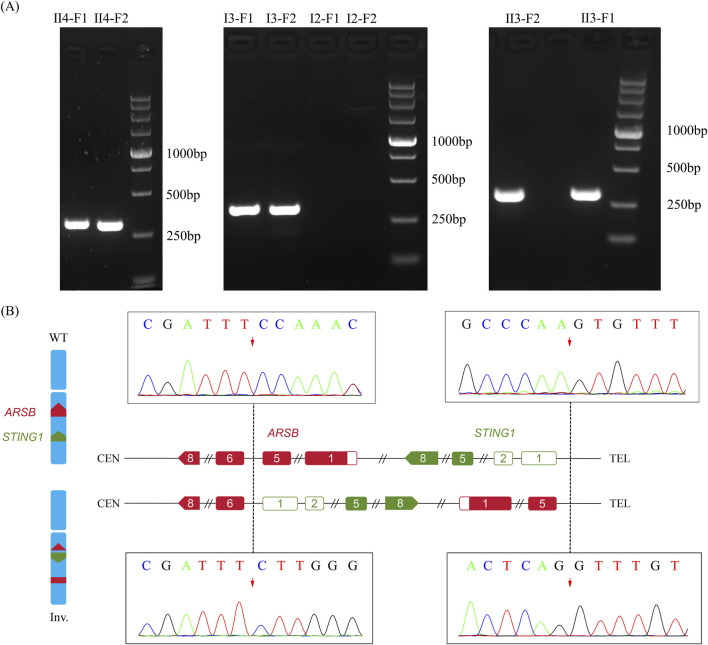
Results: This boy diagnosed with MPSVI based on clinical phenotypes and laboratory biochemical assays, and WES identified only a maternally inherited missense variant, c.908G>T (p.Gly303Val), in the ARSB gene. By performing WGS, we found a paracentric inversion involving chromosome 5q14.1q13.2 (78180730-138771424 inv), disrupting the ARSB gene on the proband and his father. The inversion was confirmed through karyotyping analysis, and the breakpoints were validated by agarose gel electrophoresis and Sanger sequencing.
Disscussion: This study reminds us that WGS should be done when WES failed to achieve a molecular diagonosis, and it also underscores the importance of WGS especially in cases of high clinical suspicion.
Frontiers in GeneticsBiochemistry, Genetics and Molecular Biology-Molecular Medicine
CiteScore
5.50
自引率
8.10%
发文量
3491
审稿时长
14 weeks
期刊介绍:
Frontiers in Genetics publishes rigorously peer-reviewed research on genes and genomes relating to all the domains of life, from humans to plants to livestock and other model organisms. Led by an outstanding Editorial Board of the world’s leading experts, this multidisciplinary, open-access journal is at the forefront of communicating cutting-edge research to researchers, academics, clinicians, policy makers and the public.
The study of inheritance and the impact of the genome on various biological processes is well documented. However, the majority of discoveries are still to come. A new era is seeing major developments in the function and variability of the genome, the use of genetic and genomic tools and the analysis of the genetic basis of various biological phenomena.







 京公网安备 11010802042870号
京ICP备2023020795号-1
京公网安备 11010802042870号
京ICP备2023020795号-1

 分享
分享
 求助内容:
求助内容: 应助结果提醒方式:
 扫码关注我们
