Xiao-Yang Bao, Jia-Jia Xin, Yuan-Xing Ye, Can-Shi Hu
{"title":"不同饥饿压力下鸟类逃跑行为的反馈","authors":"Xiao-Yang Bao, Jia-Jia Xin, Yuan-Xing Ye, Can-Shi Hu","doi":"10.1002/ece3.70866","DOIUrl":null,"url":null,"abstract":"<p>The risk of predation has always been a significant impact on wild birds. Birds, facing with limited energy, must balance their investment between foraging and vigilance. There were currently limited understandings of the vigilant behavior feedback of birds under different hunger pressure. Therefore, we employed the White-browed laughingthrush (<i>Pterorhinus sannio</i>) and White wagtail (<i>Motacilla alba</i>) as research subjects to carry out experiments in winter, in exploring the tolerance of birds to external stress under different hunger pressure. After a night of energy expenditure, individuals of both species faced greater hunger pressure in the morning. The results of general linear models showed that the flight initiation distance (FID) of both species in the morning (7:00–9:00) was significantly shorter than that in the evening (16:00–18:00). Additionally, when the weather was cold (daily minimum temperature ≤ 5°C), the FID of the White-browed laughingthrush and White wagtail was significantly shorter in the morning, as same as the results of general linear models. However, when the weather was warm (daily minimum temperature ≥ 10°C), there was no significant difference even though the FID average of both species was shorter in the morning than in the evening. These suggested that the consumption and supplementation of energy are very important for birds, as the higher their hunger pressure, the greater their willingness to forage and take on risk, especially in cold winter.</p>","PeriodicalId":11467,"journal":{"name":"Ecology and Evolution","volume":"15 1","pages":""},"PeriodicalIF":2.3000,"publicationDate":"2025-01-21","publicationTypes":"Journal Article","fieldsOfStudy":null,"isOpenAccess":false,"openAccessPdf":"https://www.ncbi.nlm.nih.gov/pmc/articles/PMC11750807/pdf/","citationCount":"0","resultStr":"{\"title\":\"Feedback on Escape Behavior of Birds Under Different Hunger Pressure\",\"authors\":\"Xiao-Yang Bao, Jia-Jia Xin, Yuan-Xing Ye, Can-Shi Hu\",\"doi\":\"10.1002/ece3.70866\",\"DOIUrl\":null,\"url\":null,\"abstract\":\"<p>The risk of predation has always been a significant impact on wild birds. Birds, facing with limited energy, must balance their investment between foraging and vigilance. There were currently limited understandings of the vigilant behavior feedback of birds under different hunger pressure. Therefore, we employed the White-browed laughingthrush (<i>Pterorhinus sannio</i>) and White wagtail (<i>Motacilla alba</i>) as research subjects to carry out experiments in winter, in exploring the tolerance of birds to external stress under different hunger pressure. After a night of energy expenditure, individuals of both species faced greater hunger pressure in the morning. The results of general linear models showed that the flight initiation distance (FID) of both species in the morning (7:00–9:00) was significantly shorter than that in the evening (16:00–18:00). Additionally, when the weather was cold (daily minimum temperature ≤ 5°C), the FID of the White-browed laughingthrush and White wagtail was significantly shorter in the morning, as same as the results of general linear models. However, when the weather was warm (daily minimum temperature ≥ 10°C), there was no significant difference even though the FID average of both species was shorter in the morning than in the evening. These suggested that the consumption and supplementation of energy are very important for birds, as the higher their hunger pressure, the greater their willingness to forage and take on risk, especially in cold winter.</p>\",\"PeriodicalId\":11467,\"journal\":{\"name\":\"Ecology and Evolution\",\"volume\":\"15 1\",\"pages\":\"\"},\"PeriodicalIF\":2.3000,\"publicationDate\":\"2025-01-21\",\"publicationTypes\":\"Journal Article\",\"fieldsOfStudy\":null,\"isOpenAccess\":false,\"openAccessPdf\":\"https://www.ncbi.nlm.nih.gov/pmc/articles/PMC11750807/pdf/\",\"citationCount\":\"0\",\"resultStr\":null,\"platform\":\"Semanticscholar\",\"paperid\":null,\"PeriodicalName\":\"Ecology and Evolution\",\"FirstCategoryId\":\"99\",\"ListUrlMain\":\"https://onlinelibrary.wiley.com/doi/10.1002/ece3.70866\",\"RegionNum\":2,\"RegionCategory\":\"生物学\",\"ArticlePicture\":[],\"TitleCN\":null,\"AbstractTextCN\":null,\"PMCID\":null,\"EPubDate\":\"\",\"PubModel\":\"\",\"JCR\":\"Q2\",\"JCRName\":\"ECOLOGY\",\"Score\":null,\"Total\":0}","platform":"Semanticscholar","paperid":null,"PeriodicalName":"Ecology and Evolution","FirstCategoryId":"99","ListUrlMain":"https://onlinelibrary.wiley.com/doi/10.1002/ece3.70866","RegionNum":2,"RegionCategory":"生物学","ArticlePicture":[],"TitleCN":null,"AbstractTextCN":null,"PMCID":null,"EPubDate":"","PubModel":"","JCR":"Q2","JCRName":"ECOLOGY","Score":null,"Total":0}
Feedback on Escape Behavior of Birds Under Different Hunger Pressure
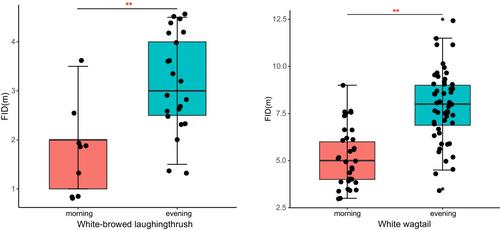
The risk of predation has always been a significant impact on wild birds. Birds, facing with limited energy, must balance their investment between foraging and vigilance. There were currently limited understandings of the vigilant behavior feedback of birds under different hunger pressure. Therefore, we employed the White-browed laughingthrush (Pterorhinus sannio) and White wagtail (Motacilla alba) as research subjects to carry out experiments in winter, in exploring the tolerance of birds to external stress under different hunger pressure. After a night of energy expenditure, individuals of both species faced greater hunger pressure in the morning. The results of general linear models showed that the flight initiation distance (FID) of both species in the morning (7:00–9:00) was significantly shorter than that in the evening (16:00–18:00). Additionally, when the weather was cold (daily minimum temperature ≤ 5°C), the FID of the White-browed laughingthrush and White wagtail was significantly shorter in the morning, as same as the results of general linear models. However, when the weather was warm (daily minimum temperature ≥ 10°C), there was no significant difference even though the FID average of both species was shorter in the morning than in the evening. These suggested that the consumption and supplementation of energy are very important for birds, as the higher their hunger pressure, the greater their willingness to forage and take on risk, especially in cold winter.
期刊介绍:
Ecology and Evolution is the peer reviewed journal for rapid dissemination of research in all areas of ecology, evolution and conservation science. The journal gives priority to quality research reports, theoretical or empirical, that develop our understanding of organisms and their diversity, interactions between them, and the natural environment.
Ecology and Evolution gives prompt and equal consideration to papers reporting theoretical, experimental, applied and descriptive work in terrestrial and aquatic environments. The journal will consider submissions across taxa in areas including but not limited to micro and macro ecological and evolutionary processes, characteristics of and interactions between individuals, populations, communities and the environment, physiological responses to environmental change, population genetics and phylogenetics, relatedness and kin selection, life histories, systematics and taxonomy, conservation genetics, extinction, speciation, adaption, behaviour, biodiversity, species abundance, macroecology, population and ecosystem dynamics, and conservation policy.




 京公网安备 11010802042870号
京ICP备2023020795号-1
京公网安备 11010802042870号
京ICP备2023020795号-1

 分享
分享
 求助内容:
求助内容: 应助结果提醒方式:
 扫码关注我们
