{"title":"从零开始循环经济:一种新的基于项目的学习方法,以提高工业设计专业学生对金属回收的积极性。","authors":"K. Schoch , M. Bickel , C. Liedtke , F. Hemmert","doi":"10.1016/j.mex.2024.103137","DOIUrl":null,"url":null,"abstract":"<div><div>Project-based learning, with its emphasis on ‘learning by doing’, is the dominant teaching method in industrial design. Learners are supposed to be motivated to tackle complex problems such as those in the dynamic field of sustainability. However, it is still unclear how the process of increasing motivation within projects can be systematically targeted for specific sustainability challenges and directed towards potential later pro-environmental behavior.</div><div>The project-based learning method presented in this paper, framed by a normative decision-making model, aims to intrinsically motivate industrial design students to engage in the exemplary circular economy field of metal recycling and at the same time promote necessary professional competencies on the metal, alloy, product and system level. It is demonstrated which specific intervention measures can be suitable to achieve this goal and how they can be methodically employed. Preliminary quantitative evaluation results indicate that the project-based learning method can indeed strongly motivate the target group.<ul><li><span>•</span><span><div>Connection to a normative decision-making model from social psychology for the domain of environmental protection as a conceptual framework</div></span></li><li><span>•</span><span><div>Consideration of intervention measures at various levels (metal, alloy, product, system)</div></span></li><li><span>•</span><span><div>Use of generative toolkits to translate the acquired knowledge into practical application during design tasks</div></span></li></ul></div></div>","PeriodicalId":18446,"journal":{"name":"MethodsX","volume":"14 ","pages":"Article 103137"},"PeriodicalIF":1.9000,"publicationDate":"2025-06-01","publicationTypes":"Journal Article","fieldsOfStudy":null,"isOpenAccess":false,"openAccessPdf":"https://www.ncbi.nlm.nih.gov/pmc/articles/PMC11751539/pdf/","citationCount":"0","resultStr":"{\"title\":\"Circular economy from scratch: A novel project-based learning method to increase motivation in metal recycling among industrial design students\",\"authors\":\"K. Schoch , M. Bickel , C. Liedtke , F. Hemmert\",\"doi\":\"10.1016/j.mex.2024.103137\",\"DOIUrl\":null,\"url\":null,\"abstract\":\"<div><div>Project-based learning, with its emphasis on ‘learning by doing’, is the dominant teaching method in industrial design. Learners are supposed to be motivated to tackle complex problems such as those in the dynamic field of sustainability. However, it is still unclear how the process of increasing motivation within projects can be systematically targeted for specific sustainability challenges and directed towards potential later pro-environmental behavior.</div><div>The project-based learning method presented in this paper, framed by a normative decision-making model, aims to intrinsically motivate industrial design students to engage in the exemplary circular economy field of metal recycling and at the same time promote necessary professional competencies on the metal, alloy, product and system level. It is demonstrated which specific intervention measures can be suitable to achieve this goal and how they can be methodically employed. Preliminary quantitative evaluation results indicate that the project-based learning method can indeed strongly motivate the target group.<ul><li><span>•</span><span><div>Connection to a normative decision-making model from social psychology for the domain of environmental protection as a conceptual framework</div></span></li><li><span>•</span><span><div>Consideration of intervention measures at various levels (metal, alloy, product, system)</div></span></li><li><span>•</span><span><div>Use of generative toolkits to translate the acquired knowledge into practical application during design tasks</div></span></li></ul></div></div>\",\"PeriodicalId\":18446,\"journal\":{\"name\":\"MethodsX\",\"volume\":\"14 \",\"pages\":\"Article 103137\"},\"PeriodicalIF\":1.9000,\"publicationDate\":\"2025-06-01\",\"publicationTypes\":\"Journal Article\",\"fieldsOfStudy\":null,\"isOpenAccess\":false,\"openAccessPdf\":\"https://www.ncbi.nlm.nih.gov/pmc/articles/PMC11751539/pdf/\",\"citationCount\":\"0\",\"resultStr\":null,\"platform\":\"Semanticscholar\",\"paperid\":null,\"PeriodicalName\":\"MethodsX\",\"FirstCategoryId\":\"1085\",\"ListUrlMain\":\"https://www.sciencedirect.com/science/article/pii/S2215016124005880\",\"RegionNum\":0,\"RegionCategory\":null,\"ArticlePicture\":[],\"TitleCN\":null,\"AbstractTextCN\":null,\"PMCID\":null,\"EPubDate\":\"2024/12/27 0:00:00\",\"PubModel\":\"Epub\",\"JCR\":\"Q2\",\"JCRName\":\"MULTIDISCIPLINARY SCIENCES\",\"Score\":null,\"Total\":0}","platform":"Semanticscholar","paperid":null,"PeriodicalName":"MethodsX","FirstCategoryId":"1085","ListUrlMain":"https://www.sciencedirect.com/science/article/pii/S2215016124005880","RegionNum":0,"RegionCategory":null,"ArticlePicture":[],"TitleCN":null,"AbstractTextCN":null,"PMCID":null,"EPubDate":"2024/12/27 0:00:00","PubModel":"Epub","JCR":"Q2","JCRName":"MULTIDISCIPLINARY SCIENCES","Score":null,"Total":0}
Circular economy from scratch: A novel project-based learning method to increase motivation in metal recycling among industrial design students
Project-based learning, with its emphasis on ‘learning by doing’, is the dominant teaching method in industrial design. Learners are supposed to be motivated to tackle complex problems such as those in the dynamic field of sustainability. However, it is still unclear how the process of increasing motivation within projects can be systematically targeted for specific sustainability challenges and directed towards potential later pro-environmental behavior.
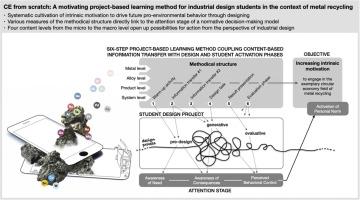
The project-based learning method presented in this paper, framed by a normative decision-making model, aims to intrinsically motivate industrial design students to engage in the exemplary circular economy field of metal recycling and at the same time promote necessary professional competencies on the metal, alloy, product and system level. It is demonstrated which specific intervention measures can be suitable to achieve this goal and how they can be methodically employed. Preliminary quantitative evaluation results indicate that the project-based learning method can indeed strongly motivate the target group.
•
Connection to a normative decision-making model from social psychology for the domain of environmental protection as a conceptual framework
•
Consideration of intervention measures at various levels (metal, alloy, product, system)
•
Use of generative toolkits to translate the acquired knowledge into practical application during design tasks




 京公网安备 11010802042870号
京ICP备2023020795号-1
京公网安备 11010802042870号
京ICP备2023020795号-1

 分享
分享
 求助内容:
求助内容: 应助结果提醒方式:
 扫码关注我们
