Akiyasu Yamamoto, Akinori Yamanaka, Kazumasa Iida, Yusuke Shimada, Satoshi Hata
{"title":"将机器学习与多晶材料的先进加工和表征相结合:一种方法综述及其在铁基超导体中的应用。","authors":"Akiyasu Yamamoto, Akinori Yamanaka, Kazumasa Iida, Yusuke Shimada, Satoshi Hata","doi":"10.1080/14686996.2024.2436347","DOIUrl":null,"url":null,"abstract":"<p><p>In this review, we present a new set of machine learning-based materials research methodologies for polycrystalline materials developed through the Core Research for Evolutionary Science and Technology project of the Japan Science and Technology Agency. We focus on the constituents of polycrystalline materials (i.e. grains, grain boundaries [GBs], and microstructures) and summarize their various aspects (experimental synthesis, artificial single GBs, multiscale experimental data acquisition via electron microscopy, formation process modeling, property description modeling, 3D reconstruction, and data-driven design methods). Specifically, we discuss a mechanochemical process involving high-energy milling, in situ observation of microstructural formation using 3D scanning transmission electron microscopy, phase-field modeling coupled with Bayesian data assimilation, nano-orientation analysis via scanning precession electron diffraction, semantic segmentation using neural network models, and the Bayesian-optimization-based process design using BOXVIA software. As a proof of concept, a researcher- and data-driven process design methodology is applied to a polycrystalline iron-based superconductor to evaluate its bulk magnet properties. Finally, future challenges and prospects for data-driven material development and iron-based superconductors are discussed.</p>","PeriodicalId":21588,"journal":{"name":"Science and Technology of Advanced Materials","volume":"26 1","pages":"2436347"},"PeriodicalIF":6.9000,"publicationDate":"2024-12-16","publicationTypes":"Journal Article","fieldsOfStudy":null,"isOpenAccess":false,"openAccessPdf":"https://www.ncbi.nlm.nih.gov/pmc/articles/PMC11753020/pdf/","citationCount":"0","resultStr":"{\"title\":\"Integrating machine learning with advanced processing and characterization for polycrystalline materials: a methodology review and application to iron-based superconductors.\",\"authors\":\"Akiyasu Yamamoto, Akinori Yamanaka, Kazumasa Iida, Yusuke Shimada, Satoshi Hata\",\"doi\":\"10.1080/14686996.2024.2436347\",\"DOIUrl\":null,\"url\":null,\"abstract\":\"<p><p>In this review, we present a new set of machine learning-based materials research methodologies for polycrystalline materials developed through the Core Research for Evolutionary Science and Technology project of the Japan Science and Technology Agency. We focus on the constituents of polycrystalline materials (i.e. grains, grain boundaries [GBs], and microstructures) and summarize their various aspects (experimental synthesis, artificial single GBs, multiscale experimental data acquisition via electron microscopy, formation process modeling, property description modeling, 3D reconstruction, and data-driven design methods). Specifically, we discuss a mechanochemical process involving high-energy milling, in situ observation of microstructural formation using 3D scanning transmission electron microscopy, phase-field modeling coupled with Bayesian data assimilation, nano-orientation analysis via scanning precession electron diffraction, semantic segmentation using neural network models, and the Bayesian-optimization-based process design using BOXVIA software. As a proof of concept, a researcher- and data-driven process design methodology is applied to a polycrystalline iron-based superconductor to evaluate its bulk magnet properties. Finally, future challenges and prospects for data-driven material development and iron-based superconductors are discussed.</p>\",\"PeriodicalId\":21588,\"journal\":{\"name\":\"Science and Technology of Advanced Materials\",\"volume\":\"26 1\",\"pages\":\"2436347\"},\"PeriodicalIF\":6.9000,\"publicationDate\":\"2024-12-16\",\"publicationTypes\":\"Journal Article\",\"fieldsOfStudy\":null,\"isOpenAccess\":false,\"openAccessPdf\":\"https://www.ncbi.nlm.nih.gov/pmc/articles/PMC11753020/pdf/\",\"citationCount\":\"0\",\"resultStr\":null,\"platform\":\"Semanticscholar\",\"paperid\":null,\"PeriodicalName\":\"Science and Technology of Advanced Materials\",\"FirstCategoryId\":\"88\",\"ListUrlMain\":\"https://doi.org/10.1080/14686996.2024.2436347\",\"RegionNum\":3,\"RegionCategory\":\"材料科学\",\"ArticlePicture\":[],\"TitleCN\":null,\"AbstractTextCN\":null,\"PMCID\":null,\"EPubDate\":\"2025/1/1 0:00:00\",\"PubModel\":\"eCollection\",\"JCR\":\"Q1\",\"JCRName\":\"MATERIALS SCIENCE, MULTIDISCIPLINARY\",\"Score\":null,\"Total\":0}","platform":"Semanticscholar","paperid":null,"PeriodicalName":"Science and Technology of Advanced Materials","FirstCategoryId":"88","ListUrlMain":"https://doi.org/10.1080/14686996.2024.2436347","RegionNum":3,"RegionCategory":"材料科学","ArticlePicture":[],"TitleCN":null,"AbstractTextCN":null,"PMCID":null,"EPubDate":"2025/1/1 0:00:00","PubModel":"eCollection","JCR":"Q1","JCRName":"MATERIALS SCIENCE, MULTIDISCIPLINARY","Score":null,"Total":0}
Integrating machine learning with advanced processing and characterization for polycrystalline materials: a methodology review and application to iron-based superconductors.
In this review, we present a new set of machine learning-based materials research methodologies for polycrystalline materials developed through the Core Research for Evolutionary Science and Technology project of the Japan Science and Technology Agency. We focus on the constituents of polycrystalline materials (i.e. grains, grain boundaries [GBs], and microstructures) and summarize their various aspects (experimental synthesis, artificial single GBs, multiscale experimental data acquisition via electron microscopy, formation process modeling, property description modeling, 3D reconstruction, and data-driven design methods). Specifically, we discuss a mechanochemical process involving high-energy milling, in situ observation of microstructural formation using 3D scanning transmission electron microscopy, phase-field modeling coupled with Bayesian data assimilation, nano-orientation analysis via scanning precession electron diffraction, semantic segmentation using neural network models, and the Bayesian-optimization-based process design using BOXVIA software. As a proof of concept, a researcher- and data-driven process design methodology is applied to a polycrystalline iron-based superconductor to evaluate its bulk magnet properties. Finally, future challenges and prospects for data-driven material development and iron-based superconductors are discussed.
期刊介绍:
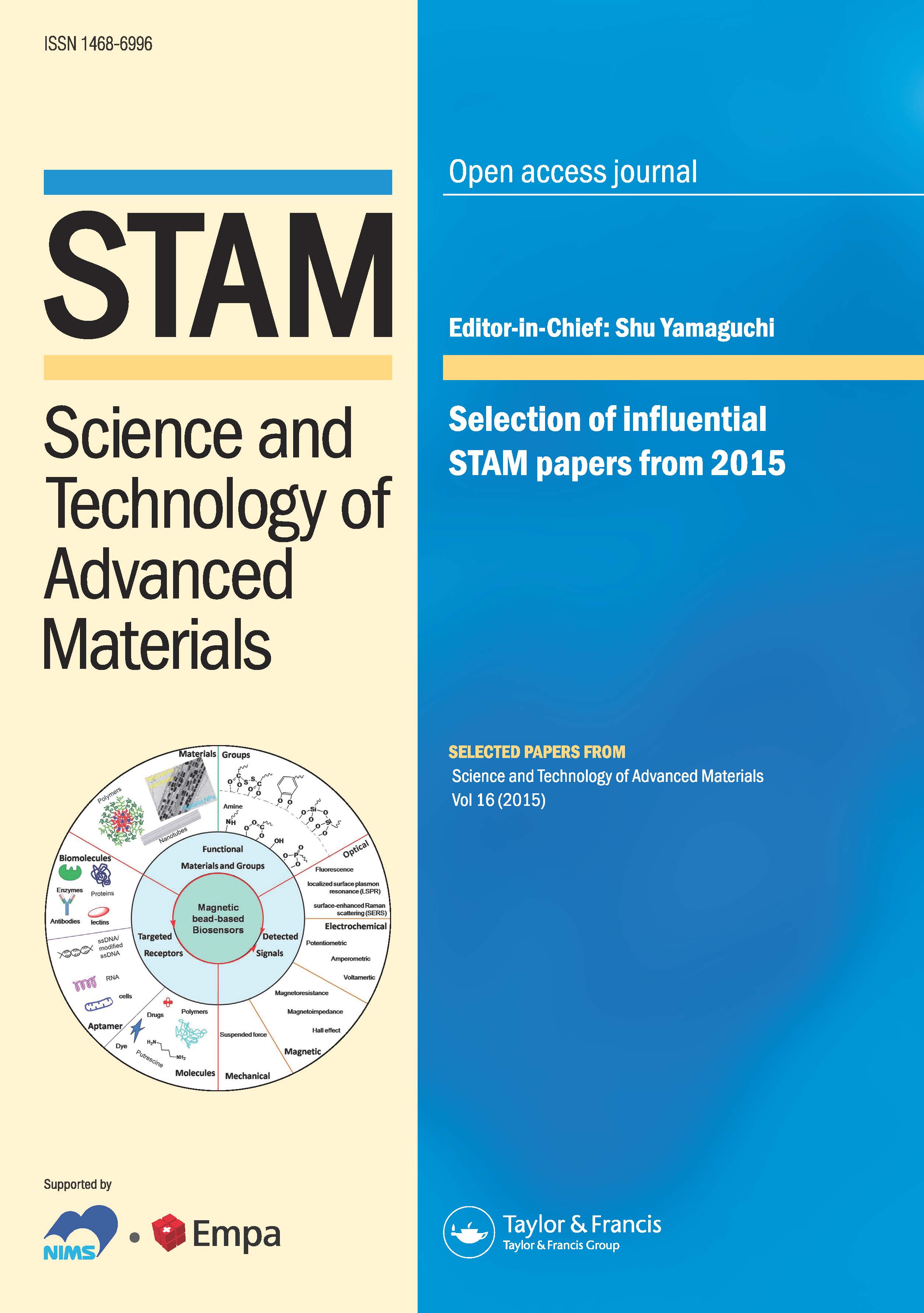
Science and Technology of Advanced Materials (STAM) is a leading open access, international journal for outstanding research articles across all aspects of materials science. Our audience is the international community across the disciplines of materials science, physics, chemistry, biology as well as engineering.
The journal covers a broad spectrum of topics including functional and structural materials, synthesis and processing, theoretical analyses, characterization and properties of materials. Emphasis is placed on the interdisciplinary nature of materials science and issues at the forefront of the field, such as energy and environmental issues, as well as medical and bioengineering applications.
Of particular interest are research papers on the following topics:
Materials informatics and materials genomics
Materials for 3D printing and additive manufacturing
Nanostructured/nanoscale materials and nanodevices
Bio-inspired, biomedical, and biological materials; nanomedicine, and novel technologies for clinical and medical applications
Materials for energy and environment, next-generation photovoltaics, and green technologies
Advanced structural materials, materials for extreme conditions.




 京公网安备 11010802042870号
京ICP备2023020795号-1
京公网安备 11010802042870号
京ICP备2023020795号-1

 分享
分享
 求助内容:
求助内容: 应助结果提醒方式:
 扫码关注我们
