Pedro J Caraballo, Anne M Meehan, Karen M Fischer, Parvez Rahman, Gyorgy J Simon, Genevieve B Melton, Hojjat Salehinejad, Bijan J Borah
{"title":"机器学习预警模型在内科和外科住院病人中的可信度。","authors":"Pedro J Caraballo, Anne M Meehan, Karen M Fischer, Parvez Rahman, Gyorgy J Simon, Genevieve B Melton, Hojjat Salehinejad, Bijan J Borah","doi":"10.1093/jamiaopen/ooae156","DOIUrl":null,"url":null,"abstract":"<p><strong>Objectives: </strong>In the general hospital wards, machine learning (ML)-based early warning systems (EWSs) can identify patients at risk of deterioration to facilitate rescue interventions. We assess subpopulation performance of a ML-based EWS on medical and surgical adult patients admitted to general hospital wards.</p><p><strong>Materials and methods: </strong>We assessed the scores of an EWS integrated into the electronic health record and calculated every 15 minutes to predict a composite adverse event (AE): all-cause mortality, transfer to intensive care, cardiac arrest, or rapid response team evaluation. The distributions of the First Score 3 hours after admission, the Highest Score at any time during the hospitalization, and the Last Score just before an AE or dismissal without an AE were calculated. The Last Score was used to calculate the area under the receiver operating characteristic curve (ROC-AUC) and the precision-recall curve (PRC-AUC).</p><p><strong>Results: </strong>From August 23, 2021 to March 31, 2022, 35 937 medical admissions had 2173 (6.05%) AE compared to 25 214 surgical admissions with 4984 (19.77%) AE. Medical and surgical admissions had significant different (<i>P</i> <.001) distributions of the First Score, Highest Score, and Last Score among those with an AE and without an AE. The model performed better in the medical group when compared to the surgical group, ROC-AUC 0.869 versus 0.677, and RPC-AUC 0.988 versus 0.878, respectively.</p><p><strong>Discussion: </strong>Heterogeneity of medical and surgical patients can significantly impact the performance of a ML-based EWS, changing the model validity and clinical discernment.</p><p><strong>Conclusions: </strong>Characterization of the target patient subpopulations has clinical implications and should be considered when developing models to be used in general hospital wards.</p>","PeriodicalId":36278,"journal":{"name":"JAMIA Open","volume":"8 1","pages":"ooae156"},"PeriodicalIF":3.4000,"publicationDate":"2025-01-06","publicationTypes":"Journal Article","fieldsOfStudy":null,"isOpenAccess":false,"openAccessPdf":"https://www.ncbi.nlm.nih.gov/pmc/articles/PMC11702360/pdf/","citationCount":"0","resultStr":"{\"title\":\"Trustworthiness of a machine learning early warning model in medical and surgical inpatients.\",\"authors\":\"Pedro J Caraballo, Anne M Meehan, Karen M Fischer, Parvez Rahman, Gyorgy J Simon, Genevieve B Melton, Hojjat Salehinejad, Bijan J Borah\",\"doi\":\"10.1093/jamiaopen/ooae156\",\"DOIUrl\":null,\"url\":null,\"abstract\":\"<p><strong>Objectives: </strong>In the general hospital wards, machine learning (ML)-based early warning systems (EWSs) can identify patients at risk of deterioration to facilitate rescue interventions. We assess subpopulation performance of a ML-based EWS on medical and surgical adult patients admitted to general hospital wards.</p><p><strong>Materials and methods: </strong>We assessed the scores of an EWS integrated into the electronic health record and calculated every 15 minutes to predict a composite adverse event (AE): all-cause mortality, transfer to intensive care, cardiac arrest, or rapid response team evaluation. The distributions of the First Score 3 hours after admission, the Highest Score at any time during the hospitalization, and the Last Score just before an AE or dismissal without an AE were calculated. The Last Score was used to calculate the area under the receiver operating characteristic curve (ROC-AUC) and the precision-recall curve (PRC-AUC).</p><p><strong>Results: </strong>From August 23, 2021 to March 31, 2022, 35 937 medical admissions had 2173 (6.05%) AE compared to 25 214 surgical admissions with 4984 (19.77%) AE. Medical and surgical admissions had significant different (<i>P</i> <.001) distributions of the First Score, Highest Score, and Last Score among those with an AE and without an AE. The model performed better in the medical group when compared to the surgical group, ROC-AUC 0.869 versus 0.677, and RPC-AUC 0.988 versus 0.878, respectively.</p><p><strong>Discussion: </strong>Heterogeneity of medical and surgical patients can significantly impact the performance of a ML-based EWS, changing the model validity and clinical discernment.</p><p><strong>Conclusions: </strong>Characterization of the target patient subpopulations has clinical implications and should be considered when developing models to be used in general hospital wards.</p>\",\"PeriodicalId\":36278,\"journal\":{\"name\":\"JAMIA Open\",\"volume\":\"8 1\",\"pages\":\"ooae156\"},\"PeriodicalIF\":3.4000,\"publicationDate\":\"2025-01-06\",\"publicationTypes\":\"Journal Article\",\"fieldsOfStudy\":null,\"isOpenAccess\":false,\"openAccessPdf\":\"https://www.ncbi.nlm.nih.gov/pmc/articles/PMC11702360/pdf/\",\"citationCount\":\"0\",\"resultStr\":null,\"platform\":\"Semanticscholar\",\"paperid\":null,\"PeriodicalName\":\"JAMIA Open\",\"FirstCategoryId\":\"1085\",\"ListUrlMain\":\"https://doi.org/10.1093/jamiaopen/ooae156\",\"RegionNum\":0,\"RegionCategory\":null,\"ArticlePicture\":[],\"TitleCN\":null,\"AbstractTextCN\":null,\"PMCID\":null,\"EPubDate\":\"2025/2/1 0:00:00\",\"PubModel\":\"eCollection\",\"JCR\":\"Q2\",\"JCRName\":\"HEALTH CARE SCIENCES & SERVICES\",\"Score\":null,\"Total\":0}","platform":"Semanticscholar","paperid":null,"PeriodicalName":"JAMIA Open","FirstCategoryId":"1085","ListUrlMain":"https://doi.org/10.1093/jamiaopen/ooae156","RegionNum":0,"RegionCategory":null,"ArticlePicture":[],"TitleCN":null,"AbstractTextCN":null,"PMCID":null,"EPubDate":"2025/2/1 0:00:00","PubModel":"eCollection","JCR":"Q2","JCRName":"HEALTH CARE SCIENCES & SERVICES","Score":null,"Total":0}
Trustworthiness of a machine learning early warning model in medical and surgical inpatients.
Objectives: In the general hospital wards, machine learning (ML)-based early warning systems (EWSs) can identify patients at risk of deterioration to facilitate rescue interventions. We assess subpopulation performance of a ML-based EWS on medical and surgical adult patients admitted to general hospital wards.
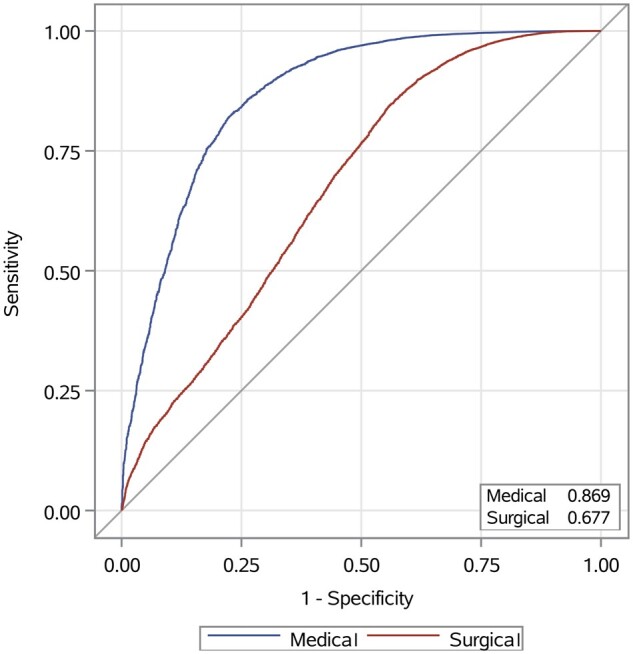
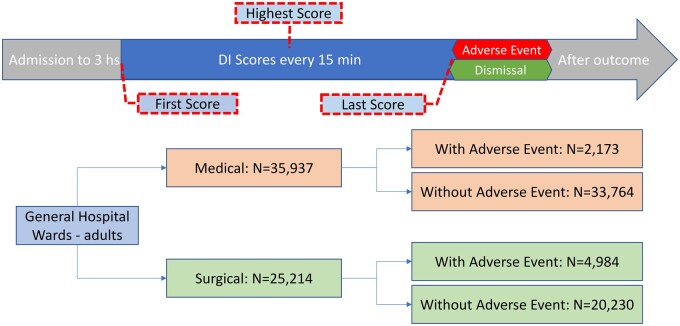
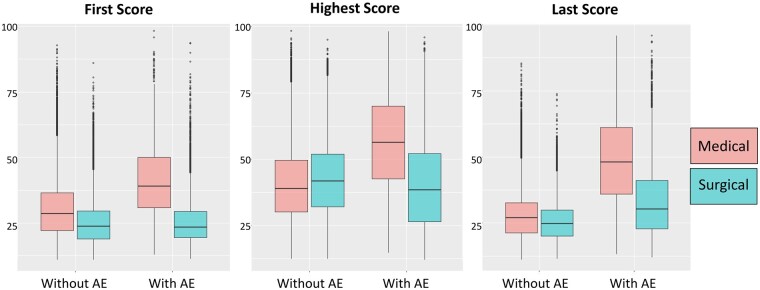
Materials and methods: We assessed the scores of an EWS integrated into the electronic health record and calculated every 15 minutes to predict a composite adverse event (AE): all-cause mortality, transfer to intensive care, cardiac arrest, or rapid response team evaluation. The distributions of the First Score 3 hours after admission, the Highest Score at any time during the hospitalization, and the Last Score just before an AE or dismissal without an AE were calculated. The Last Score was used to calculate the area under the receiver operating characteristic curve (ROC-AUC) and the precision-recall curve (PRC-AUC).
Results: From August 23, 2021 to March 31, 2022, 35 937 medical admissions had 2173 (6.05%) AE compared to 25 214 surgical admissions with 4984 (19.77%) AE. Medical and surgical admissions had significant different (P <.001) distributions of the First Score, Highest Score, and Last Score among those with an AE and without an AE. The model performed better in the medical group when compared to the surgical group, ROC-AUC 0.869 versus 0.677, and RPC-AUC 0.988 versus 0.878, respectively.
Discussion: Heterogeneity of medical and surgical patients can significantly impact the performance of a ML-based EWS, changing the model validity and clinical discernment.
Conclusions: Characterization of the target patient subpopulations has clinical implications and should be considered when developing models to be used in general hospital wards.





 京公网安备 11010802042870号
京ICP备2023020795号-1
京公网安备 11010802042870号
京ICP备2023020795号-1

 分享
分享
 求助内容:
求助内容: 应助结果提醒方式:
 扫码关注我们
