Emma K. Baker, Miya St John, Ruth Braden, Lottie D. Morison, Elana J. Forbes, Fatma Lelik, Stephen J. C. Hearps, David J. Amor, Angela T. Morgan
{"title":"儿童和青少年单基因神经发育障碍的适应性功能。","authors":"Emma K. Baker, Miya St John, Ruth Braden, Lottie D. Morison, Elana J. Forbes, Fatma Lelik, Stephen J. C. Hearps, David J. Amor, Angela T. Morgan","doi":"10.1111/dmcn.16227","DOIUrl":null,"url":null,"abstract":"<div>\n \n \n <section>\n \n <h3> Aim</h3>\n \n <p>To examine the adaptive behaviour profiles of children with monogenic neurodevelopmental disorders (NDDs) to determine whether syndrome-specific or transdiagnostic approaches provide a better understanding of the adaptive behavioural phenotypes of these NDDs.</p>\n </section>\n \n <section>\n \n <h3> Method</h3>\n \n <p>This cross-sectional study included parents and caregivers of 243 (48% female) individuals (age range = 1–25 years; mean = 8 years 10 months, SD = 5 years 8 months) with genetically confirmed monogenic NDDs (<i>CDK13</i>, <i>DYRK1A</i>, <i>FOXP2</i>, <i>KAT6A</i>, <i>KANSL1</i>, <i>SETBP1</i>, <i>BRPF1</i>, and <i>DDX3X</i>). Parents and caregivers completed the Vineland Adaptive Behavior Scales, Third Edition to assess communication, daily living, socialization, and motor skills.</p>\n </section>\n \n <section>\n \n <h3> Results</h3>\n \n <p>Linear regression models comparing mean adaptive behaviours between monogenic NDDs, adjusting for the presence of intellectual disability, revealed few group differences. Children with variants in <i>BRPF1</i> or <i>KANSL1</i> had better adaptive behaviour skills compared to children with variants in <i>CDK13</i>, <i>DDX3X</i>, <i>DYRK1A,</i> and <i>KAT6A</i>, although group differences varied across domains. A latent profile analysis showed compelling evidence for a five-profile model. These profiles were homogeneous, with similar delays across the subdomain scores in each profile. Additionally, each monogenic NDD was represented in each profile, with a few exceptions.</p>\n </section>\n \n <section>\n \n <h3> Interpretation</h3>\n \n <p>Transdiagnostic approaches to understand adaptive behaviour in monogenic NDDs provide a better understanding of individual strengths and challenges, enabling more targeted support.</p>\n </section>\n </div>","PeriodicalId":50587,"journal":{"name":"Developmental Medicine and Child Neurology","volume":"67 7","pages":"953-962"},"PeriodicalIF":3.7000,"publicationDate":"2025-01-23","publicationTypes":"Journal Article","fieldsOfStudy":null,"isOpenAccess":false,"openAccessPdf":"https://onlinelibrary.wiley.com/doi/epdf/10.1111/dmcn.16227","citationCount":"0","resultStr":"{\"title\":\"Adaptive functioning in children and young adults with monogenic neurodevelopmental disorders\",\"authors\":\"Emma K. Baker, Miya St John, Ruth Braden, Lottie D. Morison, Elana J. Forbes, Fatma Lelik, Stephen J. C. Hearps, David J. Amor, Angela T. Morgan\",\"doi\":\"10.1111/dmcn.16227\",\"DOIUrl\":null,\"url\":null,\"abstract\":\"<div>\\n \\n \\n <section>\\n \\n <h3> Aim</h3>\\n \\n <p>To examine the adaptive behaviour profiles of children with monogenic neurodevelopmental disorders (NDDs) to determine whether syndrome-specific or transdiagnostic approaches provide a better understanding of the adaptive behavioural phenotypes of these NDDs.</p>\\n </section>\\n \\n <section>\\n \\n <h3> Method</h3>\\n \\n <p>This cross-sectional study included parents and caregivers of 243 (48% female) individuals (age range = 1–25 years; mean = 8 years 10 months, SD = 5 years 8 months) with genetically confirmed monogenic NDDs (<i>CDK13</i>, <i>DYRK1A</i>, <i>FOXP2</i>, <i>KAT6A</i>, <i>KANSL1</i>, <i>SETBP1</i>, <i>BRPF1</i>, and <i>DDX3X</i>). Parents and caregivers completed the Vineland Adaptive Behavior Scales, Third Edition to assess communication, daily living, socialization, and motor skills.</p>\\n </section>\\n \\n <section>\\n \\n <h3> Results</h3>\\n \\n <p>Linear regression models comparing mean adaptive behaviours between monogenic NDDs, adjusting for the presence of intellectual disability, revealed few group differences. Children with variants in <i>BRPF1</i> or <i>KANSL1</i> had better adaptive behaviour skills compared to children with variants in <i>CDK13</i>, <i>DDX3X</i>, <i>DYRK1A,</i> and <i>KAT6A</i>, although group differences varied across domains. A latent profile analysis showed compelling evidence for a five-profile model. These profiles were homogeneous, with similar delays across the subdomain scores in each profile. Additionally, each monogenic NDD was represented in each profile, with a few exceptions.</p>\\n </section>\\n \\n <section>\\n \\n <h3> Interpretation</h3>\\n \\n <p>Transdiagnostic approaches to understand adaptive behaviour in monogenic NDDs provide a better understanding of individual strengths and challenges, enabling more targeted support.</p>\\n </section>\\n </div>\",\"PeriodicalId\":50587,\"journal\":{\"name\":\"Developmental Medicine and Child Neurology\",\"volume\":\"67 7\",\"pages\":\"953-962\"},\"PeriodicalIF\":3.7000,\"publicationDate\":\"2025-01-23\",\"publicationTypes\":\"Journal Article\",\"fieldsOfStudy\":null,\"isOpenAccess\":false,\"openAccessPdf\":\"https://onlinelibrary.wiley.com/doi/epdf/10.1111/dmcn.16227\",\"citationCount\":\"0\",\"resultStr\":null,\"platform\":\"Semanticscholar\",\"paperid\":null,\"PeriodicalName\":\"Developmental Medicine and Child Neurology\",\"FirstCategoryId\":\"3\",\"ListUrlMain\":\"https://onlinelibrary.wiley.com/doi/10.1111/dmcn.16227\",\"RegionNum\":2,\"RegionCategory\":\"医学\",\"ArticlePicture\":[],\"TitleCN\":null,\"AbstractTextCN\":null,\"PMCID\":null,\"EPubDate\":\"\",\"PubModel\":\"\",\"JCR\":\"Q1\",\"JCRName\":\"CLINICAL NEUROLOGY\",\"Score\":null,\"Total\":0}","platform":"Semanticscholar","paperid":null,"PeriodicalName":"Developmental Medicine and Child Neurology","FirstCategoryId":"3","ListUrlMain":"https://onlinelibrary.wiley.com/doi/10.1111/dmcn.16227","RegionNum":2,"RegionCategory":"医学","ArticlePicture":[],"TitleCN":null,"AbstractTextCN":null,"PMCID":null,"EPubDate":"","PubModel":"","JCR":"Q1","JCRName":"CLINICAL NEUROLOGY","Score":null,"Total":0}
Adaptive functioning in children and young adults with monogenic neurodevelopmental disorders
Aim
To examine the adaptive behaviour profiles of children with monogenic neurodevelopmental disorders (NDDs) to determine whether syndrome-specific or transdiagnostic approaches provide a better understanding of the adaptive behavioural phenotypes of these NDDs.
Method
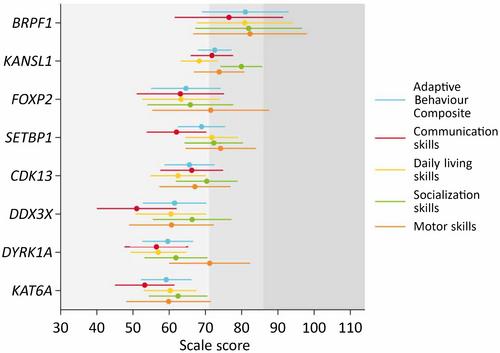
This cross-sectional study included parents and caregivers of 243 (48% female) individuals (age range = 1–25 years; mean = 8 years 10 months, SD = 5 years 8 months) with genetically confirmed monogenic NDDs (CDK13, DYRK1A, FOXP2, KAT6A, KANSL1, SETBP1, BRPF1, and DDX3X). Parents and caregivers completed the Vineland Adaptive Behavior Scales, Third Edition to assess communication, daily living, socialization, and motor skills.
Results
Linear regression models comparing mean adaptive behaviours between monogenic NDDs, adjusting for the presence of intellectual disability, revealed few group differences. Children with variants in BRPF1 or KANSL1 had better adaptive behaviour skills compared to children with variants in CDK13, DDX3X, DYRK1A, and KAT6A, although group differences varied across domains. A latent profile analysis showed compelling evidence for a five-profile model. These profiles were homogeneous, with similar delays across the subdomain scores in each profile. Additionally, each monogenic NDD was represented in each profile, with a few exceptions.
Interpretation
Transdiagnostic approaches to understand adaptive behaviour in monogenic NDDs provide a better understanding of individual strengths and challenges, enabling more targeted support.
期刊介绍:
Wiley-Blackwell is pleased to publish Developmental Medicine & Child Neurology (DMCN), a Mac Keith Press publication and official journal of the American Academy for Cerebral Palsy and Developmental Medicine (AACPDM) and the British Paediatric Neurology Association (BPNA).
For over 50 years, DMCN has defined the field of paediatric neurology and neurodisability and is one of the world’s leading journals in the whole field of paediatrics. DMCN disseminates a range of information worldwide to improve the lives of disabled children and their families. The high quality of published articles is maintained by expert review, including independent statistical assessment, before acceptance.




 京公网安备 11010802042870号
京ICP备2023020795号-1
京公网安备 11010802042870号
京ICP备2023020795号-1

 分享
分享
 求助内容:
求助内容: 应助结果提醒方式:
 扫码关注我们
