Doris Yang, Doudou Zhou, Steven Cai, Ziming Gan, Michael Pencina, Paul Avillach, Tianxi Cai, Chuan Hong
{"title":"通过集成机器学习实现异构数据的鲁棒自动协调:算法开发和验证研究。","authors":"Doris Yang, Doudou Zhou, Steven Cai, Ziming Gan, Michael Pencina, Paul Avillach, Tianxi Cai, Chuan Hong","doi":"10.2196/54133","DOIUrl":null,"url":null,"abstract":"<p><strong>Background: </strong>Cohort studies contain rich clinical data across large and diverse patient populations and are a common source of observational data for clinical research. Because large scale cohort studies are both time and resource intensive, one alternative is to harmonize data from existing cohorts through multicohort studies. However, given differences in variable encoding, accurate variable harmonization is difficult.</p><p><strong>Objective: </strong>We propose SONAR (Semantic and Distribution-Based Harmonization) as a method for harmonizing variables across cohort studies to facilitate multicohort studies.</p><p><strong>Methods: </strong>SONAR used semantic learning from variable descriptions and distribution learning from study participant data. Our method learned an embedding vector for each variable and used pairwise cosine similarity to score the similarity between variables. This approach was built off 3 National Institutes of Health cohorts, including the Cardiovascular Health Study, the Multi-Ethnic Study of Atherosclerosis, and the Women's Health Initiative. We also used gold standard labels to further refine the embeddings in a supervised manner.</p><p><strong>Results: </strong>The method was evaluated using manually curated gold standard labels from the 3 National Institutes of Health cohorts. We evaluated both the intracohort and intercohort variable harmonization performance. The supervised SONAR method outperformed existing benchmark methods for almost all intracohort and intercohort comparisons using area under the curve and top-k accuracy metrics. Notably, SONAR was able to significantly improve harmonization of concepts that were difficult for existing semantic methods to harmonize.</p><p><strong>Conclusions: </strong>SONAR achieves accurate variable harmonization within and between cohort studies by harnessing the complementary strengths of semantic learning and variable distribution learning.</p>","PeriodicalId":56334,"journal":{"name":"JMIR Medical Informatics","volume":"13 ","pages":"e54133"},"PeriodicalIF":5.0000,"publicationDate":"2025-01-22","publicationTypes":"Journal Article","fieldsOfStudy":null,"isOpenAccess":false,"openAccessPdf":"https://www.ncbi.nlm.nih.gov/pmc/articles/PMC11778729/pdf/","citationCount":"0","resultStr":"{\"title\":\"Robust Automated Harmonization of Heterogeneous Data Through Ensemble Machine Learning: Algorithm Development and Validation Study.\",\"authors\":\"Doris Yang, Doudou Zhou, Steven Cai, Ziming Gan, Michael Pencina, Paul Avillach, Tianxi Cai, Chuan Hong\",\"doi\":\"10.2196/54133\",\"DOIUrl\":null,\"url\":null,\"abstract\":\"<p><strong>Background: </strong>Cohort studies contain rich clinical data across large and diverse patient populations and are a common source of observational data for clinical research. Because large scale cohort studies are both time and resource intensive, one alternative is to harmonize data from existing cohorts through multicohort studies. However, given differences in variable encoding, accurate variable harmonization is difficult.</p><p><strong>Objective: </strong>We propose SONAR (Semantic and Distribution-Based Harmonization) as a method for harmonizing variables across cohort studies to facilitate multicohort studies.</p><p><strong>Methods: </strong>SONAR used semantic learning from variable descriptions and distribution learning from study participant data. Our method learned an embedding vector for each variable and used pairwise cosine similarity to score the similarity between variables. This approach was built off 3 National Institutes of Health cohorts, including the Cardiovascular Health Study, the Multi-Ethnic Study of Atherosclerosis, and the Women's Health Initiative. We also used gold standard labels to further refine the embeddings in a supervised manner.</p><p><strong>Results: </strong>The method was evaluated using manually curated gold standard labels from the 3 National Institutes of Health cohorts. We evaluated both the intracohort and intercohort variable harmonization performance. The supervised SONAR method outperformed existing benchmark methods for almost all intracohort and intercohort comparisons using area under the curve and top-k accuracy metrics. Notably, SONAR was able to significantly improve harmonization of concepts that were difficult for existing semantic methods to harmonize.</p><p><strong>Conclusions: </strong>SONAR achieves accurate variable harmonization within and between cohort studies by harnessing the complementary strengths of semantic learning and variable distribution learning.</p>\",\"PeriodicalId\":56334,\"journal\":{\"name\":\"JMIR Medical Informatics\",\"volume\":\"13 \",\"pages\":\"e54133\"},\"PeriodicalIF\":5.0000,\"publicationDate\":\"2025-01-22\",\"publicationTypes\":\"Journal Article\",\"fieldsOfStudy\":null,\"isOpenAccess\":false,\"openAccessPdf\":\"https://www.ncbi.nlm.nih.gov/pmc/articles/PMC11778729/pdf/\",\"citationCount\":\"0\",\"resultStr\":null,\"platform\":\"Semanticscholar\",\"paperid\":null,\"PeriodicalName\":\"JMIR Medical Informatics\",\"FirstCategoryId\":\"3\",\"ListUrlMain\":\"https://doi.org/10.2196/54133\",\"RegionNum\":3,\"RegionCategory\":\"医学\",\"ArticlePicture\":[],\"TitleCN\":null,\"AbstractTextCN\":null,\"PMCID\":null,\"EPubDate\":\"\",\"PubModel\":\"\",\"JCR\":\"Q2\",\"JCRName\":\"MEDICAL INFORMATICS\",\"Score\":null,\"Total\":0}","platform":"Semanticscholar","paperid":null,"PeriodicalName":"JMIR Medical Informatics","FirstCategoryId":"3","ListUrlMain":"https://doi.org/10.2196/54133","RegionNum":3,"RegionCategory":"医学","ArticlePicture":[],"TitleCN":null,"AbstractTextCN":null,"PMCID":null,"EPubDate":"","PubModel":"","JCR":"Q2","JCRName":"MEDICAL INFORMATICS","Score":null,"Total":0}
Robust Automated Harmonization of Heterogeneous Data Through Ensemble Machine Learning: Algorithm Development and Validation Study.
Background: Cohort studies contain rich clinical data across large and diverse patient populations and are a common source of observational data for clinical research. Because large scale cohort studies are both time and resource intensive, one alternative is to harmonize data from existing cohorts through multicohort studies. However, given differences in variable encoding, accurate variable harmonization is difficult.
Objective: We propose SONAR (Semantic and Distribution-Based Harmonization) as a method for harmonizing variables across cohort studies to facilitate multicohort studies.
Methods: SONAR used semantic learning from variable descriptions and distribution learning from study participant data. Our method learned an embedding vector for each variable and used pairwise cosine similarity to score the similarity between variables. This approach was built off 3 National Institutes of Health cohorts, including the Cardiovascular Health Study, the Multi-Ethnic Study of Atherosclerosis, and the Women's Health Initiative. We also used gold standard labels to further refine the embeddings in a supervised manner.
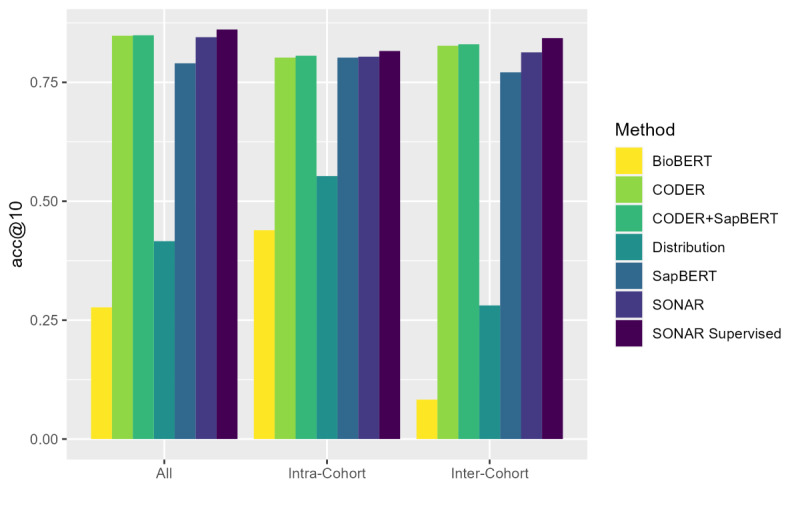
Results: The method was evaluated using manually curated gold standard labels from the 3 National Institutes of Health cohorts. We evaluated both the intracohort and intercohort variable harmonization performance. The supervised SONAR method outperformed existing benchmark methods for almost all intracohort and intercohort comparisons using area under the curve and top-k accuracy metrics. Notably, SONAR was able to significantly improve harmonization of concepts that were difficult for existing semantic methods to harmonize.
Conclusions: SONAR achieves accurate variable harmonization within and between cohort studies by harnessing the complementary strengths of semantic learning and variable distribution learning.
期刊介绍:
JMIR Medical Informatics (JMI, ISSN 2291-9694) is a top-rated, tier A journal which focuses on clinical informatics, big data in health and health care, decision support for health professionals, electronic health records, ehealth infrastructures and implementation. It has a focus on applied, translational research, with a broad readership including clinicians, CIOs, engineers, industry and health informatics professionals.
Published by JMIR Publications, publisher of the Journal of Medical Internet Research (JMIR), the leading eHealth/mHealth journal (Impact Factor 2016: 5.175), JMIR Med Inform has a slightly different scope (emphasizing more on applications for clinicians and health professionals rather than consumers/citizens, which is the focus of JMIR), publishes even faster, and also allows papers which are more technical or more formative than what would be published in the Journal of Medical Internet Research.







 京公网安备 11010802042870号
京ICP备2023020795号-1
京公网安备 11010802042870号
京ICP备2023020795号-1

 分享
分享
 求助内容:
求助内容: 应助结果提醒方式:
 扫码关注我们
