Muteb N Alotaibi, Ohood Y Alasmari, Omar E Elshaer, Ibrahim S Allehaimeed, Hajar A Alharbi, Amal A Alsubaiei, Abdullah M Alharran, Abdulmuhsen Alqallaf, Mohammed Alshammari, Abdullah Alhuwailah, Ahmed F AlFaleh
{"title":"加巴喷丁在腕管释放手术患者中的镇痛效果:随机安慰剂对照试验的系统回顾和荟萃分析。","authors":"Muteb N Alotaibi, Ohood Y Alasmari, Omar E Elshaer, Ibrahim S Allehaimeed, Hajar A Alharbi, Amal A Alsubaiei, Abdullah M Alharran, Abdulmuhsen Alqallaf, Mohammed Alshammari, Abdullah Alhuwailah, Ahmed F AlFaleh","doi":"10.7759/cureus.77808","DOIUrl":null,"url":null,"abstract":"<p><p>Carpal tunnel syndrome (CTS) results from median nerve compression and may lead to significant pain. Surgical management through release is the gold standard approach for severe CTS patients. Gabapentin is used as an analgesic drug, but data on its postoperative effects on pain assessment and safety measures are unclear. We aimed to assess the clinical effectiveness of gabapentin in patients undergoing CTS release surgery. We searched PubMed, Scopus, Web of Science (WOS), and the Cochrane Library for randomized controlled trials (RCTs) addressing the effectiveness of gabapentin in patients with CTS release until September 2024. The primary outcome was the assessment of postoperative pain at one, six, 12, and 24 hours by a visual analog scale (VAS). Other specific outcomes were adverse events. Data were pooled as effect sizes (mean difference (MD) or odds ratio (OR)) with their 95% confidence interval (CI) in a random-effects model using Stata/MP 18. Three RCTs comprising 205 patients were included in the pooled meta-analysis. Gabapentin significantly reduced postoperative pain at six, 12, and 24 hours compared to placebo (MD = -0.6, 95% CI: -0.63 to 0.57, p < 0.001; MD = -2.14, 95% CI: -2.18 to -2.1, p < 0.001; and MD = -1.41, 95% CI: -1.82 to -0.99, p < 0.001, respectively). On the other hand, no significant differences were observed regarding other studied outcomes (i.e., safety) between the two groups. This pooled meta-analysis of 205 patients revealed that gabapentin was associated with reduced pain postoperatively at 6, 12, and 24 hours with comparable rates of adverse events compared to placebo. Further RCTs are warranted to validate the current findings.</p>","PeriodicalId":93960,"journal":{"name":"Cureus","volume":"17 1","pages":"e77808"},"PeriodicalIF":1.3000,"publicationDate":"2025-01-22","publicationTypes":"Journal Article","fieldsOfStudy":null,"isOpenAccess":false,"openAccessPdf":"https://www.ncbi.nlm.nih.gov/pmc/articles/PMC11753192/pdf/","citationCount":"0","resultStr":"{\"title\":\"Analgesic Efficacy of Gabapentin in Patients Undergoing Carpal Tunnel Release Surgery: A Systematic Review and Meta-Analysis of Randomized Placebo-Controlled Trials.\",\"authors\":\"Muteb N Alotaibi, Ohood Y Alasmari, Omar E Elshaer, Ibrahim S Allehaimeed, Hajar A Alharbi, Amal A Alsubaiei, Abdullah M Alharran, Abdulmuhsen Alqallaf, Mohammed Alshammari, Abdullah Alhuwailah, Ahmed F AlFaleh\",\"doi\":\"10.7759/cureus.77808\",\"DOIUrl\":null,\"url\":null,\"abstract\":\"<p><p>Carpal tunnel syndrome (CTS) results from median nerve compression and may lead to significant pain. Surgical management through release is the gold standard approach for severe CTS patients. Gabapentin is used as an analgesic drug, but data on its postoperative effects on pain assessment and safety measures are unclear. We aimed to assess the clinical effectiveness of gabapentin in patients undergoing CTS release surgery. We searched PubMed, Scopus, Web of Science (WOS), and the Cochrane Library for randomized controlled trials (RCTs) addressing the effectiveness of gabapentin in patients with CTS release until September 2024. The primary outcome was the assessment of postoperative pain at one, six, 12, and 24 hours by a visual analog scale (VAS). Other specific outcomes were adverse events. Data were pooled as effect sizes (mean difference (MD) or odds ratio (OR)) with their 95% confidence interval (CI) in a random-effects model using Stata/MP 18. Three RCTs comprising 205 patients were included in the pooled meta-analysis. Gabapentin significantly reduced postoperative pain at six, 12, and 24 hours compared to placebo (MD = -0.6, 95% CI: -0.63 to 0.57, p < 0.001; MD = -2.14, 95% CI: -2.18 to -2.1, p < 0.001; and MD = -1.41, 95% CI: -1.82 to -0.99, p < 0.001, respectively). On the other hand, no significant differences were observed regarding other studied outcomes (i.e., safety) between the two groups. This pooled meta-analysis of 205 patients revealed that gabapentin was associated with reduced pain postoperatively at 6, 12, and 24 hours with comparable rates of adverse events compared to placebo. Further RCTs are warranted to validate the current findings.</p>\",\"PeriodicalId\":93960,\"journal\":{\"name\":\"Cureus\",\"volume\":\"17 1\",\"pages\":\"e77808\"},\"PeriodicalIF\":1.3000,\"publicationDate\":\"2025-01-22\",\"publicationTypes\":\"Journal Article\",\"fieldsOfStudy\":null,\"isOpenAccess\":false,\"openAccessPdf\":\"https://www.ncbi.nlm.nih.gov/pmc/articles/PMC11753192/pdf/\",\"citationCount\":\"0\",\"resultStr\":null,\"platform\":\"Semanticscholar\",\"paperid\":null,\"PeriodicalName\":\"Cureus\",\"FirstCategoryId\":\"1085\",\"ListUrlMain\":\"https://doi.org/10.7759/cureus.77808\",\"RegionNum\":0,\"RegionCategory\":null,\"ArticlePicture\":[],\"TitleCN\":null,\"AbstractTextCN\":null,\"PMCID\":null,\"EPubDate\":\"2025/1/1 0:00:00\",\"PubModel\":\"eCollection\",\"JCR\":\"Q3\",\"JCRName\":\"MEDICINE, GENERAL & INTERNAL\",\"Score\":null,\"Total\":0}","platform":"Semanticscholar","paperid":null,"PeriodicalName":"Cureus","FirstCategoryId":"1085","ListUrlMain":"https://doi.org/10.7759/cureus.77808","RegionNum":0,"RegionCategory":null,"ArticlePicture":[],"TitleCN":null,"AbstractTextCN":null,"PMCID":null,"EPubDate":"2025/1/1 0:00:00","PubModel":"eCollection","JCR":"Q3","JCRName":"MEDICINE, GENERAL & INTERNAL","Score":null,"Total":0}
引用次数: 0
摘要
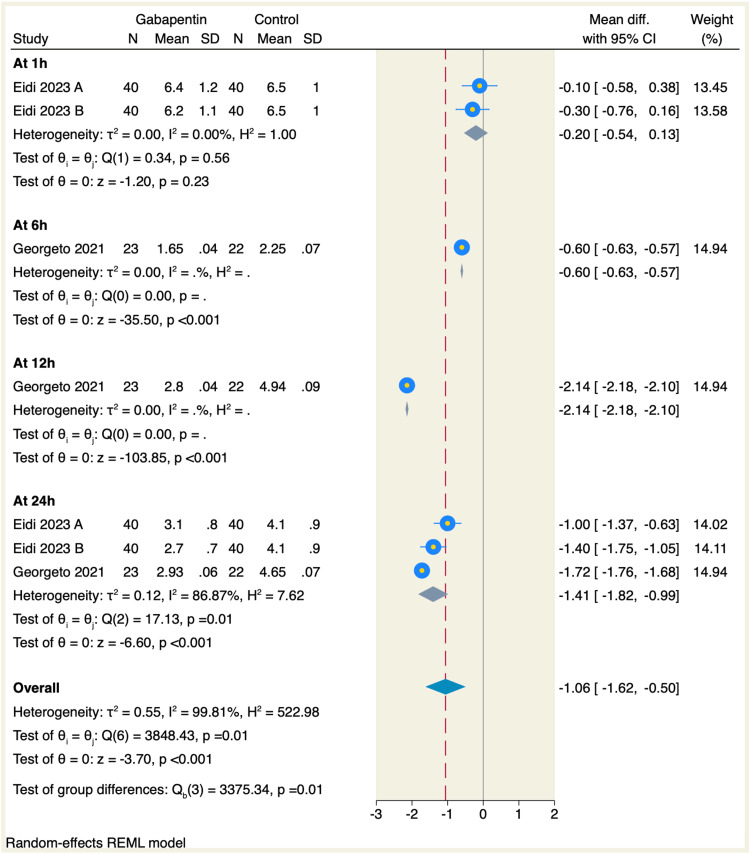
腕管综合征(CTS)是由正中神经压迫引起的,可能导致明显的疼痛。通过释放的外科治疗是严重CTS患者的金标准方法。加巴喷丁被用作镇痛药物,但其术后疼痛评估和安全措施的数据尚不清楚。我们的目的是评估加巴喷丁在接受CTS释放手术患者中的临床疗效。我们检索了PubMed、Scopus、Web of Science (WOS)和Cochrane图书馆,以寻找到2024年9月之前加巴喷丁对CTS释放患者有效性的随机对照试验(rct)。主要结果是通过视觉模拟评分(VAS)评估术后1、6、12和24小时的疼痛。其他具体结果为不良事件。使用Stata/ mp18的随机效应模型将数据合并为效应大小(平均差值(MD)或比值比(or))及其95%置信区间(CI)。合并荟萃分析纳入了3项随机对照试验,包括205例患者。与安慰剂相比,加巴喷丁显著减少了术后6、12和24小时的疼痛(MD = -0.6, 95% CI: -0.63 ~ 0.57, p < 0.001;MD = -2.14, 95% CI: -2.18 ~ -2.1, p < 0.001;MD = -1.41, 95% CI: -1.82 ~ -0.99, p < 0.001)。另一方面,在其他研究结果(即安全性)方面,两组之间没有观察到显著差异。这项对205例患者的荟萃分析显示,与安慰剂相比,加巴喷丁与术后6、12和24小时疼痛减轻相关,不良事件发生率相当。需要进一步的随机对照试验来验证当前的发现。
Analgesic Efficacy of Gabapentin in Patients Undergoing Carpal Tunnel Release Surgery: A Systematic Review and Meta-Analysis of Randomized Placebo-Controlled Trials.
Carpal tunnel syndrome (CTS) results from median nerve compression and may lead to significant pain. Surgical management through release is the gold standard approach for severe CTS patients. Gabapentin is used as an analgesic drug, but data on its postoperative effects on pain assessment and safety measures are unclear. We aimed to assess the clinical effectiveness of gabapentin in patients undergoing CTS release surgery. We searched PubMed, Scopus, Web of Science (WOS), and the Cochrane Library for randomized controlled trials (RCTs) addressing the effectiveness of gabapentin in patients with CTS release until September 2024. The primary outcome was the assessment of postoperative pain at one, six, 12, and 24 hours by a visual analog scale (VAS). Other specific outcomes were adverse events. Data were pooled as effect sizes (mean difference (MD) or odds ratio (OR)) with their 95% confidence interval (CI) in a random-effects model using Stata/MP 18. Three RCTs comprising 205 patients were included in the pooled meta-analysis. Gabapentin significantly reduced postoperative pain at six, 12, and 24 hours compared to placebo (MD = -0.6, 95% CI: -0.63 to 0.57, p < 0.001; MD = -2.14, 95% CI: -2.18 to -2.1, p < 0.001; and MD = -1.41, 95% CI: -1.82 to -0.99, p < 0.001, respectively). On the other hand, no significant differences were observed regarding other studied outcomes (i.e., safety) between the two groups. This pooled meta-analysis of 205 patients revealed that gabapentin was associated with reduced pain postoperatively at 6, 12, and 24 hours with comparable rates of adverse events compared to placebo. Further RCTs are warranted to validate the current findings.






 京公网安备 11010802042870号
京ICP备2023020795号-1
京公网安备 11010802042870号
京ICP备2023020795号-1

 分享
分享

 求助内容:
求助内容: 应助结果提醒方式:
 扫码关注我们
