{"title":"OXCT1琥珀酰化和sucl2激活促进酮解和肝脏肿瘤生长","authors":"Dong Guo, Qiujing Yu, Yingying Tong, Xu Qian, Ying Meng, Fei Ye, Xiaoming Jiang, Lihui Wu, Qingqing Yang, Suyao Li, Min Li, Qingang Wu, Liwei Xiao, Xuxiao He, Rongxuan Zhu, Guijun Liu, Dou Nie, Shudi Luo, Leina Ma, Ren-an Jin, Zhimin Lu","doi":"10.1016/j.molcel.2024.12.025","DOIUrl":null,"url":null,"abstract":"Ketone bodies generated in hepatocytes in the adult liver are used for nonhepatic tissues as an energy source. However, ketolysis is reactivated in hepatocellular carcinoma (HCC) cells with largely unelucidated mechanisms. Here, we demonstrate that 3-oxoacid CoA-transferase 1 (OXCT1), a rate-limiting enzyme in ketolysis, interacts with SUCLA2 upon IGF1 stimulation in HCC cells. This interaction results from ERK2-mediated SUCLA2 S124 phosphorylation and subsequent PIN1-mediated <em>cis-trans</em> isomerization of SUCLA2. OXCT1-associated SUCLA2 generates succinyl-CoA, which not only serves as a substrate for OXCT1 but also directly succinylates OXCT1 at K421 and activates OXCT1. SUCLA2-regulated OXCT1 activation substantially enhances ketolysis, HCC cell proliferation, and tumor growth in mice. Notably, treatment with acetohydroxamic acid, an OXCT1 inhibitor used clinically for urinary infection, inhibits liver tumor growth in mice and significantly enhances lenvatinib therapy. Our findings highlight the role of SUCLA2-coupled regulation of OXCT1 succinylation in ketolysis and unveil an unprecedented strategy for treating HCC by interrupting ketolysis.","PeriodicalId":18950,"journal":{"name":"Molecular Cell","volume":"110 1","pages":""},"PeriodicalIF":16.6000,"publicationDate":"2025-01-24","publicationTypes":"Journal Article","fieldsOfStudy":null,"isOpenAccess":false,"openAccessPdf":"","citationCount":"0","resultStr":"{\"title\":\"OXCT1 succinylation and activation by SUCLA2 promotes ketolysis and liver tumor growth\",\"authors\":\"Dong Guo, Qiujing Yu, Yingying Tong, Xu Qian, Ying Meng, Fei Ye, Xiaoming Jiang, Lihui Wu, Qingqing Yang, Suyao Li, Min Li, Qingang Wu, Liwei Xiao, Xuxiao He, Rongxuan Zhu, Guijun Liu, Dou Nie, Shudi Luo, Leina Ma, Ren-an Jin, Zhimin Lu\",\"doi\":\"10.1016/j.molcel.2024.12.025\",\"DOIUrl\":null,\"url\":null,\"abstract\":\"Ketone bodies generated in hepatocytes in the adult liver are used for nonhepatic tissues as an energy source. However, ketolysis is reactivated in hepatocellular carcinoma (HCC) cells with largely unelucidated mechanisms. Here, we demonstrate that 3-oxoacid CoA-transferase 1 (OXCT1), a rate-limiting enzyme in ketolysis, interacts with SUCLA2 upon IGF1 stimulation in HCC cells. This interaction results from ERK2-mediated SUCLA2 S124 phosphorylation and subsequent PIN1-mediated <em>cis-trans</em> isomerization of SUCLA2. OXCT1-associated SUCLA2 generates succinyl-CoA, which not only serves as a substrate for OXCT1 but also directly succinylates OXCT1 at K421 and activates OXCT1. SUCLA2-regulated OXCT1 activation substantially enhances ketolysis, HCC cell proliferation, and tumor growth in mice. Notably, treatment with acetohydroxamic acid, an OXCT1 inhibitor used clinically for urinary infection, inhibits liver tumor growth in mice and significantly enhances lenvatinib therapy. Our findings highlight the role of SUCLA2-coupled regulation of OXCT1 succinylation in ketolysis and unveil an unprecedented strategy for treating HCC by interrupting ketolysis.\",\"PeriodicalId\":18950,\"journal\":{\"name\":\"Molecular Cell\",\"volume\":\"110 1\",\"pages\":\"\"},\"PeriodicalIF\":16.6000,\"publicationDate\":\"2025-01-24\",\"publicationTypes\":\"Journal Article\",\"fieldsOfStudy\":null,\"isOpenAccess\":false,\"openAccessPdf\":\"\",\"citationCount\":\"0\",\"resultStr\":null,\"platform\":\"Semanticscholar\",\"paperid\":null,\"PeriodicalName\":\"Molecular Cell\",\"FirstCategoryId\":\"99\",\"ListUrlMain\":\"https://doi.org/10.1016/j.molcel.2024.12.025\",\"RegionNum\":1,\"RegionCategory\":\"生物学\",\"ArticlePicture\":[],\"TitleCN\":null,\"AbstractTextCN\":null,\"PMCID\":null,\"EPubDate\":\"\",\"PubModel\":\"\",\"JCR\":\"Q1\",\"JCRName\":\"BIOCHEMISTRY & MOLECULAR BIOLOGY\",\"Score\":null,\"Total\":0}","platform":"Semanticscholar","paperid":null,"PeriodicalName":"Molecular Cell","FirstCategoryId":"99","ListUrlMain":"https://doi.org/10.1016/j.molcel.2024.12.025","RegionNum":1,"RegionCategory":"生物学","ArticlePicture":[],"TitleCN":null,"AbstractTextCN":null,"PMCID":null,"EPubDate":"","PubModel":"","JCR":"Q1","JCRName":"BIOCHEMISTRY & MOLECULAR BIOLOGY","Score":null,"Total":0}
OXCT1 succinylation and activation by SUCLA2 promotes ketolysis and liver tumor growth
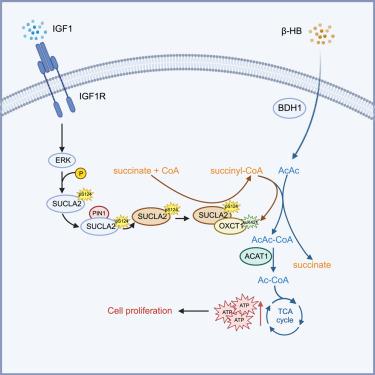
Ketone bodies generated in hepatocytes in the adult liver are used for nonhepatic tissues as an energy source. However, ketolysis is reactivated in hepatocellular carcinoma (HCC) cells with largely unelucidated mechanisms. Here, we demonstrate that 3-oxoacid CoA-transferase 1 (OXCT1), a rate-limiting enzyme in ketolysis, interacts with SUCLA2 upon IGF1 stimulation in HCC cells. This interaction results from ERK2-mediated SUCLA2 S124 phosphorylation and subsequent PIN1-mediated cis-trans isomerization of SUCLA2. OXCT1-associated SUCLA2 generates succinyl-CoA, which not only serves as a substrate for OXCT1 but also directly succinylates OXCT1 at K421 and activates OXCT1. SUCLA2-regulated OXCT1 activation substantially enhances ketolysis, HCC cell proliferation, and tumor growth in mice. Notably, treatment with acetohydroxamic acid, an OXCT1 inhibitor used clinically for urinary infection, inhibits liver tumor growth in mice and significantly enhances lenvatinib therapy. Our findings highlight the role of SUCLA2-coupled regulation of OXCT1 succinylation in ketolysis and unveil an unprecedented strategy for treating HCC by interrupting ketolysis.
期刊介绍:
Molecular Cell is a companion to Cell, the leading journal of biology and the highest-impact journal in the world. Launched in December 1997 and published monthly. Molecular Cell is dedicated to publishing cutting-edge research in molecular biology, focusing on fundamental cellular processes. The journal encompasses a wide range of topics, including DNA replication, recombination, and repair; Chromatin biology and genome organization; Transcription; RNA processing and decay; Non-coding RNA function; Translation; Protein folding, modification, and quality control; Signal transduction pathways; Cell cycle and checkpoints; Cell death; Autophagy; Metabolism.




 京公网安备 11010802042870号
京ICP备2023020795号-1
京公网安备 11010802042870号
京ICP备2023020795号-1

 分享
分享
 求助内容:
求助内容: 应助结果提醒方式:
 扫码关注我们
