Christian L. Vielhaus;Caspar von Lengerke;Vincent Latzko;Justus Rischke;Martin Reisslein;Frank H. P. Fitzek
{"title":"评估传输层拥塞控制算法:一个综合调查","authors":"Christian L. Vielhaus;Caspar von Lengerke;Vincent Latzko;Justus Rischke;Martin Reisslein;Frank H. P. Fitzek","doi":"10.1109/COMST.2025.3533303","DOIUrl":null,"url":null,"abstract":"Congestion Control (CC) limits the transmission rate of data packets in the transport layer protocol, e.g., in TCP and QUIC, of a sending endpoint so as to mitigate the congestion in packet-switched communication networks. Numerous studies have developed and evaluated Congestion Control Algorithms (CCAs) for a wide range of network types. Prior surveys have covered the functioning of the existing CCAs and their performance characteristics. In contrast, this survey focuses on the quantitative evaluation of CCAs; specifically, we comprehensively survey the CCA evaluation methodologies, i.e., the why and how of CCA evaluations. We define a CCA evaluation as a combination of a prescribed evaluation scenario with prescribed evaluation metrics. In turn, we define an evaluation scenario as a combination of a prescribed network (e.g., path) model and a particular traffic model. We present comprehensive sets of network and traffic model characteristics (i.e., network scenario characteristics) that can influence the performance of CCAs, as well as a comprehensive set of evaluation metrics for measuring the performance of CCAs. We taxonomize CCA evaluations into the main categories: Steady-state, transient-state, network variation, dynamic (e.g., wireless) network, and competition evaluations. We place and survey the existing CCA evaluation studies in this taxonomy to uncover the main trends and shortcomings of the CCA evaluation field to date. To facilitate the comprehensive rigorous evaluation of CCAs, we have developed the publicly available CCA evaluation framework ccperf, which incorporates the insights from our survey. We also outline future research directions to further advance the comprehensive rigorous evaluation of CCAs.","PeriodicalId":55029,"journal":{"name":"IEEE Communications Surveys and Tutorials","volume":"28 ","pages":"278-340"},"PeriodicalIF":50.6000,"publicationDate":"2026-01-01","publicationTypes":"Journal Article","fieldsOfStudy":null,"isOpenAccess":false,"openAccessPdf":"","citationCount":"0","resultStr":"{\"title\":\"Evaluating Transport Layer Congestion Control Algorithms: A Comprehensive Survey\",\"authors\":\"Christian L. Vielhaus;Caspar von Lengerke;Vincent Latzko;Justus Rischke;Martin Reisslein;Frank H. P. Fitzek\",\"doi\":\"10.1109/COMST.2025.3533303\",\"DOIUrl\":null,\"url\":null,\"abstract\":\"Congestion Control (CC) limits the transmission rate of data packets in the transport layer protocol, e.g., in TCP and QUIC, of a sending endpoint so as to mitigate the congestion in packet-switched communication networks. Numerous studies have developed and evaluated Congestion Control Algorithms (CCAs) for a wide range of network types. Prior surveys have covered the functioning of the existing CCAs and their performance characteristics. In contrast, this survey focuses on the quantitative evaluation of CCAs; specifically, we comprehensively survey the CCA evaluation methodologies, i.e., the why and how of CCA evaluations. We define a CCA evaluation as a combination of a prescribed evaluation scenario with prescribed evaluation metrics. In turn, we define an evaluation scenario as a combination of a prescribed network (e.g., path) model and a particular traffic model. We present comprehensive sets of network and traffic model characteristics (i.e., network scenario characteristics) that can influence the performance of CCAs, as well as a comprehensive set of evaluation metrics for measuring the performance of CCAs. We taxonomize CCA evaluations into the main categories: Steady-state, transient-state, network variation, dynamic (e.g., wireless) network, and competition evaluations. We place and survey the existing CCA evaluation studies in this taxonomy to uncover the main trends and shortcomings of the CCA evaluation field to date. To facilitate the comprehensive rigorous evaluation of CCAs, we have developed the publicly available CCA evaluation framework ccperf, which incorporates the insights from our survey. We also outline future research directions to further advance the comprehensive rigorous evaluation of CCAs.\",\"PeriodicalId\":55029,\"journal\":{\"name\":\"IEEE Communications Surveys and Tutorials\",\"volume\":\"28 \",\"pages\":\"278-340\"},\"PeriodicalIF\":50.6000,\"publicationDate\":\"2026-01-01\",\"publicationTypes\":\"Journal Article\",\"fieldsOfStudy\":null,\"isOpenAccess\":false,\"openAccessPdf\":\"\",\"citationCount\":\"0\",\"resultStr\":null,\"platform\":\"Semanticscholar\",\"paperid\":null,\"PeriodicalName\":\"IEEE Communications Surveys and Tutorials\",\"FirstCategoryId\":\"94\",\"ListUrlMain\":\"https://ieeexplore.ieee.org/document/10851263/\",\"RegionNum\":1,\"RegionCategory\":\"计算机科学\",\"ArticlePicture\":[],\"TitleCN\":null,\"AbstractTextCN\":null,\"PMCID\":null,\"EPubDate\":\"2025/1/23 0:00:00\",\"PubModel\":\"Epub\",\"JCR\":\"Q1\",\"JCRName\":\"COMPUTER SCIENCE, INFORMATION SYSTEMS\",\"Score\":null,\"Total\":0}","platform":"Semanticscholar","paperid":null,"PeriodicalName":"IEEE Communications Surveys and Tutorials","FirstCategoryId":"94","ListUrlMain":"https://ieeexplore.ieee.org/document/10851263/","RegionNum":1,"RegionCategory":"计算机科学","ArticlePicture":[],"TitleCN":null,"AbstractTextCN":null,"PMCID":null,"EPubDate":"2025/1/23 0:00:00","PubModel":"Epub","JCR":"Q1","JCRName":"COMPUTER SCIENCE, INFORMATION SYSTEMS","Score":null,"Total":0}
Evaluating Transport Layer Congestion Control Algorithms: A Comprehensive Survey
Congestion Control (CC) limits the transmission rate of data packets in the transport layer protocol, e.g., in TCP and QUIC, of a sending endpoint so as to mitigate the congestion in packet-switched communication networks. Numerous studies have developed and evaluated Congestion Control Algorithms (CCAs) for a wide range of network types. Prior surveys have covered the functioning of the existing CCAs and their performance characteristics. In contrast, this survey focuses on the quantitative evaluation of CCAs; specifically, we comprehensively survey the CCA evaluation methodologies, i.e., the why and how of CCA evaluations. We define a CCA evaluation as a combination of a prescribed evaluation scenario with prescribed evaluation metrics. In turn, we define an evaluation scenario as a combination of a prescribed network (e.g., path) model and a particular traffic model. We present comprehensive sets of network and traffic model characteristics (i.e., network scenario characteristics) that can influence the performance of CCAs, as well as a comprehensive set of evaluation metrics for measuring the performance of CCAs. We taxonomize CCA evaluations into the main categories: Steady-state, transient-state, network variation, dynamic (e.g., wireless) network, and competition evaluations. We place and survey the existing CCA evaluation studies in this taxonomy to uncover the main trends and shortcomings of the CCA evaluation field to date. To facilitate the comprehensive rigorous evaluation of CCAs, we have developed the publicly available CCA evaluation framework ccperf, which incorporates the insights from our survey. We also outline future research directions to further advance the comprehensive rigorous evaluation of CCAs.
期刊介绍:
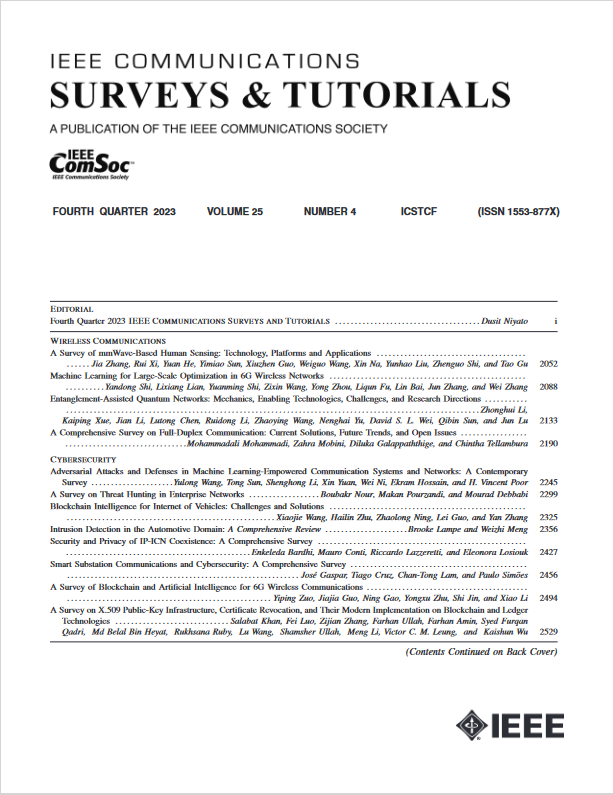
IEEE Communications Surveys & Tutorials is an online journal published by the IEEE Communications Society for tutorials and surveys covering all aspects of the communications field. Telecommunications technology is progressing at a rapid pace, and the IEEE Communications Society is committed to providing researchers and other professionals the information and tools to stay abreast. IEEE Communications Surveys and Tutorials focuses on integrating and adding understanding to the existing literature on communications, putting results in context. Whether searching for in-depth information about a familiar area or an introduction into a new area, IEEE Communications Surveys & Tutorials aims to be the premier source of peer-reviewed, comprehensive tutorials and surveys, and pointers to further sources. IEEE Communications Surveys & Tutorials publishes only articles exclusively written for IEEE Communications Surveys & Tutorials and go through a rigorous review process before their publication in the quarterly issues.
A tutorial article in the IEEE Communications Surveys & Tutorials should be designed to help the reader to become familiar with and learn something specific about a chosen topic. In contrast, the term survey, as applied here, is defined to mean a survey of the literature. A survey article in IEEE Communications Surveys & Tutorials should provide a comprehensive review of developments in a selected area, covering its development from its inception to its current state and beyond, and illustrating its development through liberal citations from the literature. Both tutorials and surveys should be tutorial in nature and should be written in a style comprehensible to readers outside the specialty of the article.




 京公网安备 11010802042870号
京ICP备2023020795号-1
京公网安备 11010802042870号
京ICP备2023020795号-1

 分享
分享
 求助内容:
求助内容: 应助结果提醒方式:
 扫码关注我们
