{"title":"新型肼基HDAC3抑制剂作为肿瘤免疫治疗的表观遗传免疫调节剂的发现","authors":"Zhiqiang Sun, Jinmei Cheng, Chenglong Xu, Xuewen Zhang, Qinru Zang, Xixiang Yang, Yueyu He, Aiqi Su, Xiaopeng Peng, Jianjun Chen","doi":"10.1021/acs.jmedchem.4c02296","DOIUrl":null,"url":null,"abstract":"Based on our previous work, a series of imidazole-based small molecules were designed and synthesized as HDAC3 inhibitors. Among them, compound <b>SC26</b> showed selective HDAC3 inhibition activity with an IC<sub>50</sub> of 53 nM (SI = 75 for HDAC3 over HDAC1). Further studies revealed that <b>SC26</b> could dose-dependently induce the expression of PD-L1 in MC38 cells by activating the PD-L1 transcription. <b>SC26</b> also showed high in vivo antitumor efficacy in a colorectal cancer model (50 mg/kg po, TGI = 63%). Importantly, the combination of <b>SC26</b> with the PD-L1 inhibitor <b>NP19</b> activated the immune system in tumor-bearing mice, enhancing the antitumor immune response (TGI = 80%, 50 + 50 mg/kg, p.o.). Collectively, we report for the first time that an HDAC3 inhibitor could upregulate PD-L1 expression in vitro and in vivo, specifically in MC38 cells and MC38-bearing tumors, and <b>SC26</b> represents a novel epigenetic immunomodulator with potential applications in tumor immunotherapy.","PeriodicalId":46,"journal":{"name":"Journal of Medicinal Chemistry","volume":"34 1","pages":""},"PeriodicalIF":6.8000,"publicationDate":"2025-01-23","publicationTypes":"Journal Article","fieldsOfStudy":null,"isOpenAccess":false,"openAccessPdf":"","citationCount":"0","resultStr":"{\"title\":\"Discovery of Novel Hydrazide-Based HDAC3 Inhibitors as Epigenetic Immunomodulators for Cancer Immunotherapy\",\"authors\":\"Zhiqiang Sun, Jinmei Cheng, Chenglong Xu, Xuewen Zhang, Qinru Zang, Xixiang Yang, Yueyu He, Aiqi Su, Xiaopeng Peng, Jianjun Chen\",\"doi\":\"10.1021/acs.jmedchem.4c02296\",\"DOIUrl\":null,\"url\":null,\"abstract\":\"Based on our previous work, a series of imidazole-based small molecules were designed and synthesized as HDAC3 inhibitors. Among them, compound <b>SC26</b> showed selective HDAC3 inhibition activity with an IC<sub>50</sub> of 53 nM (SI = 75 for HDAC3 over HDAC1). Further studies revealed that <b>SC26</b> could dose-dependently induce the expression of PD-L1 in MC38 cells by activating the PD-L1 transcription. <b>SC26</b> also showed high in vivo antitumor efficacy in a colorectal cancer model (50 mg/kg po, TGI = 63%). Importantly, the combination of <b>SC26</b> with the PD-L1 inhibitor <b>NP19</b> activated the immune system in tumor-bearing mice, enhancing the antitumor immune response (TGI = 80%, 50 + 50 mg/kg, p.o.). Collectively, we report for the first time that an HDAC3 inhibitor could upregulate PD-L1 expression in vitro and in vivo, specifically in MC38 cells and MC38-bearing tumors, and <b>SC26</b> represents a novel epigenetic immunomodulator with potential applications in tumor immunotherapy.\",\"PeriodicalId\":46,\"journal\":{\"name\":\"Journal of Medicinal Chemistry\",\"volume\":\"34 1\",\"pages\":\"\"},\"PeriodicalIF\":6.8000,\"publicationDate\":\"2025-01-23\",\"publicationTypes\":\"Journal Article\",\"fieldsOfStudy\":null,\"isOpenAccess\":false,\"openAccessPdf\":\"\",\"citationCount\":\"0\",\"resultStr\":null,\"platform\":\"Semanticscholar\",\"paperid\":null,\"PeriodicalName\":\"Journal of Medicinal Chemistry\",\"FirstCategoryId\":\"3\",\"ListUrlMain\":\"https://doi.org/10.1021/acs.jmedchem.4c02296\",\"RegionNum\":1,\"RegionCategory\":\"医学\",\"ArticlePicture\":[],\"TitleCN\":null,\"AbstractTextCN\":null,\"PMCID\":null,\"EPubDate\":\"\",\"PubModel\":\"\",\"JCR\":\"Q1\",\"JCRName\":\"CHEMISTRY, MEDICINAL\",\"Score\":null,\"Total\":0}","platform":"Semanticscholar","paperid":null,"PeriodicalName":"Journal of Medicinal Chemistry","FirstCategoryId":"3","ListUrlMain":"https://doi.org/10.1021/acs.jmedchem.4c02296","RegionNum":1,"RegionCategory":"医学","ArticlePicture":[],"TitleCN":null,"AbstractTextCN":null,"PMCID":null,"EPubDate":"","PubModel":"","JCR":"Q1","JCRName":"CHEMISTRY, MEDICINAL","Score":null,"Total":0}
Discovery of Novel Hydrazide-Based HDAC3 Inhibitors as Epigenetic Immunomodulators for Cancer Immunotherapy
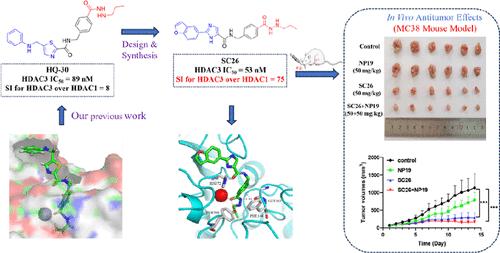
Based on our previous work, a series of imidazole-based small molecules were designed and synthesized as HDAC3 inhibitors. Among them, compound SC26 showed selective HDAC3 inhibition activity with an IC50 of 53 nM (SI = 75 for HDAC3 over HDAC1). Further studies revealed that SC26 could dose-dependently induce the expression of PD-L1 in MC38 cells by activating the PD-L1 transcription. SC26 also showed high in vivo antitumor efficacy in a colorectal cancer model (50 mg/kg po, TGI = 63%). Importantly, the combination of SC26 with the PD-L1 inhibitor NP19 activated the immune system in tumor-bearing mice, enhancing the antitumor immune response (TGI = 80%, 50 + 50 mg/kg, p.o.). Collectively, we report for the first time that an HDAC3 inhibitor could upregulate PD-L1 expression in vitro and in vivo, specifically in MC38 cells and MC38-bearing tumors, and SC26 represents a novel epigenetic immunomodulator with potential applications in tumor immunotherapy.
期刊介绍:
The Journal of Medicinal Chemistry is a prestigious biweekly peer-reviewed publication that focuses on the multifaceted field of medicinal chemistry. Since its inception in 1959 as the Journal of Medicinal and Pharmaceutical Chemistry, it has evolved to become a cornerstone in the dissemination of research findings related to the design, synthesis, and development of therapeutic agents.
The Journal of Medicinal Chemistry is recognized for its significant impact in the scientific community, as evidenced by its 2022 impact factor of 7.3. This metric reflects the journal's influence and the importance of its content in shaping the future of drug discovery and development. The journal serves as a vital resource for chemists, pharmacologists, and other researchers interested in the molecular mechanisms of drug action and the optimization of therapeutic compounds.




 京公网安备 11010802042870号
京ICP备2023020795号-1
京公网安备 11010802042870号
京ICP备2023020795号-1

 分享
分享
 求助内容:
求助内容: 应助结果提醒方式:
 扫码关注我们
