Liu Yang, Li Du, Yuanyuan Ge, Muhui Ou, Wanyan Huang, Xianmei Wang
{"title":"基于炎症和营养指标的AMI患者pci术后不良事件预后建模","authors":"Liu Yang, Li Du, Yuanyuan Ge, Muhui Ou, Wanyan Huang, Xianmei Wang","doi":"10.1186/s12872-025-04480-7","DOIUrl":null,"url":null,"abstract":"<p><strong>Objective: </strong>This study aimed to evaluate the predictive performance of inflammatory and nutritional indices for adverse cardiovascular events (ACE) in patients with acute myocardial infarction (AMI) after percutaneous coronary intervention (PCI) using a machine learning (ML) algorithm.</p><p><strong>Methods: </strong>AMI patients who underwent PCI were recruited and randomly divided into non/ACE groups. Inflammatory and nutritional indices were graded according to the laboratory examination reports. Logistic Regression was used to screen for factors that were significant for ML model establishment. The performances of the algorithms were evaluated in terms of accuracy, kappa, F1, receiver operating characteristic, precision recall curve, etc. RESULTS: Age, LVEF%, Killip Grade, heart rate, creatinine, albumin, neutrophil/lymphocyte ratio (NLR), platelet/lymphocyte ratio (PLR), and prognostic nutritional index (PNI) were significantly correlated with ACE by Logistic regression analysis (P < 0.05). These nine factors were employed to establish stepwise regression (SR), random forest (RF), naïve Bayes (NB), decision trees (DT), and artificial neutron network (ANN), whose performances were evaluated in terms of accuracy, kappa, F1, receiver operating characteristic, precision recall curve, etc. The accuracy of the decision tree was greater than that of other trees. The area under the curves was the highest in the ANN model compared with the other models.</p><p><strong>Conclusion: </strong>ANN predictive performance had an advantage over other ML algorithms based on age, LVEF%, Killip Grade, heart rate, creatinine, albumin, NLR, PLR, and PNI.</p>","PeriodicalId":9195,"journal":{"name":"BMC Cardiovascular Disorders","volume":"25 1","pages":"36"},"PeriodicalIF":2.3000,"publicationDate":"2025-01-23","publicationTypes":"Journal Article","fieldsOfStudy":null,"isOpenAccess":false,"openAccessPdf":"https://www.ncbi.nlm.nih.gov/pmc/articles/PMC11756209/pdf/","citationCount":"0","resultStr":"{\"title\":\"Prognosis modelling of adverse events for post-PCI treated AMI patients based on inflammation and nutrition indexes.\",\"authors\":\"Liu Yang, Li Du, Yuanyuan Ge, Muhui Ou, Wanyan Huang, Xianmei Wang\",\"doi\":\"10.1186/s12872-025-04480-7\",\"DOIUrl\":null,\"url\":null,\"abstract\":\"<p><strong>Objective: </strong>This study aimed to evaluate the predictive performance of inflammatory and nutritional indices for adverse cardiovascular events (ACE) in patients with acute myocardial infarction (AMI) after percutaneous coronary intervention (PCI) using a machine learning (ML) algorithm.</p><p><strong>Methods: </strong>AMI patients who underwent PCI were recruited and randomly divided into non/ACE groups. Inflammatory and nutritional indices were graded according to the laboratory examination reports. Logistic Regression was used to screen for factors that were significant for ML model establishment. The performances of the algorithms were evaluated in terms of accuracy, kappa, F1, receiver operating characteristic, precision recall curve, etc. RESULTS: Age, LVEF%, Killip Grade, heart rate, creatinine, albumin, neutrophil/lymphocyte ratio (NLR), platelet/lymphocyte ratio (PLR), and prognostic nutritional index (PNI) were significantly correlated with ACE by Logistic regression analysis (P < 0.05). These nine factors were employed to establish stepwise regression (SR), random forest (RF), naïve Bayes (NB), decision trees (DT), and artificial neutron network (ANN), whose performances were evaluated in terms of accuracy, kappa, F1, receiver operating characteristic, precision recall curve, etc. The accuracy of the decision tree was greater than that of other trees. The area under the curves was the highest in the ANN model compared with the other models.</p><p><strong>Conclusion: </strong>ANN predictive performance had an advantage over other ML algorithms based on age, LVEF%, Killip Grade, heart rate, creatinine, albumin, NLR, PLR, and PNI.</p>\",\"PeriodicalId\":9195,\"journal\":{\"name\":\"BMC Cardiovascular Disorders\",\"volume\":\"25 1\",\"pages\":\"36\"},\"PeriodicalIF\":2.3000,\"publicationDate\":\"2025-01-23\",\"publicationTypes\":\"Journal Article\",\"fieldsOfStudy\":null,\"isOpenAccess\":false,\"openAccessPdf\":\"https://www.ncbi.nlm.nih.gov/pmc/articles/PMC11756209/pdf/\",\"citationCount\":\"0\",\"resultStr\":null,\"platform\":\"Semanticscholar\",\"paperid\":null,\"PeriodicalName\":\"BMC Cardiovascular Disorders\",\"FirstCategoryId\":\"3\",\"ListUrlMain\":\"https://doi.org/10.1186/s12872-025-04480-7\",\"RegionNum\":3,\"RegionCategory\":\"医学\",\"ArticlePicture\":[],\"TitleCN\":null,\"AbstractTextCN\":null,\"PMCID\":null,\"EPubDate\":\"\",\"PubModel\":\"\",\"JCR\":\"Q3\",\"JCRName\":\"CARDIAC & CARDIOVASCULAR SYSTEMS\",\"Score\":null,\"Total\":0}","platform":"Semanticscholar","paperid":null,"PeriodicalName":"BMC Cardiovascular Disorders","FirstCategoryId":"3","ListUrlMain":"https://doi.org/10.1186/s12872-025-04480-7","RegionNum":3,"RegionCategory":"医学","ArticlePicture":[],"TitleCN":null,"AbstractTextCN":null,"PMCID":null,"EPubDate":"","PubModel":"","JCR":"Q3","JCRName":"CARDIAC & CARDIOVASCULAR SYSTEMS","Score":null,"Total":0}
Prognosis modelling of adverse events for post-PCI treated AMI patients based on inflammation and nutrition indexes.
Objective: This study aimed to evaluate the predictive performance of inflammatory and nutritional indices for adverse cardiovascular events (ACE) in patients with acute myocardial infarction (AMI) after percutaneous coronary intervention (PCI) using a machine learning (ML) algorithm.
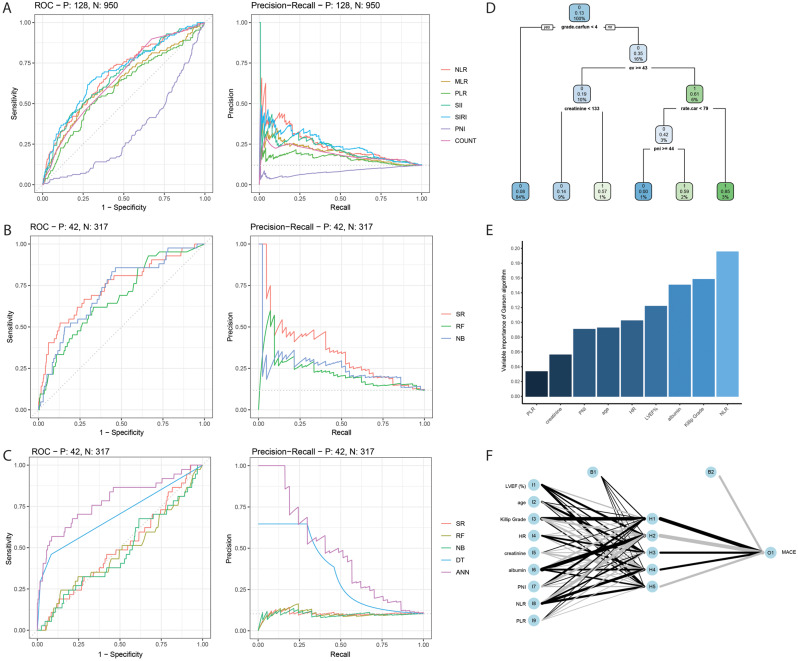
Methods: AMI patients who underwent PCI were recruited and randomly divided into non/ACE groups. Inflammatory and nutritional indices were graded according to the laboratory examination reports. Logistic Regression was used to screen for factors that were significant for ML model establishment. The performances of the algorithms were evaluated in terms of accuracy, kappa, F1, receiver operating characteristic, precision recall curve, etc. RESULTS: Age, LVEF%, Killip Grade, heart rate, creatinine, albumin, neutrophil/lymphocyte ratio (NLR), platelet/lymphocyte ratio (PLR), and prognostic nutritional index (PNI) were significantly correlated with ACE by Logistic regression analysis (P < 0.05). These nine factors were employed to establish stepwise regression (SR), random forest (RF), naïve Bayes (NB), decision trees (DT), and artificial neutron network (ANN), whose performances were evaluated in terms of accuracy, kappa, F1, receiver operating characteristic, precision recall curve, etc. The accuracy of the decision tree was greater than that of other trees. The area under the curves was the highest in the ANN model compared with the other models.
Conclusion: ANN predictive performance had an advantage over other ML algorithms based on age, LVEF%, Killip Grade, heart rate, creatinine, albumin, NLR, PLR, and PNI.
期刊介绍:
BMC Cardiovascular Disorders is an open access, peer-reviewed journal that considers articles on all aspects of the prevention, diagnosis and management of disorders of the heart and circulatory system, as well as related molecular and cell biology, genetics, pathophysiology, epidemiology, and controlled trials.





 京公网安备 11010802042870号
京ICP备2023020795号-1
京公网安备 11010802042870号
京ICP备2023020795号-1

 分享
分享
 求助内容:
求助内容: 应助结果提醒方式:
 扫码关注我们
