{"title":"甘油三酯-葡萄糖-腰围作为糖尿病的有效预测因子:利用日本队列研究的二次回顾性分析。","authors":"Yawei Li, Linlin Shan, Qiong Wen, Changchun Cao, Meiling Huang, Chunxia Zhang, Xiaoping Li, Kun Wang, Tianlun Zhou, Fubing Zha, Yulong Wang","doi":"10.1186/s12902-025-01834-2","DOIUrl":null,"url":null,"abstract":"<p><strong>Background and objective: </strong>While the connection between the Triglyceride glucose-waist circumference (TyG-WC) index and the risk of diabetes remains understudied, this particular research delves into the potential predictive value of the TyG-WC index within a significant Japanese population.</p><p><strong>Methods: </strong>This retrospective cohort study encompassed a comprehensive analysis of 15,413 Japanese adults, all of whom were diabetes-free at the outset of the study period from 2004 to 2015. Comprehensive medical records were obtained for all participants who underwent physical examinations. The study employed Cox proportional-hazards regression, smooth curve fitting, various sensitivity, and subgroup analyses to explore the association between TyG-WC and the development of diabetes. Furthermore, a Receiver Operating Characteristic (ROC) curve was created to detect the predictive capability of TyG-WC for diabetes risk.</p><p><strong>Results: </strong>After a maximum of 13.0 years of follow-up, 358 people finally developed diabetes. Upon adjusting for covariates, the result showed TyG-WC was positively and independently associated with incident Diabetes Mellitus (DM) (Hazard Ratio (HR): 1.004, 95%C: 1.001-1.006). Furthermore, ROC curve analysis demonstrated that TyG-WC outperformed both the triglycerides-glucose index and triglyceride glucose-body mass index in predicting the onset of diabetes.</p><p><strong>Conclusion: </strong>High levels of TyG-WC are autonomously linked to a heightened risk of diabetes in the Japanese demographic, indicating its potential as a dependable predictive indicator for diabetes mellitus in individuals at elevated risk.</p>","PeriodicalId":9152,"journal":{"name":"BMC Endocrine Disorders","volume":"25 1","pages":"17"},"PeriodicalIF":3.3000,"publicationDate":"2025-01-23","publicationTypes":"Journal Article","fieldsOfStudy":null,"isOpenAccess":false,"openAccessPdf":"https://www.ncbi.nlm.nih.gov/pmc/articles/PMC11755913/pdf/","citationCount":"0","resultStr":"{\"title\":\"Triglyceride glucose-waist circumference as a useful predictor for diabetes mellitus: a secondary retrospective analysis utilizing a Japanese cohort study.\",\"authors\":\"Yawei Li, Linlin Shan, Qiong Wen, Changchun Cao, Meiling Huang, Chunxia Zhang, Xiaoping Li, Kun Wang, Tianlun Zhou, Fubing Zha, Yulong Wang\",\"doi\":\"10.1186/s12902-025-01834-2\",\"DOIUrl\":null,\"url\":null,\"abstract\":\"<p><strong>Background and objective: </strong>While the connection between the Triglyceride glucose-waist circumference (TyG-WC) index and the risk of diabetes remains understudied, this particular research delves into the potential predictive value of the TyG-WC index within a significant Japanese population.</p><p><strong>Methods: </strong>This retrospective cohort study encompassed a comprehensive analysis of 15,413 Japanese adults, all of whom were diabetes-free at the outset of the study period from 2004 to 2015. Comprehensive medical records were obtained for all participants who underwent physical examinations. The study employed Cox proportional-hazards regression, smooth curve fitting, various sensitivity, and subgroup analyses to explore the association between TyG-WC and the development of diabetes. Furthermore, a Receiver Operating Characteristic (ROC) curve was created to detect the predictive capability of TyG-WC for diabetes risk.</p><p><strong>Results: </strong>After a maximum of 13.0 years of follow-up, 358 people finally developed diabetes. Upon adjusting for covariates, the result showed TyG-WC was positively and independently associated with incident Diabetes Mellitus (DM) (Hazard Ratio (HR): 1.004, 95%C: 1.001-1.006). Furthermore, ROC curve analysis demonstrated that TyG-WC outperformed both the triglycerides-glucose index and triglyceride glucose-body mass index in predicting the onset of diabetes.</p><p><strong>Conclusion: </strong>High levels of TyG-WC are autonomously linked to a heightened risk of diabetes in the Japanese demographic, indicating its potential as a dependable predictive indicator for diabetes mellitus in individuals at elevated risk.</p>\",\"PeriodicalId\":9152,\"journal\":{\"name\":\"BMC Endocrine Disorders\",\"volume\":\"25 1\",\"pages\":\"17\"},\"PeriodicalIF\":3.3000,\"publicationDate\":\"2025-01-23\",\"publicationTypes\":\"Journal Article\",\"fieldsOfStudy\":null,\"isOpenAccess\":false,\"openAccessPdf\":\"https://www.ncbi.nlm.nih.gov/pmc/articles/PMC11755913/pdf/\",\"citationCount\":\"0\",\"resultStr\":null,\"platform\":\"Semanticscholar\",\"paperid\":null,\"PeriodicalName\":\"BMC Endocrine Disorders\",\"FirstCategoryId\":\"3\",\"ListUrlMain\":\"https://doi.org/10.1186/s12902-025-01834-2\",\"RegionNum\":3,\"RegionCategory\":\"医学\",\"ArticlePicture\":[],\"TitleCN\":null,\"AbstractTextCN\":null,\"PMCID\":null,\"EPubDate\":\"\",\"PubModel\":\"\",\"JCR\":\"Q3\",\"JCRName\":\"ENDOCRINOLOGY & METABOLISM\",\"Score\":null,\"Total\":0}","platform":"Semanticscholar","paperid":null,"PeriodicalName":"BMC Endocrine Disorders","FirstCategoryId":"3","ListUrlMain":"https://doi.org/10.1186/s12902-025-01834-2","RegionNum":3,"RegionCategory":"医学","ArticlePicture":[],"TitleCN":null,"AbstractTextCN":null,"PMCID":null,"EPubDate":"","PubModel":"","JCR":"Q3","JCRName":"ENDOCRINOLOGY & METABOLISM","Score":null,"Total":0}
Triglyceride glucose-waist circumference as a useful predictor for diabetes mellitus: a secondary retrospective analysis utilizing a Japanese cohort study.
Background and objective: While the connection between the Triglyceride glucose-waist circumference (TyG-WC) index and the risk of diabetes remains understudied, this particular research delves into the potential predictive value of the TyG-WC index within a significant Japanese population.
Methods: This retrospective cohort study encompassed a comprehensive analysis of 15,413 Japanese adults, all of whom were diabetes-free at the outset of the study period from 2004 to 2015. Comprehensive medical records were obtained for all participants who underwent physical examinations. The study employed Cox proportional-hazards regression, smooth curve fitting, various sensitivity, and subgroup analyses to explore the association between TyG-WC and the development of diabetes. Furthermore, a Receiver Operating Characteristic (ROC) curve was created to detect the predictive capability of TyG-WC for diabetes risk.
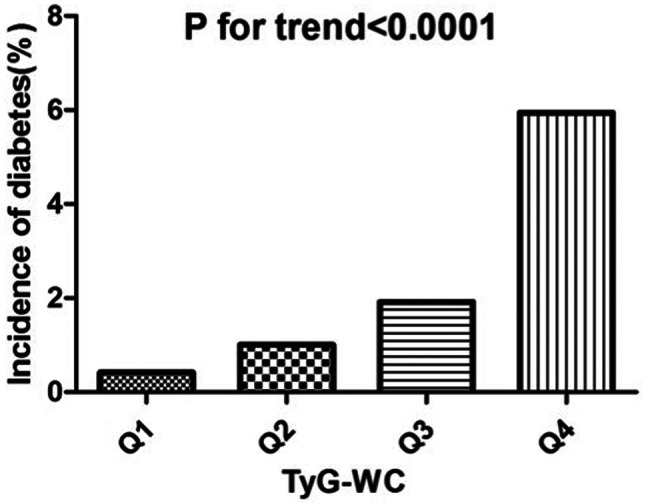
Results: After a maximum of 13.0 years of follow-up, 358 people finally developed diabetes. Upon adjusting for covariates, the result showed TyG-WC was positively and independently associated with incident Diabetes Mellitus (DM) (Hazard Ratio (HR): 1.004, 95%C: 1.001-1.006). Furthermore, ROC curve analysis demonstrated that TyG-WC outperformed both the triglycerides-glucose index and triglyceride glucose-body mass index in predicting the onset of diabetes.
Conclusion: High levels of TyG-WC are autonomously linked to a heightened risk of diabetes in the Japanese demographic, indicating its potential as a dependable predictive indicator for diabetes mellitus in individuals at elevated risk.
期刊介绍:
BMC Endocrine Disorders is an open access, peer-reviewed journal that considers articles on all aspects of the prevention, diagnosis and management of endocrine disorders, as well as related molecular genetics, pathophysiology, and epidemiology.





 京公网安备 11010802042870号
京ICP备2023020795号-1
京公网安备 11010802042870号
京ICP备2023020795号-1

 分享
分享
 求助内容:
求助内容: 应助结果提醒方式:
 扫码关注我们
