{"title":"抑郁是血液透析患者骨质疏松症的危险因素,独立于肌肉减少症:来自一项多中心横断面研究的结果","authors":"Xiaohua Hu, Xianwu Ye, Haimin Chen, Bibo Wu, Qi Guo, Chen Yu, Wei Ding, Jianying Niu, Junli Zhao, Hualin Qi, Suhua Zhang, Cheng Xue, Liming Zhang","doi":"10.1186/s12882-025-03963-1","DOIUrl":null,"url":null,"abstract":"<p><strong>Background: </strong>Osteoporosis and sarcopenia frequently occur in patients with end-stage renal disease undergoing hemodialysis (HD), and depression is also a common mental health issue in this population. Despite the prevalence of these conditions, the interrelationships among them remain poorly understood in HD patients.</p><p><strong>Methods: </strong>In this multicenter cross-sectional study, 858 HD patients from 7 dialysis centers were recruited. Bone mineral density (BMD) was assessed using dual-energy X-ray absorptiometry. Skeletal muscle mass index (SMI) was calculated from body composition data obtained through multifrequency bioimpedance analysis (BIA), while handgrip strength (HGS) was measured with a dynamometer. Gait speed was evaluated with a 4-meter walk test, and depression was assessed using the Patient Health Questionnaire-9 (PHQ-9).</p><p><strong>Results: </strong>Among the 858 participants (524 men, 334 women), 39.2% had osteoporosis. The prevalence of sarcopenia and depression was 18.9% and 42.1%, respectively. Logistic regression analysis showed that SMI was significantly associated with a decreased risk of osteoporosis (OR = 0.638, 95% CI = 0.494-0.823, P = 0.001), while HGS was not(OR = 0.990, 95% CI = 0.963-1.017, P = 0.449). HD patients with sarcopenia were 1.92 times more likely to have osteoporosis than those without sarcopenia. Most notably, after adjusting for both sarcopenia and SMI, the risk of osteoporosis in HD patients with depression was 1.45 times higher than in those without depression (OR = 1.452, 95% CI = 1.060-1.989, P = 0.020).</p><p><strong>Conclusions: </strong>In HD patients, increased muscle mass, rather than muscle strength, is linked to a lower risk of osteoporosis. Notably, depression emerges as a significant risk factor for osteoporosis in this population, highlighting the need for mental health considerations in managing bone health.</p>","PeriodicalId":9089,"journal":{"name":"BMC Nephrology","volume":"26 1","pages":"35"},"PeriodicalIF":2.9000,"publicationDate":"2025-01-23","publicationTypes":"Journal Article","fieldsOfStudy":null,"isOpenAccess":false,"openAccessPdf":"https://www.ncbi.nlm.nih.gov/pmc/articles/PMC11755883/pdf/","citationCount":"0","resultStr":"{\"title\":\"Depression as a risk factor for osteoporosis independent of sarcopenia in hemodialysis patients: findings from a multicenter cross-sectional study.\",\"authors\":\"Xiaohua Hu, Xianwu Ye, Haimin Chen, Bibo Wu, Qi Guo, Chen Yu, Wei Ding, Jianying Niu, Junli Zhao, Hualin Qi, Suhua Zhang, Cheng Xue, Liming Zhang\",\"doi\":\"10.1186/s12882-025-03963-1\",\"DOIUrl\":null,\"url\":null,\"abstract\":\"<p><strong>Background: </strong>Osteoporosis and sarcopenia frequently occur in patients with end-stage renal disease undergoing hemodialysis (HD), and depression is also a common mental health issue in this population. Despite the prevalence of these conditions, the interrelationships among them remain poorly understood in HD patients.</p><p><strong>Methods: </strong>In this multicenter cross-sectional study, 858 HD patients from 7 dialysis centers were recruited. Bone mineral density (BMD) was assessed using dual-energy X-ray absorptiometry. Skeletal muscle mass index (SMI) was calculated from body composition data obtained through multifrequency bioimpedance analysis (BIA), while handgrip strength (HGS) was measured with a dynamometer. Gait speed was evaluated with a 4-meter walk test, and depression was assessed using the Patient Health Questionnaire-9 (PHQ-9).</p><p><strong>Results: </strong>Among the 858 participants (524 men, 334 women), 39.2% had osteoporosis. The prevalence of sarcopenia and depression was 18.9% and 42.1%, respectively. Logistic regression analysis showed that SMI was significantly associated with a decreased risk of osteoporosis (OR = 0.638, 95% CI = 0.494-0.823, P = 0.001), while HGS was not(OR = 0.990, 95% CI = 0.963-1.017, P = 0.449). HD patients with sarcopenia were 1.92 times more likely to have osteoporosis than those without sarcopenia. Most notably, after adjusting for both sarcopenia and SMI, the risk of osteoporosis in HD patients with depression was 1.45 times higher than in those without depression (OR = 1.452, 95% CI = 1.060-1.989, P = 0.020).</p><p><strong>Conclusions: </strong>In HD patients, increased muscle mass, rather than muscle strength, is linked to a lower risk of osteoporosis. Notably, depression emerges as a significant risk factor for osteoporosis in this population, highlighting the need for mental health considerations in managing bone health.</p>\",\"PeriodicalId\":9089,\"journal\":{\"name\":\"BMC Nephrology\",\"volume\":\"26 1\",\"pages\":\"35\"},\"PeriodicalIF\":2.9000,\"publicationDate\":\"2025-01-23\",\"publicationTypes\":\"Journal Article\",\"fieldsOfStudy\":null,\"isOpenAccess\":false,\"openAccessPdf\":\"https://www.ncbi.nlm.nih.gov/pmc/articles/PMC11755883/pdf/\",\"citationCount\":\"0\",\"resultStr\":null,\"platform\":\"Semanticscholar\",\"paperid\":null,\"PeriodicalName\":\"BMC Nephrology\",\"FirstCategoryId\":\"3\",\"ListUrlMain\":\"https://doi.org/10.1186/s12882-025-03963-1\",\"RegionNum\":4,\"RegionCategory\":\"医学\",\"ArticlePicture\":[],\"TitleCN\":null,\"AbstractTextCN\":null,\"PMCID\":null,\"EPubDate\":\"\",\"PubModel\":\"\",\"JCR\":\"Q2\",\"JCRName\":\"UROLOGY & NEPHROLOGY\",\"Score\":null,\"Total\":0}","platform":"Semanticscholar","paperid":null,"PeriodicalName":"BMC Nephrology","FirstCategoryId":"3","ListUrlMain":"https://doi.org/10.1186/s12882-025-03963-1","RegionNum":4,"RegionCategory":"医学","ArticlePicture":[],"TitleCN":null,"AbstractTextCN":null,"PMCID":null,"EPubDate":"","PubModel":"","JCR":"Q2","JCRName":"UROLOGY & NEPHROLOGY","Score":null,"Total":0}
引用次数: 0
摘要
背景:骨质疏松症和肌肉减少症经常发生在接受血液透析(HD)的终末期肾脏疾病患者中,抑郁症也是这一人群中常见的心理健康问题。尽管这些疾病普遍存在,但它们之间的相互关系在HD患者中仍然知之甚少。方法:在这项多中心横断面研究中,从7个透析中心招募了858名HD患者。采用双能x线骨密度仪测定骨密度。通过多频生物阻抗分析(BIA)获得的身体成分数据计算骨骼肌质量指数(SMI),用测功机测量握力(HGS)。通过4米步行测试评估步态速度,并使用患者健康问卷-9 (PHQ-9)评估抑郁程度。结果:在858名参与者中(524名男性,334名女性),39.2%患有骨质疏松症。肌肉减少症和抑郁症的患病率分别为18.9%和42.1%。Logistic回归分析显示,重度抑郁与骨质疏松风险降低有显著相关性(OR = 0.638, 95% CI = 0.494 ~ 0.823, P = 0.001),而重度抑郁与骨质疏松风险降低无显著相关性(OR = 0.990, 95% CI = 0.963 ~ 1.017, P = 0.449)。伴有肌肉减少症的HD患者发生骨质疏松症的可能性是无肌肉减少症患者的1.92倍。最值得注意的是,在调整肌肉减少症和重度精神分裂症后,患有抑郁症的HD患者发生骨质疏松的风险是无抑郁症患者的1.45倍(OR = 1.452, 95% CI = 1.060-1.989, P = 0.020)。结论:在HD患者中,增加的肌肉质量,而不是肌肉力量,与骨质疏松症的风险降低有关。值得注意的是,抑郁症在这一人群中成为骨质疏松症的一个重要危险因素,这突出了在管理骨骼健康时考虑心理健康的必要性。
Depression as a risk factor for osteoporosis independent of sarcopenia in hemodialysis patients: findings from a multicenter cross-sectional study.
Background: Osteoporosis and sarcopenia frequently occur in patients with end-stage renal disease undergoing hemodialysis (HD), and depression is also a common mental health issue in this population. Despite the prevalence of these conditions, the interrelationships among them remain poorly understood in HD patients.
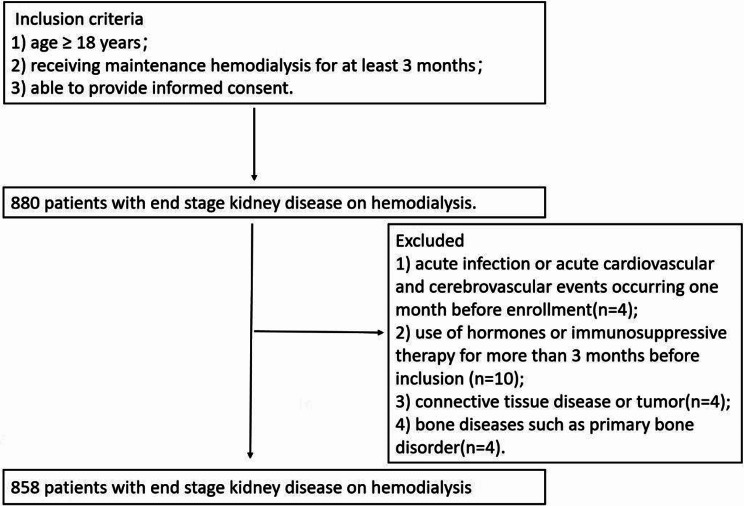
Methods: In this multicenter cross-sectional study, 858 HD patients from 7 dialysis centers were recruited. Bone mineral density (BMD) was assessed using dual-energy X-ray absorptiometry. Skeletal muscle mass index (SMI) was calculated from body composition data obtained through multifrequency bioimpedance analysis (BIA), while handgrip strength (HGS) was measured with a dynamometer. Gait speed was evaluated with a 4-meter walk test, and depression was assessed using the Patient Health Questionnaire-9 (PHQ-9).
Results: Among the 858 participants (524 men, 334 women), 39.2% had osteoporosis. The prevalence of sarcopenia and depression was 18.9% and 42.1%, respectively. Logistic regression analysis showed that SMI was significantly associated with a decreased risk of osteoporosis (OR = 0.638, 95% CI = 0.494-0.823, P = 0.001), while HGS was not(OR = 0.990, 95% CI = 0.963-1.017, P = 0.449). HD patients with sarcopenia were 1.92 times more likely to have osteoporosis than those without sarcopenia. Most notably, after adjusting for both sarcopenia and SMI, the risk of osteoporosis in HD patients with depression was 1.45 times higher than in those without depression (OR = 1.452, 95% CI = 1.060-1.989, P = 0.020).
Conclusions: In HD patients, increased muscle mass, rather than muscle strength, is linked to a lower risk of osteoporosis. Notably, depression emerges as a significant risk factor for osteoporosis in this population, highlighting the need for mental health considerations in managing bone health.
期刊介绍:
BMC Nephrology is an open access journal publishing original peer-reviewed research articles in all aspects of the prevention, diagnosis and management of kidney and associated disorders, as well as related molecular genetics, pathophysiology, and epidemiology.





 京公网安备 11010802042870号
京ICP备2023020795号-1
京公网安备 11010802042870号
京ICP备2023020795号-1

 分享
分享
 求助内容:
求助内容: 应助结果提醒方式:
 扫码关注我们
