Breanna J Mueller, Michael D Roberts, Christopher B Mobley, Robert L Judd, Andreas N Kavazis
{"title":"一氧化氮在运动生理学:过去和现在的观点。","authors":"Breanna J Mueller, Michael D Roberts, Christopher B Mobley, Robert L Judd, Andreas N Kavazis","doi":"10.3389/fphys.2024.1504978","DOIUrl":null,"url":null,"abstract":"<p><p>Nitric oxide (NO) is a ubiquitous signaling molecule known to modulate various physiological processes, with specific implications in skeletal muscle and broader applications in exercise performance. This review focuses on the modulation of skeletal muscle function, mitochondrial adaptation and function, redox state by NO, and the effect of nitrate supplementation on exercise performance. In skeletal muscle function, NO is believed to increase the maximal shortening velocity and peak power output of muscle fibers. However, its effect on submaximal contraction is still undetermined. In mitochondria, NO may stimulate biogenesis and affect respiratory efficiency. NO also plays a role in the redox state within the skeletal muscle, partially through its interaction with respiratory chain enzymes and transcriptional regulators of antioxidant production. Nitrate supplementation leads to an increased bioavailability of NO in skeletal muscle. Thus, nitrate supplementation has been investigated for its ability to impact performance outcomes in endurance and resistance exercise. The effect of nitrate supplementation on endurance exercise is currently indecisive, although evidence indicates that it may extend the time to exhaustion in endurance exercise. Alternatively, the effect of nitrate supplementation on resistance exercise performance has been less studied. Limited research indicates that nitrate supplementation may improve repetitions to failure. Further research is needed to investigate the influence of training status, age, sex, and duration of supplementation to further elucidate the impact of nitrate supplementation on exercise performance.</p>","PeriodicalId":12477,"journal":{"name":"Frontiers in Physiology","volume":"15 ","pages":"1504978"},"PeriodicalIF":3.2000,"publicationDate":"2025-01-09","publicationTypes":"Journal Article","fieldsOfStudy":null,"isOpenAccess":false,"openAccessPdf":"https://www.ncbi.nlm.nih.gov/pmc/articles/PMC11754211/pdf/","citationCount":"0","resultStr":"{\"title\":\"Nitric oxide in exercise physiology: past and present perspectives.\",\"authors\":\"Breanna J Mueller, Michael D Roberts, Christopher B Mobley, Robert L Judd, Andreas N Kavazis\",\"doi\":\"10.3389/fphys.2024.1504978\",\"DOIUrl\":null,\"url\":null,\"abstract\":\"<p><p>Nitric oxide (NO) is a ubiquitous signaling molecule known to modulate various physiological processes, with specific implications in skeletal muscle and broader applications in exercise performance. This review focuses on the modulation of skeletal muscle function, mitochondrial adaptation and function, redox state by NO, and the effect of nitrate supplementation on exercise performance. In skeletal muscle function, NO is believed to increase the maximal shortening velocity and peak power output of muscle fibers. However, its effect on submaximal contraction is still undetermined. In mitochondria, NO may stimulate biogenesis and affect respiratory efficiency. NO also plays a role in the redox state within the skeletal muscle, partially through its interaction with respiratory chain enzymes and transcriptional regulators of antioxidant production. Nitrate supplementation leads to an increased bioavailability of NO in skeletal muscle. Thus, nitrate supplementation has been investigated for its ability to impact performance outcomes in endurance and resistance exercise. The effect of nitrate supplementation on endurance exercise is currently indecisive, although evidence indicates that it may extend the time to exhaustion in endurance exercise. Alternatively, the effect of nitrate supplementation on resistance exercise performance has been less studied. Limited research indicates that nitrate supplementation may improve repetitions to failure. Further research is needed to investigate the influence of training status, age, sex, and duration of supplementation to further elucidate the impact of nitrate supplementation on exercise performance.</p>\",\"PeriodicalId\":12477,\"journal\":{\"name\":\"Frontiers in Physiology\",\"volume\":\"15 \",\"pages\":\"1504978\"},\"PeriodicalIF\":3.2000,\"publicationDate\":\"2025-01-09\",\"publicationTypes\":\"Journal Article\",\"fieldsOfStudy\":null,\"isOpenAccess\":false,\"openAccessPdf\":\"https://www.ncbi.nlm.nih.gov/pmc/articles/PMC11754211/pdf/\",\"citationCount\":\"0\",\"resultStr\":null,\"platform\":\"Semanticscholar\",\"paperid\":null,\"PeriodicalName\":\"Frontiers in Physiology\",\"FirstCategoryId\":\"3\",\"ListUrlMain\":\"https://doi.org/10.3389/fphys.2024.1504978\",\"RegionNum\":3,\"RegionCategory\":\"医学\",\"ArticlePicture\":[],\"TitleCN\":null,\"AbstractTextCN\":null,\"PMCID\":null,\"EPubDate\":\"2024/1/1 0:00:00\",\"PubModel\":\"eCollection\",\"JCR\":\"Q2\",\"JCRName\":\"PHYSIOLOGY\",\"Score\":null,\"Total\":0}","platform":"Semanticscholar","paperid":null,"PeriodicalName":"Frontiers in Physiology","FirstCategoryId":"3","ListUrlMain":"https://doi.org/10.3389/fphys.2024.1504978","RegionNum":3,"RegionCategory":"医学","ArticlePicture":[],"TitleCN":null,"AbstractTextCN":null,"PMCID":null,"EPubDate":"2024/1/1 0:00:00","PubModel":"eCollection","JCR":"Q2","JCRName":"PHYSIOLOGY","Score":null,"Total":0}
Nitric oxide in exercise physiology: past and present perspectives.
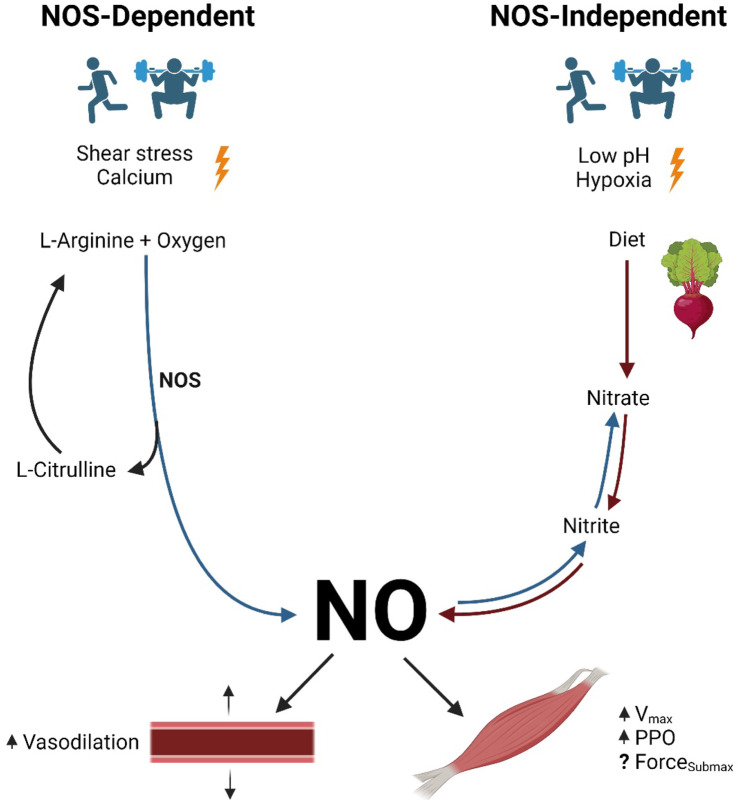
Nitric oxide (NO) is a ubiquitous signaling molecule known to modulate various physiological processes, with specific implications in skeletal muscle and broader applications in exercise performance. This review focuses on the modulation of skeletal muscle function, mitochondrial adaptation and function, redox state by NO, and the effect of nitrate supplementation on exercise performance. In skeletal muscle function, NO is believed to increase the maximal shortening velocity and peak power output of muscle fibers. However, its effect on submaximal contraction is still undetermined. In mitochondria, NO may stimulate biogenesis and affect respiratory efficiency. NO also plays a role in the redox state within the skeletal muscle, partially through its interaction with respiratory chain enzymes and transcriptional regulators of antioxidant production. Nitrate supplementation leads to an increased bioavailability of NO in skeletal muscle. Thus, nitrate supplementation has been investigated for its ability to impact performance outcomes in endurance and resistance exercise. The effect of nitrate supplementation on endurance exercise is currently indecisive, although evidence indicates that it may extend the time to exhaustion in endurance exercise. Alternatively, the effect of nitrate supplementation on resistance exercise performance has been less studied. Limited research indicates that nitrate supplementation may improve repetitions to failure. Further research is needed to investigate the influence of training status, age, sex, and duration of supplementation to further elucidate the impact of nitrate supplementation on exercise performance.
期刊介绍:
Frontiers in Physiology is a leading journal in its field, publishing rigorously peer-reviewed research on the physiology of living systems, from the subcellular and molecular domains to the intact organism, and its interaction with the environment. Field Chief Editor George E. Billman at the Ohio State University Columbus is supported by an outstanding Editorial Board of international researchers. This multidisciplinary open-access journal is at the forefront of disseminating and communicating scientific knowledge and impactful discoveries to researchers, academics, clinicians and the public worldwide.







 京公网安备 11010802042870号
京ICP备2023020795号-1
京公网安备 11010802042870号
京ICP备2023020795号-1

 分享
分享
 求助内容:
求助内容: 应助结果提醒方式:
 扫码关注我们
