Marco Montemurro , Michela Verni , Francesca Fanelli , Yaquin Wang , Henry N. Maina , Andrea Torreggiani , Emmi Lamminaho , Rossana Coda , Vincenzina Fusco , Carlo G. Rizzello
{"title":"beninensis LMG 25373T胞外多糖的分子特征及其在植物性食品生产中的技术性能","authors":"Marco Montemurro , Michela Verni , Francesca Fanelli , Yaquin Wang , Henry N. Maina , Andrea Torreggiani , Emmi Lamminaho , Rossana Coda , Vincenzina Fusco , Carlo G. Rizzello","doi":"10.1016/j.foodres.2024.115537","DOIUrl":null,"url":null,"abstract":"<div><div><em>Periweissella beninensis</em> LMG 25373<sup>T</sup>, belonging to the recently established <em>Periweissella</em> genus, exhibits unique motility and high adhesion capabilities, indicating significant probiotic potential, including resilience under simulated gastrointestinal conditions. This study demonstrates for the first time that <em>P. beninensis</em> LMG 25373^T produces a dextran-type exopolysaccharide (EPS) with a distinctive high degree of branching (approximately 71 % of α-(1 → 6)-linkages and 29 % α-(1 → 3)-linkages). Growth performance, acidification, and proteolytic activity were investigated in various plant-based substrates (lentil, chickpea, and rice flours water soluble extracts and semi-liquid mixtures), in comparison with the well-characterized lactic acid bacteria strains <em>Leuconostoc pseudomesenteroides</em> DSM 20193 (EPS-producing) and <em>Lacticaseibacillus rhamnosus</em> GG (probiotic).</div><div>The strain displayed effective pro-technological properties, especially in gelatinized and non-gelatinized legume-based substrates, achieving EPS synthesis levels of up to 1.3 g/100 g and 2.7 ± 0.2 g/100 g, respectively. When used as a starter for a plant-based yogurt-type (“gurt”) prototype, compared to the control, <em>P. beninensis</em> LMG 25373<sup>T</sup> produced a substantial increase in viscosity which remained stable during refrigerated storage, confirming the role of its unique structure pattern as a hydrocolloid. Furthermore, the strain demonstrated high viability throughout storage, an essential trait for probiotic food applications.</div></div>","PeriodicalId":323,"journal":{"name":"Food Research International","volume":"201 ","pages":"Article 115537"},"PeriodicalIF":8.0000,"publicationDate":"2025-02-01","publicationTypes":"Journal Article","fieldsOfStudy":null,"isOpenAccess":false,"openAccessPdf":"","citationCount":"0","resultStr":"{\"title\":\"Molecular characterization of exopolysaccharide from Periweissella beninensis LMG 25373T and technological properties in plant-based food production\",\"authors\":\"Marco Montemurro , Michela Verni , Francesca Fanelli , Yaquin Wang , Henry N. Maina , Andrea Torreggiani , Emmi Lamminaho , Rossana Coda , Vincenzina Fusco , Carlo G. Rizzello\",\"doi\":\"10.1016/j.foodres.2024.115537\",\"DOIUrl\":null,\"url\":null,\"abstract\":\"<div><div><em>Periweissella beninensis</em> LMG 25373<sup>T</sup>, belonging to the recently established <em>Periweissella</em> genus, exhibits unique motility and high adhesion capabilities, indicating significant probiotic potential, including resilience under simulated gastrointestinal conditions. This study demonstrates for the first time that <em>P. beninensis</em> LMG 25373^T produces a dextran-type exopolysaccharide (EPS) with a distinctive high degree of branching (approximately 71 % of α-(1 → 6)-linkages and 29 % α-(1 → 3)-linkages). Growth performance, acidification, and proteolytic activity were investigated in various plant-based substrates (lentil, chickpea, and rice flours water soluble extracts and semi-liquid mixtures), in comparison with the well-characterized lactic acid bacteria strains <em>Leuconostoc pseudomesenteroides</em> DSM 20193 (EPS-producing) and <em>Lacticaseibacillus rhamnosus</em> GG (probiotic).</div><div>The strain displayed effective pro-technological properties, especially in gelatinized and non-gelatinized legume-based substrates, achieving EPS synthesis levels of up to 1.3 g/100 g and 2.7 ± 0.2 g/100 g, respectively. When used as a starter for a plant-based yogurt-type (“gurt”) prototype, compared to the control, <em>P. beninensis</em> LMG 25373<sup>T</sup> produced a substantial increase in viscosity which remained stable during refrigerated storage, confirming the role of its unique structure pattern as a hydrocolloid. Furthermore, the strain demonstrated high viability throughout storage, an essential trait for probiotic food applications.</div></div>\",\"PeriodicalId\":323,\"journal\":{\"name\":\"Food Research International\",\"volume\":\"201 \",\"pages\":\"Article 115537\"},\"PeriodicalIF\":8.0000,\"publicationDate\":\"2025-02-01\",\"publicationTypes\":\"Journal Article\",\"fieldsOfStudy\":null,\"isOpenAccess\":false,\"openAccessPdf\":\"\",\"citationCount\":\"0\",\"resultStr\":null,\"platform\":\"Semanticscholar\",\"paperid\":null,\"PeriodicalName\":\"Food Research International\",\"FirstCategoryId\":\"97\",\"ListUrlMain\":\"https://www.sciencedirect.com/science/article/pii/S0963996924016089\",\"RegionNum\":1,\"RegionCategory\":\"农林科学\",\"ArticlePicture\":[],\"TitleCN\":null,\"AbstractTextCN\":null,\"PMCID\":null,\"EPubDate\":\"2024/12/30 0:00:00\",\"PubModel\":\"Epub\",\"JCR\":\"Q1\",\"JCRName\":\"FOOD SCIENCE & TECHNOLOGY\",\"Score\":null,\"Total\":0}","platform":"Semanticscholar","paperid":null,"PeriodicalName":"Food Research International","FirstCategoryId":"97","ListUrlMain":"https://www.sciencedirect.com/science/article/pii/S0963996924016089","RegionNum":1,"RegionCategory":"农林科学","ArticlePicture":[],"TitleCN":null,"AbstractTextCN":null,"PMCID":null,"EPubDate":"2024/12/30 0:00:00","PubModel":"Epub","JCR":"Q1","JCRName":"FOOD SCIENCE & TECHNOLOGY","Score":null,"Total":0}
Molecular characterization of exopolysaccharide from Periweissella beninensis LMG 25373T and technological properties in plant-based food production
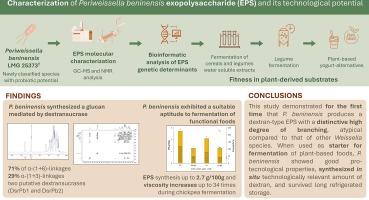
Periweissella beninensis LMG 25373T, belonging to the recently established Periweissella genus, exhibits unique motility and high adhesion capabilities, indicating significant probiotic potential, including resilience under simulated gastrointestinal conditions. This study demonstrates for the first time that P. beninensis LMG 25373^T produces a dextran-type exopolysaccharide (EPS) with a distinctive high degree of branching (approximately 71 % of α-(1 → 6)-linkages and 29 % α-(1 → 3)-linkages). Growth performance, acidification, and proteolytic activity were investigated in various plant-based substrates (lentil, chickpea, and rice flours water soluble extracts and semi-liquid mixtures), in comparison with the well-characterized lactic acid bacteria strains Leuconostoc pseudomesenteroides DSM 20193 (EPS-producing) and Lacticaseibacillus rhamnosus GG (probiotic).
The strain displayed effective pro-technological properties, especially in gelatinized and non-gelatinized legume-based substrates, achieving EPS synthesis levels of up to 1.3 g/100 g and 2.7 ± 0.2 g/100 g, respectively. When used as a starter for a plant-based yogurt-type (“gurt”) prototype, compared to the control, P. beninensis LMG 25373T produced a substantial increase in viscosity which remained stable during refrigerated storage, confirming the role of its unique structure pattern as a hydrocolloid. Furthermore, the strain demonstrated high viability throughout storage, an essential trait for probiotic food applications.
期刊介绍:
Food Research International serves as a rapid dissemination platform for significant and impactful research in food science, technology, engineering, and nutrition. The journal focuses on publishing novel, high-quality, and high-impact review papers, original research papers, and letters to the editors across various disciplines in the science and technology of food. Additionally, it follows a policy of publishing special issues on topical and emergent subjects in food research or related areas. Selected, peer-reviewed papers from scientific meetings, workshops, and conferences on the science, technology, and engineering of foods are also featured in special issues.




 京公网安备 11010802042870号
京ICP备2023020795号-1
京公网安备 11010802042870号
京ICP备2023020795号-1

 分享
分享
 求助内容:
求助内容: 应助结果提醒方式:
 扫码关注我们
