Peihong Yuan;Muriel Médard;Kevin Galligan;Ken R. Duffy
{"title":"软输出(SO) GRAND和迭代译码优于LDPC码","authors":"Peihong Yuan;Muriel Médard;Kevin Galligan;Ken R. Duffy","doi":"10.1109/TWC.2025.3530880","DOIUrl":null,"url":null,"abstract":"We establish that a large, flexible class of long, high redundancy error correcting codes can be efficiently and accurately decoded with guessing random additive noise decoding (GRAND). Performance evaluation demonstrates that it is possible to construct simple product codes with lengths of approximately 200 to 4000 bits and rates between 0.2 and 0.8 that outperform low-density parity-check (LDPC) codes from the 5G New Radio standard in both AWGN and fading channels. The concatenated structure enables many desirable features, including: low-complexity hardware-friendly encoding and decoding; significant flexibility in length and rate through modularity; and high levels of parallelism in encoding and decoding that enable low latency. Central is the development of a method through which any soft-input (SI) GRAND algorithm can provide soft-output (SO) in the form of an accurate a-posteriori estimate of the likelihood that a decoding is correct or, in the case of list decoding, the likelihood that each element of the list is correct. The distinguishing feature of soft-output GRAND (SOGRAND) is the provision of an estimate that the correct decoding has not been found, even when providing a single decoding. Per-block SO can be converted into accurate per-bit SO by a weighted sum that includes a term for the SI. Implementing SOGRAND adds negligible computation and memory to the existing decoding process, and using it results in a practical, low-latency alternative to LDPC codes.","PeriodicalId":13431,"journal":{"name":"IEEE Transactions on Wireless Communications","volume":"24 4","pages":"3386-3399"},"PeriodicalIF":10.3000,"publicationDate":"2025-01-24","publicationTypes":"Journal Article","fieldsOfStudy":null,"isOpenAccess":false,"openAccessPdf":"","citationCount":"0","resultStr":"{\"title\":\"Soft-Output (SO) GRAND and Iterative Decoding to Outperform LDPC Codes\",\"authors\":\"Peihong Yuan;Muriel Médard;Kevin Galligan;Ken R. Duffy\",\"doi\":\"10.1109/TWC.2025.3530880\",\"DOIUrl\":null,\"url\":null,\"abstract\":\"We establish that a large, flexible class of long, high redundancy error correcting codes can be efficiently and accurately decoded with guessing random additive noise decoding (GRAND). Performance evaluation demonstrates that it is possible to construct simple product codes with lengths of approximately 200 to 4000 bits and rates between 0.2 and 0.8 that outperform low-density parity-check (LDPC) codes from the 5G New Radio standard in both AWGN and fading channels. The concatenated structure enables many desirable features, including: low-complexity hardware-friendly encoding and decoding; significant flexibility in length and rate through modularity; and high levels of parallelism in encoding and decoding that enable low latency. Central is the development of a method through which any soft-input (SI) GRAND algorithm can provide soft-output (SO) in the form of an accurate a-posteriori estimate of the likelihood that a decoding is correct or, in the case of list decoding, the likelihood that each element of the list is correct. The distinguishing feature of soft-output GRAND (SOGRAND) is the provision of an estimate that the correct decoding has not been found, even when providing a single decoding. Per-block SO can be converted into accurate per-bit SO by a weighted sum that includes a term for the SI. Implementing SOGRAND adds negligible computation and memory to the existing decoding process, and using it results in a practical, low-latency alternative to LDPC codes.\",\"PeriodicalId\":13431,\"journal\":{\"name\":\"IEEE Transactions on Wireless Communications\",\"volume\":\"24 4\",\"pages\":\"3386-3399\"},\"PeriodicalIF\":10.3000,\"publicationDate\":\"2025-01-24\",\"publicationTypes\":\"Journal Article\",\"fieldsOfStudy\":null,\"isOpenAccess\":false,\"openAccessPdf\":\"\",\"citationCount\":\"0\",\"resultStr\":null,\"platform\":\"Semanticscholar\",\"paperid\":null,\"PeriodicalName\":\"IEEE Transactions on Wireless Communications\",\"FirstCategoryId\":\"94\",\"ListUrlMain\":\"https://ieeexplore.ieee.org/document/10852599/\",\"RegionNum\":1,\"RegionCategory\":\"计算机科学\",\"ArticlePicture\":[],\"TitleCN\":null,\"AbstractTextCN\":null,\"PMCID\":null,\"EPubDate\":\"\",\"PubModel\":\"\",\"JCR\":\"Q1\",\"JCRName\":\"ENGINEERING, ELECTRICAL & ELECTRONIC\",\"Score\":null,\"Total\":0}","platform":"Semanticscholar","paperid":null,"PeriodicalName":"IEEE Transactions on Wireless Communications","FirstCategoryId":"94","ListUrlMain":"https://ieeexplore.ieee.org/document/10852599/","RegionNum":1,"RegionCategory":"计算机科学","ArticlePicture":[],"TitleCN":null,"AbstractTextCN":null,"PMCID":null,"EPubDate":"","PubModel":"","JCR":"Q1","JCRName":"ENGINEERING, ELECTRICAL & ELECTRONIC","Score":null,"Total":0}
Soft-Output (SO) GRAND and Iterative Decoding to Outperform LDPC Codes
We establish that a large, flexible class of long, high redundancy error correcting codes can be efficiently and accurately decoded with guessing random additive noise decoding (GRAND). Performance evaluation demonstrates that it is possible to construct simple product codes with lengths of approximately 200 to 4000 bits and rates between 0.2 and 0.8 that outperform low-density parity-check (LDPC) codes from the 5G New Radio standard in both AWGN and fading channels. The concatenated structure enables many desirable features, including: low-complexity hardware-friendly encoding and decoding; significant flexibility in length and rate through modularity; and high levels of parallelism in encoding and decoding that enable low latency. Central is the development of a method through which any soft-input (SI) GRAND algorithm can provide soft-output (SO) in the form of an accurate a-posteriori estimate of the likelihood that a decoding is correct or, in the case of list decoding, the likelihood that each element of the list is correct. The distinguishing feature of soft-output GRAND (SOGRAND) is the provision of an estimate that the correct decoding has not been found, even when providing a single decoding. Per-block SO can be converted into accurate per-bit SO by a weighted sum that includes a term for the SI. Implementing SOGRAND adds negligible computation and memory to the existing decoding process, and using it results in a practical, low-latency alternative to LDPC codes.
期刊介绍:
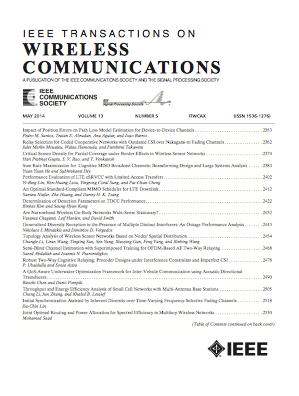
The IEEE Transactions on Wireless Communications is a prestigious publication that showcases cutting-edge advancements in wireless communications. It welcomes both theoretical and practical contributions in various areas. The scope of the Transactions encompasses a wide range of topics, including modulation and coding, detection and estimation, propagation and channel characterization, and diversity techniques. The journal also emphasizes the physical and link layer communication aspects of network architectures and protocols.
The journal is open to papers on specific topics or non-traditional topics related to specific application areas. This includes simulation tools and methodologies, orthogonal frequency division multiplexing, MIMO systems, and wireless over optical technologies.
Overall, the IEEE Transactions on Wireless Communications serves as a platform for high-quality manuscripts that push the boundaries of wireless communications and contribute to advancements in the field.




 京公网安备 11010802042870号
京ICP备2023020795号-1
京公网安备 11010802042870号
京ICP备2023020795号-1

 分享
分享
 求助内容:
求助内容: 应助结果提醒方式:
 扫码关注我们
