{"title":"具有聚集诱导发射的铜纳米团簇:一种治疗细菌感染伤口的有效光动力抗菌剂","authors":"Zhen Jiang, Yongqi Wei, Yun Wang, Songjie Han, Ze Li, Sihang Liu, Zihao Wang, Zhijun Li, Ting Feng, Haiguang Zhu and Xun Yuan","doi":"10.1039/D4NR04718D","DOIUrl":null,"url":null,"abstract":"<p >Designing antibacterial agents with broad-spectrum antibacterial effects and resistance-free properties is essential for treating bacteriainfected wounds. In this study, we present the design of copper nanoclusters (Cu NCs) that exhibit aggregation-induced emission (AIE). This was achieved by controlling the aggregation state of ligand layers (cysteine and chitosan) through the manipulation of pH and temperature. The AIE properties, characterized by strong photoluminescence (PL), a large Stokes shift, and microsecond-long lifetimes, enable these Cu NCs to generate significant amounts of reactive oxygen species (ROS) upon light illumination for efficient bacterial elimination without inducing drug resistance. As a result, they effectively inactivate various microbial pathogens, including Gram-negative and Gram-positive bacteria, as well as <em>Candida albicans</em> (<em>C. albicans</em>), achieving elimination rates of 99.52% for <em>Escherichia coli</em> (<em>E. coli</em>), 98.89% for <em>Staphylococcus aureus</em> (<em>S. aureus</em>), and 94.60% for <em>C. albicans in vitro</em>. Furthermore, the natural antibacterial properties of chitosan and Cu species enhance the photodynamic antibacterial efficacy of the AIE-typed Cu NCs. Importantly, <em>in vivo</em> experiments demonstrate that these Cu NCs can effectively eradicate bacteria at infection sites, reduce inflammation, and promote collagen synthesis, facilitating nearly 100% wound recovery in <em>S. aureus</em>-infected wounds within 9 days. The findings of this study are of considerable significance, providing a foundation for the application of AIE-typed Cu NCs in photodynamic nanotherapy for bacterial infections.</p>","PeriodicalId":92,"journal":{"name":"Nanoscale","volume":" 10","pages":" 5778-5787"},"PeriodicalIF":5.1000,"publicationDate":"2025-01-25","publicationTypes":"Journal Article","fieldsOfStudy":null,"isOpenAccess":false,"openAccessPdf":"","citationCount":"0","resultStr":"{\"title\":\"Copper nanoclusters with aggregation-induced emission: an effective photodynamic antibacterial agent for treating bacteria-infected wounds†\",\"authors\":\"Zhen Jiang, Yongqi Wei, Yun Wang, Songjie Han, Ze Li, Sihang Liu, Zihao Wang, Zhijun Li, Ting Feng, Haiguang Zhu and Xun Yuan\",\"doi\":\"10.1039/D4NR04718D\",\"DOIUrl\":null,\"url\":null,\"abstract\":\"<p >Designing antibacterial agents with broad-spectrum antibacterial effects and resistance-free properties is essential for treating bacteriainfected wounds. In this study, we present the design of copper nanoclusters (Cu NCs) that exhibit aggregation-induced emission (AIE). This was achieved by controlling the aggregation state of ligand layers (cysteine and chitosan) through the manipulation of pH and temperature. The AIE properties, characterized by strong photoluminescence (PL), a large Stokes shift, and microsecond-long lifetimes, enable these Cu NCs to generate significant amounts of reactive oxygen species (ROS) upon light illumination for efficient bacterial elimination without inducing drug resistance. As a result, they effectively inactivate various microbial pathogens, including Gram-negative and Gram-positive bacteria, as well as <em>Candida albicans</em> (<em>C. albicans</em>), achieving elimination rates of 99.52% for <em>Escherichia coli</em> (<em>E. coli</em>), 98.89% for <em>Staphylococcus aureus</em> (<em>S. aureus</em>), and 94.60% for <em>C. albicans in vitro</em>. Furthermore, the natural antibacterial properties of chitosan and Cu species enhance the photodynamic antibacterial efficacy of the AIE-typed Cu NCs. Importantly, <em>in vivo</em> experiments demonstrate that these Cu NCs can effectively eradicate bacteria at infection sites, reduce inflammation, and promote collagen synthesis, facilitating nearly 100% wound recovery in <em>S. aureus</em>-infected wounds within 9 days. The findings of this study are of considerable significance, providing a foundation for the application of AIE-typed Cu NCs in photodynamic nanotherapy for bacterial infections.</p>\",\"PeriodicalId\":92,\"journal\":{\"name\":\"Nanoscale\",\"volume\":\" 10\",\"pages\":\" 5778-5787\"},\"PeriodicalIF\":5.1000,\"publicationDate\":\"2025-01-25\",\"publicationTypes\":\"Journal Article\",\"fieldsOfStudy\":null,\"isOpenAccess\":false,\"openAccessPdf\":\"\",\"citationCount\":\"0\",\"resultStr\":null,\"platform\":\"Semanticscholar\",\"paperid\":null,\"PeriodicalName\":\"Nanoscale\",\"FirstCategoryId\":\"88\",\"ListUrlMain\":\"https://pubs.rsc.org/en/content/articlelanding/2025/nr/d4nr04718d\",\"RegionNum\":3,\"RegionCategory\":\"材料科学\",\"ArticlePicture\":[],\"TitleCN\":null,\"AbstractTextCN\":null,\"PMCID\":null,\"EPubDate\":\"\",\"PubModel\":\"\",\"JCR\":\"Q1\",\"JCRName\":\"CHEMISTRY, MULTIDISCIPLINARY\",\"Score\":null,\"Total\":0}","platform":"Semanticscholar","paperid":null,"PeriodicalName":"Nanoscale","FirstCategoryId":"88","ListUrlMain":"https://pubs.rsc.org/en/content/articlelanding/2025/nr/d4nr04718d","RegionNum":3,"RegionCategory":"材料科学","ArticlePicture":[],"TitleCN":null,"AbstractTextCN":null,"PMCID":null,"EPubDate":"","PubModel":"","JCR":"Q1","JCRName":"CHEMISTRY, MULTIDISCIPLINARY","Score":null,"Total":0}
Copper nanoclusters with aggregation-induced emission: an effective photodynamic antibacterial agent for treating bacteria-infected wounds†
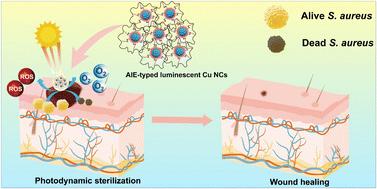
Designing antibacterial agents with broad-spectrum antibacterial effects and resistance-free properties is essential for treating bacteriainfected wounds. In this study, we present the design of copper nanoclusters (Cu NCs) that exhibit aggregation-induced emission (AIE). This was achieved by controlling the aggregation state of ligand layers (cysteine and chitosan) through the manipulation of pH and temperature. The AIE properties, characterized by strong photoluminescence (PL), a large Stokes shift, and microsecond-long lifetimes, enable these Cu NCs to generate significant amounts of reactive oxygen species (ROS) upon light illumination for efficient bacterial elimination without inducing drug resistance. As a result, they effectively inactivate various microbial pathogens, including Gram-negative and Gram-positive bacteria, as well as Candida albicans (C. albicans), achieving elimination rates of 99.52% for Escherichia coli (E. coli), 98.89% for Staphylococcus aureus (S. aureus), and 94.60% for C. albicans in vitro. Furthermore, the natural antibacterial properties of chitosan and Cu species enhance the photodynamic antibacterial efficacy of the AIE-typed Cu NCs. Importantly, in vivo experiments demonstrate that these Cu NCs can effectively eradicate bacteria at infection sites, reduce inflammation, and promote collagen synthesis, facilitating nearly 100% wound recovery in S. aureus-infected wounds within 9 days. The findings of this study are of considerable significance, providing a foundation for the application of AIE-typed Cu NCs in photodynamic nanotherapy for bacterial infections.
期刊介绍:
Nanoscale is a high-impact international journal, publishing high-quality research across nanoscience and nanotechnology. Nanoscale publishes a full mix of research articles on experimental and theoretical work, including reviews, communications, and full papers.Highly interdisciplinary, this journal appeals to scientists, researchers and professionals interested in nanoscience and nanotechnology, quantum materials and quantum technology, including the areas of physics, chemistry, biology, medicine, materials, energy/environment, information technology, detection science, healthcare and drug discovery, and electronics.




 京公网安备 11010802042870号
京ICP备2023020795号-1
京公网安备 11010802042870号
京ICP备2023020795号-1

 分享
分享
 求助内容:
求助内容: 应助结果提醒方式:
 扫码关注我们
