Axel Leblanc, Chotivut Tangchingchai, Zahra Sadre Momtaz, Elyjah Kiyooka, Jean-Michel Hartmann, Frédéric Gustavo, Jean-Luc Thomassin, Boris Brun, Vivien Schmitt, Simon Zihlmann, Romain Maurand, Étienne Dumur, Silvano De Franceschi, François Lefloch
{"title":"具有平面ge结的栅极和磁通可调谐sin(2φ) Josephson元件","authors":"Axel Leblanc, Chotivut Tangchingchai, Zahra Sadre Momtaz, Elyjah Kiyooka, Jean-Michel Hartmann, Frédéric Gustavo, Jean-Luc Thomassin, Boris Brun, Vivien Schmitt, Simon Zihlmann, Romain Maurand, Étienne Dumur, Silvano De Franceschi, François Lefloch","doi":"10.1038/s41467-025-56245-7","DOIUrl":null,"url":null,"abstract":"<p>Hybrid superconductor-semiconductor Josephson field-effect transistors (JoFETs) function as Josephson junctions with gate-tunable critical current. Additionally, they can feature a non-sinusoidal current-phase relation (CPR) containing multiple harmonics of the superconducting phase difference, a so-far underutilized property. Here we exploit this multi-harmonicity to create a Josephson circuit element with an almost perfectly <i>π</i>-periodic CPR, indicative of a largely dominant charge-4e supercurrent transport. We realize such a Josephson element, recently proposed as building block of a protected superconducting qubit, using a superconducting quantum interference device (SQUID) with low-inductance aluminum arms and two nominally identical JoFETs. The latter are fabricated from a SiGe/Ge/SiGe quantum-well heterostructure embedding a high-mobility two-dimensional hole gas. By carefully adjusting the JoFET gate voltages and finely tuning the magnetic flux through the SQUID close to half a flux quantum, we achieve a regime where the <span>\\(\\sin (2\\varphi )\\)</span> component accounts for more than 95% of the total supercurrent. This result demonstrates a new promising route towards parity-protected superconducting qubits.</p>","PeriodicalId":19066,"journal":{"name":"Nature Communications","volume":"34 1","pages":""},"PeriodicalIF":15.7000,"publicationDate":"2025-01-25","publicationTypes":"Journal Article","fieldsOfStudy":null,"isOpenAccess":false,"openAccessPdf":"","citationCount":"0","resultStr":"{\"title\":\"Gate- and flux-tunable sin(2φ) Josephson element with planar-Ge junctions\",\"authors\":\"Axel Leblanc, Chotivut Tangchingchai, Zahra Sadre Momtaz, Elyjah Kiyooka, Jean-Michel Hartmann, Frédéric Gustavo, Jean-Luc Thomassin, Boris Brun, Vivien Schmitt, Simon Zihlmann, Romain Maurand, Étienne Dumur, Silvano De Franceschi, François Lefloch\",\"doi\":\"10.1038/s41467-025-56245-7\",\"DOIUrl\":null,\"url\":null,\"abstract\":\"<p>Hybrid superconductor-semiconductor Josephson field-effect transistors (JoFETs) function as Josephson junctions with gate-tunable critical current. Additionally, they can feature a non-sinusoidal current-phase relation (CPR) containing multiple harmonics of the superconducting phase difference, a so-far underutilized property. Here we exploit this multi-harmonicity to create a Josephson circuit element with an almost perfectly <i>π</i>-periodic CPR, indicative of a largely dominant charge-4e supercurrent transport. We realize such a Josephson element, recently proposed as building block of a protected superconducting qubit, using a superconducting quantum interference device (SQUID) with low-inductance aluminum arms and two nominally identical JoFETs. The latter are fabricated from a SiGe/Ge/SiGe quantum-well heterostructure embedding a high-mobility two-dimensional hole gas. By carefully adjusting the JoFET gate voltages and finely tuning the magnetic flux through the SQUID close to half a flux quantum, we achieve a regime where the <span>\\\\(\\\\sin (2\\\\varphi )\\\\)</span> component accounts for more than 95% of the total supercurrent. This result demonstrates a new promising route towards parity-protected superconducting qubits.</p>\",\"PeriodicalId\":19066,\"journal\":{\"name\":\"Nature Communications\",\"volume\":\"34 1\",\"pages\":\"\"},\"PeriodicalIF\":15.7000,\"publicationDate\":\"2025-01-25\",\"publicationTypes\":\"Journal Article\",\"fieldsOfStudy\":null,\"isOpenAccess\":false,\"openAccessPdf\":\"\",\"citationCount\":\"0\",\"resultStr\":null,\"platform\":\"Semanticscholar\",\"paperid\":null,\"PeriodicalName\":\"Nature Communications\",\"FirstCategoryId\":\"103\",\"ListUrlMain\":\"https://doi.org/10.1038/s41467-025-56245-7\",\"RegionNum\":1,\"RegionCategory\":\"综合性期刊\",\"ArticlePicture\":[],\"TitleCN\":null,\"AbstractTextCN\":null,\"PMCID\":null,\"EPubDate\":\"\",\"PubModel\":\"\",\"JCR\":\"Q1\",\"JCRName\":\"MULTIDISCIPLINARY SCIENCES\",\"Score\":null,\"Total\":0}","platform":"Semanticscholar","paperid":null,"PeriodicalName":"Nature Communications","FirstCategoryId":"103","ListUrlMain":"https://doi.org/10.1038/s41467-025-56245-7","RegionNum":1,"RegionCategory":"综合性期刊","ArticlePicture":[],"TitleCN":null,"AbstractTextCN":null,"PMCID":null,"EPubDate":"","PubModel":"","JCR":"Q1","JCRName":"MULTIDISCIPLINARY SCIENCES","Score":null,"Total":0}
引用次数: 0
摘要
混合超导体半导体约瑟夫森场效应晶体管(jofet)是具有门可调临界电流的约瑟夫森结。此外,它们可以具有非正弦电流-相位关系(CPR),其中包含超导相位差的多个谐波,这是迄今为止未充分利用的特性。在这里,我们利用这种多谐性创造了一个约瑟夫森电路元件,具有几乎完美的π周期CPR,表明在很大程度上占主导地位的电荷-4e超电流输运。我们使用具有低电感铝臂和两个名义上相同的jofet的超导量子干涉器件(SQUID)实现了这样一个约瑟夫森元件,最近被提议作为受保护超导量子比特的构建块。后者由嵌入高迁移率二维空穴气体的SiGe/Ge/SiGe量子阱异质结构制备而成。通过仔细调整JoFET栅极电压,并通过SQUID精细调节接近半个通量量子的磁通量,我们实现了\(\sin (2\varphi )\)分量占95以上的状态% of the total supercurrent. This result demonstrates a new promising route towards parity-protected superconducting qubits.
Gate- and flux-tunable sin(2φ) Josephson element with planar-Ge junctions
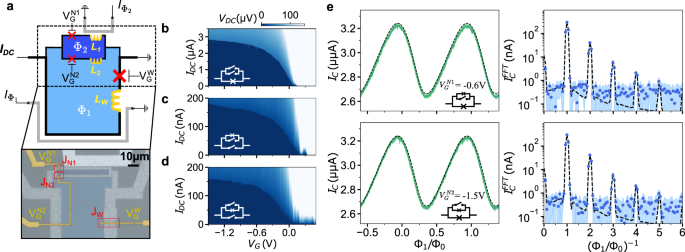
Hybrid superconductor-semiconductor Josephson field-effect transistors (JoFETs) function as Josephson junctions with gate-tunable critical current. Additionally, they can feature a non-sinusoidal current-phase relation (CPR) containing multiple harmonics of the superconducting phase difference, a so-far underutilized property. Here we exploit this multi-harmonicity to create a Josephson circuit element with an almost perfectly π-periodic CPR, indicative of a largely dominant charge-4e supercurrent transport. We realize such a Josephson element, recently proposed as building block of a protected superconducting qubit, using a superconducting quantum interference device (SQUID) with low-inductance aluminum arms and two nominally identical JoFETs. The latter are fabricated from a SiGe/Ge/SiGe quantum-well heterostructure embedding a high-mobility two-dimensional hole gas. By carefully adjusting the JoFET gate voltages and finely tuning the magnetic flux through the SQUID close to half a flux quantum, we achieve a regime where the \(\sin (2\varphi )\) component accounts for more than 95% of the total supercurrent. This result demonstrates a new promising route towards parity-protected superconducting qubits.
期刊介绍:
Nature Communications, an open-access journal, publishes high-quality research spanning all areas of the natural sciences. Papers featured in the journal showcase significant advances relevant to specialists in each respective field. With a 2-year impact factor of 16.6 (2022) and a median time of 8 days from submission to the first editorial decision, Nature Communications is committed to rapid dissemination of research findings. As a multidisciplinary journal, it welcomes contributions from biological, health, physical, chemical, Earth, social, mathematical, applied, and engineering sciences, aiming to highlight important breakthroughs within each domain.





 京公网安备 11010802042870号
京ICP备2023020795号-1
京公网安备 11010802042870号
京ICP备2023020795号-1

 分享
分享
 求助内容:
求助内容: 应助结果提醒方式:
 扫码关注我们
