Keitaro Ohashi, Kosei Nishimura, Kaito Nagita, Takuya Hashimoto, Shoko Nakahata, Takashi Harada, Toshiaki Ina, Prof. Dr. Shuji Nakanishi, Prof. Dr. Kazuhide Kamiya
{"title":"CO还原反应中由单个铜原子衍生的电化学生长铜纳米团簇的尺寸依赖性。","authors":"Keitaro Ohashi, Kosei Nishimura, Kaito Nagita, Takuya Hashimoto, Shoko Nakahata, Takashi Harada, Toshiaki Ina, Prof. Dr. Shuji Nakanishi, Prof. Dr. Kazuhide Kamiya","doi":"10.1002/cssc.202402576","DOIUrl":null,"url":null,"abstract":"<p>Electrochemically grown copper nanoclusters (CuNCs: <3 nm) from single-atom catalysts have recently attracted intensive attention as electrocatalysts for CO<sub>2</sub> and CO reduction reaction (CO<sub>2</sub>RR/CORR) because they exhibit distinct product selectivity compared with conventional Cu nanoparticles (typically larger than 10nm). Herein, we conducted a detailed investigation into the size dependence of CuNCs on selectivity for multicarbon (C<sub>2+</sub>) production in CORR. These nanoclusters were electrochemically grown from single Cu atoms dispersed on covalent triazine frameworks (Cu-CTFs). <i>Operando</i> X-ray absorption fine structure analysis revealed that Cu-CTFs containing 1.21 wt % and 0.41 wt % Cu (Cu(h)-CTFs and Cu(l)-CTFs, respectively) formed CuNCs of 2.0 and 1.1 nm, respectively, at −1.0 V <i>vs</i>. RHE. The selectivity for CORR products was particularly dependent on the size of CuNCs, with the Faraday efficiencies of C<sub>2+</sub> products being 52.3 % and 32.7 % at −1.0 V <i>vs</i>. RHE with Cu(h)-CTFs and Cu(l)-CTFs, respectively. Spherical CuNCs modeling revealed that larger cluster sizes led to a greater proportion of a surface coordination number (SCN) of 8 or 9. Density functional calculations revealed that the CO dimerization reaction was more likely to proceed at SCNs of 8 or 9 compared to SCN of 7 because of the stability of the *OCCO intermediate.</p>","PeriodicalId":149,"journal":{"name":"ChemSusChem","volume":"18 10","pages":""},"PeriodicalIF":6.6000,"publicationDate":"2025-01-24","publicationTypes":"Journal Article","fieldsOfStudy":null,"isOpenAccess":false,"openAccessPdf":"https://onlinelibrary.wiley.com/doi/epdf/10.1002/cssc.202402576","citationCount":"0","resultStr":"{\"title\":\"Size-Dependency of Electrochemically Grown Copper Nanoclusters Derived from Single Copper Atoms for the CO Reduction Reaction\",\"authors\":\"Keitaro Ohashi, Kosei Nishimura, Kaito Nagita, Takuya Hashimoto, Shoko Nakahata, Takashi Harada, Toshiaki Ina, Prof. Dr. Shuji Nakanishi, Prof. Dr. Kazuhide Kamiya\",\"doi\":\"10.1002/cssc.202402576\",\"DOIUrl\":null,\"url\":null,\"abstract\":\"<p>Electrochemically grown copper nanoclusters (CuNCs: <3 nm) from single-atom catalysts have recently attracted intensive attention as electrocatalysts for CO<sub>2</sub> and CO reduction reaction (CO<sub>2</sub>RR/CORR) because they exhibit distinct product selectivity compared with conventional Cu nanoparticles (typically larger than 10nm). Herein, we conducted a detailed investigation into the size dependence of CuNCs on selectivity for multicarbon (C<sub>2+</sub>) production in CORR. These nanoclusters were electrochemically grown from single Cu atoms dispersed on covalent triazine frameworks (Cu-CTFs). <i>Operando</i> X-ray absorption fine structure analysis revealed that Cu-CTFs containing 1.21 wt % and 0.41 wt % Cu (Cu(h)-CTFs and Cu(l)-CTFs, respectively) formed CuNCs of 2.0 and 1.1 nm, respectively, at −1.0 V <i>vs</i>. RHE. The selectivity for CORR products was particularly dependent on the size of CuNCs, with the Faraday efficiencies of C<sub>2+</sub> products being 52.3 % and 32.7 % at −1.0 V <i>vs</i>. RHE with Cu(h)-CTFs and Cu(l)-CTFs, respectively. Spherical CuNCs modeling revealed that larger cluster sizes led to a greater proportion of a surface coordination number (SCN) of 8 or 9. Density functional calculations revealed that the CO dimerization reaction was more likely to proceed at SCNs of 8 or 9 compared to SCN of 7 because of the stability of the *OCCO intermediate.</p>\",\"PeriodicalId\":149,\"journal\":{\"name\":\"ChemSusChem\",\"volume\":\"18 10\",\"pages\":\"\"},\"PeriodicalIF\":6.6000,\"publicationDate\":\"2025-01-24\",\"publicationTypes\":\"Journal Article\",\"fieldsOfStudy\":null,\"isOpenAccess\":false,\"openAccessPdf\":\"https://onlinelibrary.wiley.com/doi/epdf/10.1002/cssc.202402576\",\"citationCount\":\"0\",\"resultStr\":null,\"platform\":\"Semanticscholar\",\"paperid\":null,\"PeriodicalName\":\"ChemSusChem\",\"FirstCategoryId\":\"92\",\"ListUrlMain\":\"https://chemistry-europe.onlinelibrary.wiley.com/doi/10.1002/cssc.202402576\",\"RegionNum\":2,\"RegionCategory\":\"化学\",\"ArticlePicture\":[],\"TitleCN\":null,\"AbstractTextCN\":null,\"PMCID\":null,\"EPubDate\":\"\",\"PubModel\":\"\",\"JCR\":\"Q1\",\"JCRName\":\"CHEMISTRY, MULTIDISCIPLINARY\",\"Score\":null,\"Total\":0}","platform":"Semanticscholar","paperid":null,"PeriodicalName":"ChemSusChem","FirstCategoryId":"92","ListUrlMain":"https://chemistry-europe.onlinelibrary.wiley.com/doi/10.1002/cssc.202402576","RegionNum":2,"RegionCategory":"化学","ArticlePicture":[],"TitleCN":null,"AbstractTextCN":null,"PMCID":null,"EPubDate":"","PubModel":"","JCR":"Q1","JCRName":"CHEMISTRY, MULTIDISCIPLINARY","Score":null,"Total":0}
引用次数: 0
摘要
与传统的铜纳米颗粒(通常大于10 nm)相比,电化学生长的铜纳米团簇(Cu: < 3 nm)作为CO2和CO还原反应(CO2RR/CORR)的电催化剂,近年来引起了人们的广泛关注。在此,我们详细研究了cnc的尺寸对CORR中产生多碳(C2+)选择性的依赖性。这些纳米簇是由分散在共价三嗪框架(Cu- ctfs)上的单个Cu原子电化学生长而成的。Operando x射线吸收精细结构分析表明,Cu-CTFs (Cu(h)-CTFs和Cu(l)-CTFs)的Cu含量分别为1.21 wt%和0.41 wt%,在-1.0 V vs. RHE下形成的Cu cs分别为2.0 nm和1.1 nm。与Cu(h)-CTFs和Cu(l)-CTFs相比,在-1.0 V下,C2+产物的法拉第效率分别为52.3%和32.7%。球形孔细胞模型表明,簇大小越大,表面配位数(SCN)为8或9的比例越大。密度泛函计算表明,由于*OCCO中间体的稳定性,在SCN为8或9时,CO二聚化反应比SCN为7时更容易进行。
Size-Dependency of Electrochemically Grown Copper Nanoclusters Derived from Single Copper Atoms for the CO Reduction Reaction
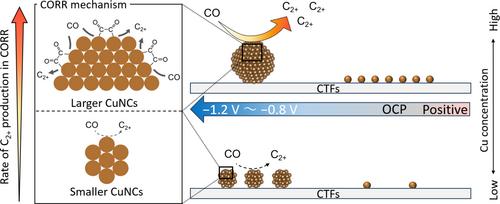
Electrochemically grown copper nanoclusters (CuNCs: <3 nm) from single-atom catalysts have recently attracted intensive attention as electrocatalysts for CO2 and CO reduction reaction (CO2RR/CORR) because they exhibit distinct product selectivity compared with conventional Cu nanoparticles (typically larger than 10nm). Herein, we conducted a detailed investigation into the size dependence of CuNCs on selectivity for multicarbon (C2+) production in CORR. These nanoclusters were electrochemically grown from single Cu atoms dispersed on covalent triazine frameworks (Cu-CTFs). Operando X-ray absorption fine structure analysis revealed that Cu-CTFs containing 1.21 wt % and 0.41 wt % Cu (Cu(h)-CTFs and Cu(l)-CTFs, respectively) formed CuNCs of 2.0 and 1.1 nm, respectively, at −1.0 V vs. RHE. The selectivity for CORR products was particularly dependent on the size of CuNCs, with the Faraday efficiencies of C2+ products being 52.3 % and 32.7 % at −1.0 V vs. RHE with Cu(h)-CTFs and Cu(l)-CTFs, respectively. Spherical CuNCs modeling revealed that larger cluster sizes led to a greater proportion of a surface coordination number (SCN) of 8 or 9. Density functional calculations revealed that the CO dimerization reaction was more likely to proceed at SCNs of 8 or 9 compared to SCN of 7 because of the stability of the *OCCO intermediate.
期刊介绍:
ChemSusChem
Impact Factor (2016): 7.226
Scope:
Interdisciplinary journal
Focuses on research at the interface of chemistry and sustainability
Features the best research on sustainability and energy
Areas Covered:
Chemistry
Materials Science
Chemical Engineering
Biotechnology







 京公网安备 11010802042870号
京ICP备2023020795号-1
京公网安备 11010802042870号
京ICP备2023020795号-1

 分享
分享
 求助内容:
求助内容: 应助结果提醒方式:
 扫码关注我们
