Mónica Grande-Alonso, Manuel Estradera-Bel, Carlos Forner-Álvarez, Ferran Cuenca-Martínez, Celia Vidal-Quevedo, Alba Paris-Alemany, Roy La Touche
{"title":"动作观察速度对慢性腰痛患者运动功能的影响:从观察到执行。","authors":"Mónica Grande-Alonso, Manuel Estradera-Bel, Carlos Forner-Álvarez, Ferran Cuenca-Martínez, Celia Vidal-Quevedo, Alba Paris-Alemany, Roy La Touche","doi":"10.3390/brainsci15010031","DOIUrl":null,"url":null,"abstract":"<p><strong>Objective: </strong>The objective of this study was to examine the effect of observing actions at different speeds on the speed of motor task performance in subsequent actions.</p><p><strong>Methods: </strong>Sixty individuals, divided equally between those with non-specific chronic low back pain (NSCLBP) and asymptomatic subjects, were enrolled. Participants were further split into subgroups to observe lumbar flexion and Timed Up and Go (TUG) test actions at either a slow or fast pace, following a randomized assignment. For post-video observation, participants replicated the observed actions three times without specific performance instructions, allowing for the assessment of their execution speed.</p><p><strong>Results: </strong>The analysis revealed that individuals observing actions at a faster pace executed the subsequent motor tasks significantly quicker than their counterparts who viewed the same actions at a slower speed. This was consistent across both NSCLBP sufferers and asymptomatic subjects, indicating that the action observation (AO) speed directly influenced the execution speeds of lumbar flexion and TUG test movements.</p><p><strong>Conclusions: </strong>The findings demonstrate that AO speed significantly affects the pace of motor execution, irrespective of NSCLBP presence. This underscores the potential of utilizing varied AO speeds as a strategic component in clinical practice, particularly for enhancing motor planning and execution in physical therapy settings. The study highlights the importance of incorporating AO speed variations into therapeutic interventions for improving patient outcomes in motor task performance.</p>","PeriodicalId":9095,"journal":{"name":"Brain Sciences","volume":"15 1","pages":""},"PeriodicalIF":2.8000,"publicationDate":"2024-12-30","publicationTypes":"Journal Article","fieldsOfStudy":null,"isOpenAccess":false,"openAccessPdf":"https://www.ncbi.nlm.nih.gov/pmc/articles/PMC11764160/pdf/","citationCount":"0","resultStr":"{\"title\":\"The Effects of Action Observation Speed on Motor Function in Patients with Chronic Low Back Pain: From Observation to Execution.\",\"authors\":\"Mónica Grande-Alonso, Manuel Estradera-Bel, Carlos Forner-Álvarez, Ferran Cuenca-Martínez, Celia Vidal-Quevedo, Alba Paris-Alemany, Roy La Touche\",\"doi\":\"10.3390/brainsci15010031\",\"DOIUrl\":null,\"url\":null,\"abstract\":\"<p><strong>Objective: </strong>The objective of this study was to examine the effect of observing actions at different speeds on the speed of motor task performance in subsequent actions.</p><p><strong>Methods: </strong>Sixty individuals, divided equally between those with non-specific chronic low back pain (NSCLBP) and asymptomatic subjects, were enrolled. Participants were further split into subgroups to observe lumbar flexion and Timed Up and Go (TUG) test actions at either a slow or fast pace, following a randomized assignment. For post-video observation, participants replicated the observed actions three times without specific performance instructions, allowing for the assessment of their execution speed.</p><p><strong>Results: </strong>The analysis revealed that individuals observing actions at a faster pace executed the subsequent motor tasks significantly quicker than their counterparts who viewed the same actions at a slower speed. This was consistent across both NSCLBP sufferers and asymptomatic subjects, indicating that the action observation (AO) speed directly influenced the execution speeds of lumbar flexion and TUG test movements.</p><p><strong>Conclusions: </strong>The findings demonstrate that AO speed significantly affects the pace of motor execution, irrespective of NSCLBP presence. This underscores the potential of utilizing varied AO speeds as a strategic component in clinical practice, particularly for enhancing motor planning and execution in physical therapy settings. The study highlights the importance of incorporating AO speed variations into therapeutic interventions for improving patient outcomes in motor task performance.</p>\",\"PeriodicalId\":9095,\"journal\":{\"name\":\"Brain Sciences\",\"volume\":\"15 1\",\"pages\":\"\"},\"PeriodicalIF\":2.8000,\"publicationDate\":\"2024-12-30\",\"publicationTypes\":\"Journal Article\",\"fieldsOfStudy\":null,\"isOpenAccess\":false,\"openAccessPdf\":\"https://www.ncbi.nlm.nih.gov/pmc/articles/PMC11764160/pdf/\",\"citationCount\":\"0\",\"resultStr\":null,\"platform\":\"Semanticscholar\",\"paperid\":null,\"PeriodicalName\":\"Brain Sciences\",\"FirstCategoryId\":\"3\",\"ListUrlMain\":\"https://doi.org/10.3390/brainsci15010031\",\"RegionNum\":3,\"RegionCategory\":\"医学\",\"ArticlePicture\":[],\"TitleCN\":null,\"AbstractTextCN\":null,\"PMCID\":null,\"EPubDate\":\"\",\"PubModel\":\"\",\"JCR\":\"Q3\",\"JCRName\":\"NEUROSCIENCES\",\"Score\":null,\"Total\":0}","platform":"Semanticscholar","paperid":null,"PeriodicalName":"Brain Sciences","FirstCategoryId":"3","ListUrlMain":"https://doi.org/10.3390/brainsci15010031","RegionNum":3,"RegionCategory":"医学","ArticlePicture":[],"TitleCN":null,"AbstractTextCN":null,"PMCID":null,"EPubDate":"","PubModel":"","JCR":"Q3","JCRName":"NEUROSCIENCES","Score":null,"Total":0}
The Effects of Action Observation Speed on Motor Function in Patients with Chronic Low Back Pain: From Observation to Execution.
Objective: The objective of this study was to examine the effect of observing actions at different speeds on the speed of motor task performance in subsequent actions.
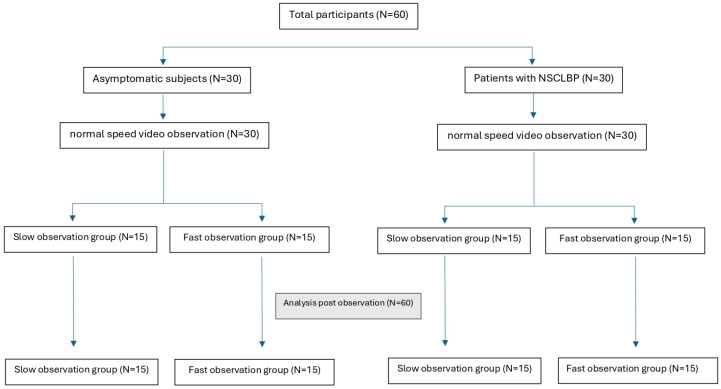
Methods: Sixty individuals, divided equally between those with non-specific chronic low back pain (NSCLBP) and asymptomatic subjects, were enrolled. Participants were further split into subgroups to observe lumbar flexion and Timed Up and Go (TUG) test actions at either a slow or fast pace, following a randomized assignment. For post-video observation, participants replicated the observed actions three times without specific performance instructions, allowing for the assessment of their execution speed.
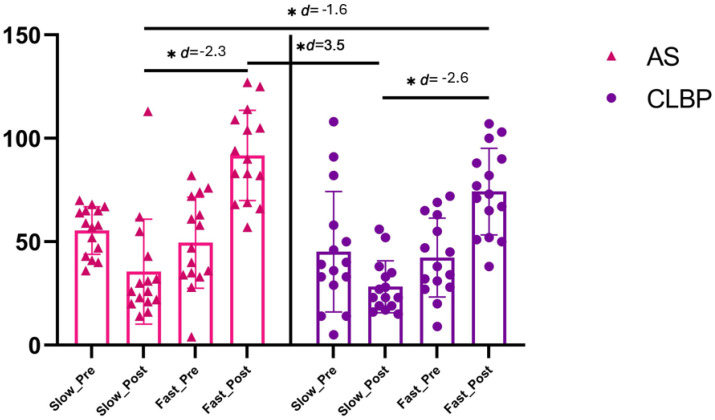
Results: The analysis revealed that individuals observing actions at a faster pace executed the subsequent motor tasks significantly quicker than their counterparts who viewed the same actions at a slower speed. This was consistent across both NSCLBP sufferers and asymptomatic subjects, indicating that the action observation (AO) speed directly influenced the execution speeds of lumbar flexion and TUG test movements.
Conclusions: The findings demonstrate that AO speed significantly affects the pace of motor execution, irrespective of NSCLBP presence. This underscores the potential of utilizing varied AO speeds as a strategic component in clinical practice, particularly for enhancing motor planning and execution in physical therapy settings. The study highlights the importance of incorporating AO speed variations into therapeutic interventions for improving patient outcomes in motor task performance.
期刊介绍:
Brain Sciences (ISSN 2076-3425) is a peer-reviewed scientific journal that publishes original articles, critical reviews, research notes and short communications in the areas of cognitive neuroscience, developmental neuroscience, molecular and cellular neuroscience, neural engineering, neuroimaging, neurolinguistics, neuropathy, systems neuroscience, and theoretical and computational neuroscience. Our aim is to encourage scientists to publish their experimental and theoretical results in as much detail as possible. There is no restriction on the length of the papers. The full experimental details must be provided so that the results can be reproduced. Electronic files or software regarding the full details of the calculation and experimental procedure, if unable to be published in a normal way, can be deposited as supplementary material.





 京公网安备 11010802042870号
京ICP备2023020795号-1
京公网安备 11010802042870号
京ICP备2023020795号-1

 分享
分享
 求助内容:
求助内容: 应助结果提醒方式:
 扫码关注我们
