Jasmine Cheuk Ying Ho, Hollis Haotian Chai, Bella Weijia Luo, Edward Chin Man Lo, Michelle Zeping Huang, Chun Hung Chu
{"title":"优质牙科护理中牙医与病人沟通的概述。","authors":"Jasmine Cheuk Ying Ho, Hollis Haotian Chai, Bella Weijia Luo, Edward Chin Man Lo, Michelle Zeping Huang, Chun Hung Chu","doi":"10.3390/dj13010031","DOIUrl":null,"url":null,"abstract":"<p><p>Dentist-patient communication is at the core of providing quality dental care. This study aims to review the importance, challenges, strategies, and training of dentist-patient communication. The World Dental Federation (FDI) emphasizes the importance of effective communication between oral healthcare providers and patients as a critical component of high-quality care. Effective dentist-patient communication allows dentists to accurately and effectively pass on essential medical information to patients. It improves the dentist's efficiency, boosts self-confidence, reduces occupational stress, and minimizes the risks of complaint or litigation. Moreover, it alleviates dental anxiety and fear, helps build trust between dentists and patients, addresses patients' needs and preferences, increases patients' adherence to improved treatment outcomes, and ultimately leads to enhanced patient satisfaction. Nonetheless, it has been widely acknowledged that dentists universally encounter the repercussions arising from suboptimal communication strategies. Time constraints, difficulties in establishing rapport, the oral-health illiteracy of the patients, the poor communication skills of the dentists, dentists' perceptions, and language barriers often hinder dentist-patient communication. Dentists should take the patient-centered approach as a premise and acquire verbal and non-verbal communication skills to overcome these communication barriers. The patient-centered approach comprises the understanding of patients' illness, shared decision-making, and intervention with mindfulness of the patient's own pace. Simple, succinct, and jargon-free language should be used in verbal communication. Proper body postures and gestures are fundamental for showing positive attitudes towards patients. Communication training for dental students should involve a structured pedagogical approach that includes didactic instruction, role-playing exercises, patient interviewing, and ongoing assessments. Key components of effective communication skills training in dental education include motivational interviewing, open-ended questioning, affirmations, reflective listening, and summaries to enhance patient engagement and adherence to treatment plans.</p>","PeriodicalId":11269,"journal":{"name":"Dentistry Journal","volume":"13 1","pages":""},"PeriodicalIF":3.4000,"publicationDate":"2025-01-14","publicationTypes":"Journal Article","fieldsOfStudy":null,"isOpenAccess":false,"openAccessPdf":"https://www.ncbi.nlm.nih.gov/pmc/articles/PMC11763373/pdf/","citationCount":"0","resultStr":"{\"title\":\"An Overview of Dentist-Patient Communication in Quality Dental Care.\",\"authors\":\"Jasmine Cheuk Ying Ho, Hollis Haotian Chai, Bella Weijia Luo, Edward Chin Man Lo, Michelle Zeping Huang, Chun Hung Chu\",\"doi\":\"10.3390/dj13010031\",\"DOIUrl\":null,\"url\":null,\"abstract\":\"<p><p>Dentist-patient communication is at the core of providing quality dental care. This study aims to review the importance, challenges, strategies, and training of dentist-patient communication. The World Dental Federation (FDI) emphasizes the importance of effective communication between oral healthcare providers and patients as a critical component of high-quality care. Effective dentist-patient communication allows dentists to accurately and effectively pass on essential medical information to patients. It improves the dentist's efficiency, boosts self-confidence, reduces occupational stress, and minimizes the risks of complaint or litigation. Moreover, it alleviates dental anxiety and fear, helps build trust between dentists and patients, addresses patients' needs and preferences, increases patients' adherence to improved treatment outcomes, and ultimately leads to enhanced patient satisfaction. Nonetheless, it has been widely acknowledged that dentists universally encounter the repercussions arising from suboptimal communication strategies. Time constraints, difficulties in establishing rapport, the oral-health illiteracy of the patients, the poor communication skills of the dentists, dentists' perceptions, and language barriers often hinder dentist-patient communication. Dentists should take the patient-centered approach as a premise and acquire verbal and non-verbal communication skills to overcome these communication barriers. The patient-centered approach comprises the understanding of patients' illness, shared decision-making, and intervention with mindfulness of the patient's own pace. Simple, succinct, and jargon-free language should be used in verbal communication. Proper body postures and gestures are fundamental for showing positive attitudes towards patients. Communication training for dental students should involve a structured pedagogical approach that includes didactic instruction, role-playing exercises, patient interviewing, and ongoing assessments. Key components of effective communication skills training in dental education include motivational interviewing, open-ended questioning, affirmations, reflective listening, and summaries to enhance patient engagement and adherence to treatment plans.</p>\",\"PeriodicalId\":11269,\"journal\":{\"name\":\"Dentistry Journal\",\"volume\":\"13 1\",\"pages\":\"\"},\"PeriodicalIF\":3.4000,\"publicationDate\":\"2025-01-14\",\"publicationTypes\":\"Journal Article\",\"fieldsOfStudy\":null,\"isOpenAccess\":false,\"openAccessPdf\":\"https://www.ncbi.nlm.nih.gov/pmc/articles/PMC11763373/pdf/\",\"citationCount\":\"0\",\"resultStr\":null,\"platform\":\"Semanticscholar\",\"paperid\":null,\"PeriodicalName\":\"Dentistry Journal\",\"FirstCategoryId\":\"1085\",\"ListUrlMain\":\"https://doi.org/10.3390/dj13010031\",\"RegionNum\":0,\"RegionCategory\":null,\"ArticlePicture\":[],\"TitleCN\":null,\"AbstractTextCN\":null,\"PMCID\":null,\"EPubDate\":\"\",\"PubModel\":\"\",\"JCR\":\"Q2\",\"JCRName\":\"DENTISTRY, ORAL SURGERY & MEDICINE\",\"Score\":null,\"Total\":0}","platform":"Semanticscholar","paperid":null,"PeriodicalName":"Dentistry Journal","FirstCategoryId":"1085","ListUrlMain":"https://doi.org/10.3390/dj13010031","RegionNum":0,"RegionCategory":null,"ArticlePicture":[],"TitleCN":null,"AbstractTextCN":null,"PMCID":null,"EPubDate":"","PubModel":"","JCR":"Q2","JCRName":"DENTISTRY, ORAL SURGERY & MEDICINE","Score":null,"Total":0}
An Overview of Dentist-Patient Communication in Quality Dental Care.
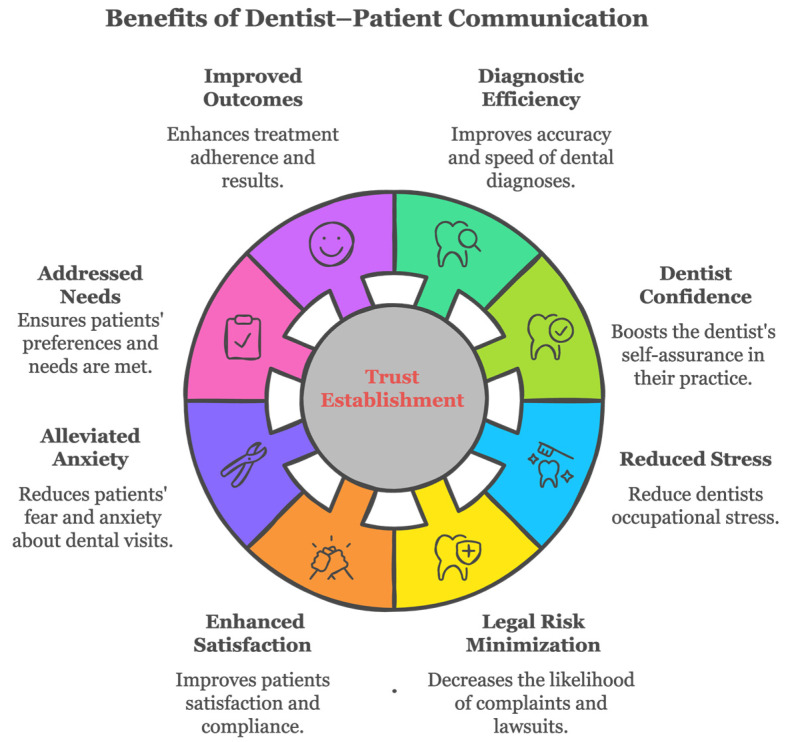
Dentist-patient communication is at the core of providing quality dental care. This study aims to review the importance, challenges, strategies, and training of dentist-patient communication. The World Dental Federation (FDI) emphasizes the importance of effective communication between oral healthcare providers and patients as a critical component of high-quality care. Effective dentist-patient communication allows dentists to accurately and effectively pass on essential medical information to patients. It improves the dentist's efficiency, boosts self-confidence, reduces occupational stress, and minimizes the risks of complaint or litigation. Moreover, it alleviates dental anxiety and fear, helps build trust between dentists and patients, addresses patients' needs and preferences, increases patients' adherence to improved treatment outcomes, and ultimately leads to enhanced patient satisfaction. Nonetheless, it has been widely acknowledged that dentists universally encounter the repercussions arising from suboptimal communication strategies. Time constraints, difficulties in establishing rapport, the oral-health illiteracy of the patients, the poor communication skills of the dentists, dentists' perceptions, and language barriers often hinder dentist-patient communication. Dentists should take the patient-centered approach as a premise and acquire verbal and non-verbal communication skills to overcome these communication barriers. The patient-centered approach comprises the understanding of patients' illness, shared decision-making, and intervention with mindfulness of the patient's own pace. Simple, succinct, and jargon-free language should be used in verbal communication. Proper body postures and gestures are fundamental for showing positive attitudes towards patients. Communication training for dental students should involve a structured pedagogical approach that includes didactic instruction, role-playing exercises, patient interviewing, and ongoing assessments. Key components of effective communication skills training in dental education include motivational interviewing, open-ended questioning, affirmations, reflective listening, and summaries to enhance patient engagement and adherence to treatment plans.






 京公网安备 11010802042870号
京ICP备2023020795号-1
京公网安备 11010802042870号
京ICP备2023020795号-1

 分享
分享
 求助内容:
求助内容: 应助结果提醒方式:
 扫码关注我们
