Francesca Bandinelli, Andrea Delle Sedie, Ilenia Mallia, Ilaria Mauro, Nikita Pecani, Linda Carli, Lorenzo Esti, Marco Di Carlo, Marina Carotti, Fausto Salaffi
{"title":"早期ASAS脊椎关节炎睡眠障碍的原因:一项回顾性的长期经验。","authors":"Francesca Bandinelli, Andrea Delle Sedie, Ilenia Mallia, Ilaria Mauro, Nikita Pecani, Linda Carli, Lorenzo Esti, Marco Di Carlo, Marina Carotti, Fausto Salaffi","doi":"10.3390/jpm15010031","DOIUrl":null,"url":null,"abstract":"<p><p><b>Introduction:</b> Sleep disturbance (SD) in the second half of the night due to inflammatory pain was included in the 2009 ASAS classification criteria of Spondyloarthritis (SpA), even though its definition is uncertain. <b>Aim:</b> We aimed to investigate SD in early-SpA (e-SpA) patients at T1 (2010-2013), comparing them to long-term SpA (l-SpA) patients at T2 (2023-2024) after at least 10 years of follow-up. <b>Methods:</b> At T1, in e-SpA and l-SpA cases, SD, classified as \"difficulty in initiating sleep\" (DIS), \"difficulty in maintaining sleep\" (DMS) and \"early awakening\" (EA), was compared to clinical parameters (ASDAS-CRP, BASDAI, m-HAQ-S, BASMI, MASES, 68/66 joint count, tenderness of sacroiliac joints, fatigue [FACIT] and HADS for anxiety [A] and depression [D]). At T2, e-SpA patients were re-evaluated using the Pittsburgh Sleep Quality Index (PSQI). <b>Results:</b> At T1, 45% of 166 SpA patients had SD; in e-SpA patients (60), SD correlated with sacroiliac pain (DMS) BASDAI, FACIT and HADS-D (EA); in l-SpA patients (106), it correlated with HADS-A (DIS), BASDAI and FACIT (DMS). At T2, e-SpA patients showed a high PSQI in 51.5% of cases, correlated with T2-ASDAS-CRP and T2-BASDAI. Moreover, T1-ASDAS-CRP was predictive of T2-PSQI. <b>Conclusions:</b> SD is more specific for inflammatory pain in e-SpA and might be influenced by disease activity also in long-term disease.</p>","PeriodicalId":16722,"journal":{"name":"Journal of Personalized Medicine","volume":"15 1","pages":""},"PeriodicalIF":3.0000,"publicationDate":"2025-01-17","publicationTypes":"Journal Article","fieldsOfStudy":null,"isOpenAccess":false,"openAccessPdf":"https://www.ncbi.nlm.nih.gov/pmc/articles/PMC11767170/pdf/","citationCount":"0","resultStr":"{\"title\":\"Causes of Sleep Disturbance in Early ASAS Spondyloarthritis: A Retrospective Long-Term Experience.\",\"authors\":\"Francesca Bandinelli, Andrea Delle Sedie, Ilenia Mallia, Ilaria Mauro, Nikita Pecani, Linda Carli, Lorenzo Esti, Marco Di Carlo, Marina Carotti, Fausto Salaffi\",\"doi\":\"10.3390/jpm15010031\",\"DOIUrl\":null,\"url\":null,\"abstract\":\"<p><p><b>Introduction:</b> Sleep disturbance (SD) in the second half of the night due to inflammatory pain was included in the 2009 ASAS classification criteria of Spondyloarthritis (SpA), even though its definition is uncertain. <b>Aim:</b> We aimed to investigate SD in early-SpA (e-SpA) patients at T1 (2010-2013), comparing them to long-term SpA (l-SpA) patients at T2 (2023-2024) after at least 10 years of follow-up. <b>Methods:</b> At T1, in e-SpA and l-SpA cases, SD, classified as \\\"difficulty in initiating sleep\\\" (DIS), \\\"difficulty in maintaining sleep\\\" (DMS) and \\\"early awakening\\\" (EA), was compared to clinical parameters (ASDAS-CRP, BASDAI, m-HAQ-S, BASMI, MASES, 68/66 joint count, tenderness of sacroiliac joints, fatigue [FACIT] and HADS for anxiety [A] and depression [D]). At T2, e-SpA patients were re-evaluated using the Pittsburgh Sleep Quality Index (PSQI). <b>Results:</b> At T1, 45% of 166 SpA patients had SD; in e-SpA patients (60), SD correlated with sacroiliac pain (DMS) BASDAI, FACIT and HADS-D (EA); in l-SpA patients (106), it correlated with HADS-A (DIS), BASDAI and FACIT (DMS). At T2, e-SpA patients showed a high PSQI in 51.5% of cases, correlated with T2-ASDAS-CRP and T2-BASDAI. Moreover, T1-ASDAS-CRP was predictive of T2-PSQI. <b>Conclusions:</b> SD is more specific for inflammatory pain in e-SpA and might be influenced by disease activity also in long-term disease.</p>\",\"PeriodicalId\":16722,\"journal\":{\"name\":\"Journal of Personalized Medicine\",\"volume\":\"15 1\",\"pages\":\"\"},\"PeriodicalIF\":3.0000,\"publicationDate\":\"2025-01-17\",\"publicationTypes\":\"Journal Article\",\"fieldsOfStudy\":null,\"isOpenAccess\":false,\"openAccessPdf\":\"https://www.ncbi.nlm.nih.gov/pmc/articles/PMC11767170/pdf/\",\"citationCount\":\"0\",\"resultStr\":null,\"platform\":\"Semanticscholar\",\"paperid\":null,\"PeriodicalName\":\"Journal of Personalized Medicine\",\"FirstCategoryId\":\"3\",\"ListUrlMain\":\"https://doi.org/10.3390/jpm15010031\",\"RegionNum\":3,\"RegionCategory\":\"医学\",\"ArticlePicture\":[],\"TitleCN\":null,\"AbstractTextCN\":null,\"PMCID\":null,\"EPubDate\":\"\",\"PubModel\":\"\",\"JCR\":\"Q2\",\"JCRName\":\"HEALTH CARE SCIENCES & SERVICES\",\"Score\":null,\"Total\":0}","platform":"Semanticscholar","paperid":null,"PeriodicalName":"Journal of Personalized Medicine","FirstCategoryId":"3","ListUrlMain":"https://doi.org/10.3390/jpm15010031","RegionNum":3,"RegionCategory":"医学","ArticlePicture":[],"TitleCN":null,"AbstractTextCN":null,"PMCID":null,"EPubDate":"","PubModel":"","JCR":"Q2","JCRName":"HEALTH CARE SCIENCES & SERVICES","Score":null,"Total":0}
Causes of Sleep Disturbance in Early ASAS Spondyloarthritis: A Retrospective Long-Term Experience.
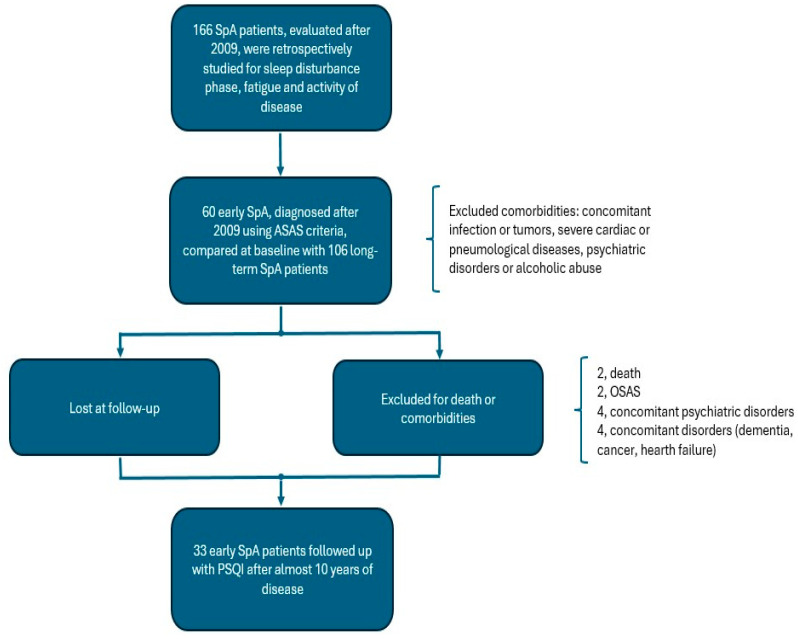
Introduction: Sleep disturbance (SD) in the second half of the night due to inflammatory pain was included in the 2009 ASAS classification criteria of Spondyloarthritis (SpA), even though its definition is uncertain. Aim: We aimed to investigate SD in early-SpA (e-SpA) patients at T1 (2010-2013), comparing them to long-term SpA (l-SpA) patients at T2 (2023-2024) after at least 10 years of follow-up. Methods: At T1, in e-SpA and l-SpA cases, SD, classified as "difficulty in initiating sleep" (DIS), "difficulty in maintaining sleep" (DMS) and "early awakening" (EA), was compared to clinical parameters (ASDAS-CRP, BASDAI, m-HAQ-S, BASMI, MASES, 68/66 joint count, tenderness of sacroiliac joints, fatigue [FACIT] and HADS for anxiety [A] and depression [D]). At T2, e-SpA patients were re-evaluated using the Pittsburgh Sleep Quality Index (PSQI). Results: At T1, 45% of 166 SpA patients had SD; in e-SpA patients (60), SD correlated with sacroiliac pain (DMS) BASDAI, FACIT and HADS-D (EA); in l-SpA patients (106), it correlated with HADS-A (DIS), BASDAI and FACIT (DMS). At T2, e-SpA patients showed a high PSQI in 51.5% of cases, correlated with T2-ASDAS-CRP and T2-BASDAI. Moreover, T1-ASDAS-CRP was predictive of T2-PSQI. Conclusions: SD is more specific for inflammatory pain in e-SpA and might be influenced by disease activity also in long-term disease.
期刊介绍:
Journal of Personalized Medicine (JPM; ISSN 2075-4426) is an international, open access journal aimed at bringing all aspects of personalized medicine to one platform. JPM publishes cutting edge, innovative preclinical and translational scientific research and technologies related to personalized medicine (e.g., pharmacogenomics/proteomics, systems biology). JPM recognizes that personalized medicine—the assessment of genetic, environmental and host factors that cause variability of individuals—is a challenging, transdisciplinary topic that requires discussions from a range of experts. For a comprehensive perspective of personalized medicine, JPM aims to integrate expertise from the molecular and translational sciences, therapeutics and diagnostics, as well as discussions of regulatory, social, ethical and policy aspects. We provide a forum to bring together academic and clinical researchers, biotechnology, diagnostic and pharmaceutical companies, health professionals, regulatory and ethical experts, and government and regulatory authorities.





 京公网安备 11010802042870号
京ICP备2023020795号-1
京公网安备 11010802042870号
京ICP备2023020795号-1

 分享
分享
 求助内容:
求助内容: 应助结果提醒方式:
 扫码关注我们
