Mandisa Singata-Madliki, Albaro J. Nieto-Calvache, Luisa F. Rivera Torres, Hazmath Abdul, Joanne Batting, Sylvia N. Cebekhulu, Lawrence Chauke, Priya Soma-Pillay, Susan Fawcus, Logie Govender, Busiwe Majeke, Xolani Mbongozi, Katrin Middleton, Poovangela Naidoo, Sanele Ndaba, Trevi Spence, Gaynor M. Balie, Angelica Monroy, Monica Cantor, G. Justus Hofmeyr
{"title":"子宫吸管填塞与子宫球囊填塞治疗难治性产后出血:一项随机临床可行性试验。","authors":"Mandisa Singata-Madliki, Albaro J. Nieto-Calvache, Luisa F. Rivera Torres, Hazmath Abdul, Joanne Batting, Sylvia N. Cebekhulu, Lawrence Chauke, Priya Soma-Pillay, Susan Fawcus, Logie Govender, Busiwe Majeke, Xolani Mbongozi, Katrin Middleton, Poovangela Naidoo, Sanele Ndaba, Trevi Spence, Gaynor M. Balie, Angelica Monroy, Monica Cantor, G. Justus Hofmeyr","doi":"10.1002/ijgo.16164","DOIUrl":null,"url":null,"abstract":"<div>\n \n \n <section>\n \n <h3> Objective</h3>\n \n <p>To compare low-cost “Suction Tube Uterine Tamponade” (STUT) treatment for refractory postpartum hemorrhage (PPH) with uterine balloon tamponade (UBT) using a randomized feasibility study.</p>\n </section>\n \n <section>\n \n <h3> Methods</h3>\n \n <p>After verbal assent, we allocated participants with refractory PPH by randomly ordered envelopes to STUT or routine UBT at 10 hospitals in South Africa and one tertiary referral center in Colombia between January 10, 2020, and May 3, 2024. In the STUT group, we inserted a 24 FG Levin stomach tube into the uterine cavity and applied suction. The control group received standard UBT, mainly the Elavi free-flow balloon or the Bakri fixed volume balloon. There were fundamental differences between the South African and the Colombian sites, so the pre-specified analysis combined data from the two countries by meta-analysis.</p>\n </section>\n \n <section>\n \n <h3> Results</h3>\n \n <p>We enrolled 59 participants. The rate of the primary outcome (blood loss >1000 mL or laparotomy or death) was 8/27 (30%) in the STUT group versus 14/27 (52%) in the UBT group (risk ratio [RR] 0.56, 95% confidence interval [CI] 0.30–1.05, <i>P</i> = 0.07). Per protocol analysis was 7/26 (27%) versus 15/28 (54%) (RR 0.49, 95% CI 0.25–0.96, <i>P</i> = 0.04). Reporting severe pain during the procedures was less frequent in the STUT group (RR 0.46, 95% CI 0.25–0.86, <i>P</i> = 0.01). Most secondary outcomes favored the STUT group, with low certainty.</p>\n </section>\n \n <section>\n \n <h3> Conclusions</h3>\n \n <p>STUT was experienced as less painful than UBT. Results were consistent with reported observational findings and one other randomized trial evidence of greater effectiveness for suction than balloon tamponade.</p>\n </section>\n </div>","PeriodicalId":14164,"journal":{"name":"International Journal of Gynecology & Obstetrics","volume":"170 1","pages":"326-337"},"PeriodicalIF":2.4000,"publicationDate":"2025-01-24","publicationTypes":"Journal Article","fieldsOfStudy":null,"isOpenAccess":false,"openAccessPdf":"https://onlinelibrary.wiley.com/doi/epdf/10.1002/ijgo.16164","citationCount":"0","resultStr":"{\"title\":\"Suction tube uterine tamponade versus uterine balloon tamponade for treatment of refractory postpartum hemorrhage: A randomized clinical feasibility trial\",\"authors\":\"Mandisa Singata-Madliki, Albaro J. Nieto-Calvache, Luisa F. Rivera Torres, Hazmath Abdul, Joanne Batting, Sylvia N. Cebekhulu, Lawrence Chauke, Priya Soma-Pillay, Susan Fawcus, Logie Govender, Busiwe Majeke, Xolani Mbongozi, Katrin Middleton, Poovangela Naidoo, Sanele Ndaba, Trevi Spence, Gaynor M. Balie, Angelica Monroy, Monica Cantor, G. Justus Hofmeyr\",\"doi\":\"10.1002/ijgo.16164\",\"DOIUrl\":null,\"url\":null,\"abstract\":\"<div>\\n \\n \\n <section>\\n \\n <h3> Objective</h3>\\n \\n <p>To compare low-cost “Suction Tube Uterine Tamponade” (STUT) treatment for refractory postpartum hemorrhage (PPH) with uterine balloon tamponade (UBT) using a randomized feasibility study.</p>\\n </section>\\n \\n <section>\\n \\n <h3> Methods</h3>\\n \\n <p>After verbal assent, we allocated participants with refractory PPH by randomly ordered envelopes to STUT or routine UBT at 10 hospitals in South Africa and one tertiary referral center in Colombia between January 10, 2020, and May 3, 2024. In the STUT group, we inserted a 24 FG Levin stomach tube into the uterine cavity and applied suction. The control group received standard UBT, mainly the Elavi free-flow balloon or the Bakri fixed volume balloon. There were fundamental differences between the South African and the Colombian sites, so the pre-specified analysis combined data from the two countries by meta-analysis.</p>\\n </section>\\n \\n <section>\\n \\n <h3> Results</h3>\\n \\n <p>We enrolled 59 participants. The rate of the primary outcome (blood loss >1000 mL or laparotomy or death) was 8/27 (30%) in the STUT group versus 14/27 (52%) in the UBT group (risk ratio [RR] 0.56, 95% confidence interval [CI] 0.30–1.05, <i>P</i> = 0.07). Per protocol analysis was 7/26 (27%) versus 15/28 (54%) (RR 0.49, 95% CI 0.25–0.96, <i>P</i> = 0.04). Reporting severe pain during the procedures was less frequent in the STUT group (RR 0.46, 95% CI 0.25–0.86, <i>P</i> = 0.01). Most secondary outcomes favored the STUT group, with low certainty.</p>\\n </section>\\n \\n <section>\\n \\n <h3> Conclusions</h3>\\n \\n <p>STUT was experienced as less painful than UBT. Results were consistent with reported observational findings and one other randomized trial evidence of greater effectiveness for suction than balloon tamponade.</p>\\n </section>\\n </div>\",\"PeriodicalId\":14164,\"journal\":{\"name\":\"International Journal of Gynecology & Obstetrics\",\"volume\":\"170 1\",\"pages\":\"326-337\"},\"PeriodicalIF\":2.4000,\"publicationDate\":\"2025-01-24\",\"publicationTypes\":\"Journal Article\",\"fieldsOfStudy\":null,\"isOpenAccess\":false,\"openAccessPdf\":\"https://onlinelibrary.wiley.com/doi/epdf/10.1002/ijgo.16164\",\"citationCount\":\"0\",\"resultStr\":null,\"platform\":\"Semanticscholar\",\"paperid\":null,\"PeriodicalName\":\"International Journal of Gynecology & Obstetrics\",\"FirstCategoryId\":\"3\",\"ListUrlMain\":\"https://obgyn.onlinelibrary.wiley.com/doi/10.1002/ijgo.16164\",\"RegionNum\":3,\"RegionCategory\":\"医学\",\"ArticlePicture\":[],\"TitleCN\":null,\"AbstractTextCN\":null,\"PMCID\":null,\"EPubDate\":\"\",\"PubModel\":\"\",\"JCR\":\"Q2\",\"JCRName\":\"OBSTETRICS & GYNECOLOGY\",\"Score\":null,\"Total\":0}","platform":"Semanticscholar","paperid":null,"PeriodicalName":"International Journal of Gynecology & Obstetrics","FirstCategoryId":"3","ListUrlMain":"https://obgyn.onlinelibrary.wiley.com/doi/10.1002/ijgo.16164","RegionNum":3,"RegionCategory":"医学","ArticlePicture":[],"TitleCN":null,"AbstractTextCN":null,"PMCID":null,"EPubDate":"","PubModel":"","JCR":"Q2","JCRName":"OBSTETRICS & GYNECOLOGY","Score":null,"Total":0}
引用次数: 0
摘要
目的:采用随机可行性研究,比较低成本“子宫吸管填塞”(STUT)与子宫球囊填塞(UBT)治疗难治性产后出血(PPH)的可行性。方法:在口头同意后,我们将难治性PPH患者随机分配到南非10家医院和哥伦比亚一家三级转诊中心的STUT或常规UBT,时间为2020年1月10日至2024年5月3日。在STUT组,我们将24fg Levin胃管插入子宫腔并进行抽吸。对照组采用标准UBT,主要为Elavi自由流球囊或Bakri固定体积球囊。南非和哥伦比亚的遗址之间存在根本差异,因此预先指定的分析通过荟萃分析将两国的数据结合起来。结果:我们招募了59名参与者。STUT组的主要结局(出血量1000 mL或剖腹或死亡)率为8/27 (30%),UBT组为14/27(52%)(风险比[RR] 0.56, 95%可信区间[CI] 0.30-1.05, P = 0.07)。每个方案分析为7/26(27%)对15/28 (54%)(RR 0.49, 95% CI 0.25-0.96, P = 0.04)。STUT组在手术过程中报告剧烈疼痛的频率较低(RR 0.46, 95% CI 0.25-0.86, P = 0.01)。大多数次要结果有利于STUT组,确定性较低。结论:STUT患者的疼痛程度低于UBT患者。结果与报道的观察结果和另一项随机试验证据一致,表明吸痰比球囊填塞更有效。
Suction tube uterine tamponade versus uterine balloon tamponade for treatment of refractory postpartum hemorrhage: A randomized clinical feasibility trial
Objective
To compare low-cost “Suction Tube Uterine Tamponade” (STUT) treatment for refractory postpartum hemorrhage (PPH) with uterine balloon tamponade (UBT) using a randomized feasibility study.
Methods
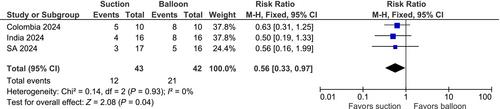
After verbal assent, we allocated participants with refractory PPH by randomly ordered envelopes to STUT or routine UBT at 10 hospitals in South Africa and one tertiary referral center in Colombia between January 10, 2020, and May 3, 2024. In the STUT group, we inserted a 24 FG Levin stomach tube into the uterine cavity and applied suction. The control group received standard UBT, mainly the Elavi free-flow balloon or the Bakri fixed volume balloon. There were fundamental differences between the South African and the Colombian sites, so the pre-specified analysis combined data from the two countries by meta-analysis.
Results
We enrolled 59 participants. The rate of the primary outcome (blood loss >1000 mL or laparotomy or death) was 8/27 (30%) in the STUT group versus 14/27 (52%) in the UBT group (risk ratio [RR] 0.56, 95% confidence interval [CI] 0.30–1.05, P = 0.07). Per protocol analysis was 7/26 (27%) versus 15/28 (54%) (RR 0.49, 95% CI 0.25–0.96, P = 0.04). Reporting severe pain during the procedures was less frequent in the STUT group (RR 0.46, 95% CI 0.25–0.86, P = 0.01). Most secondary outcomes favored the STUT group, with low certainty.
Conclusions
STUT was experienced as less painful than UBT. Results were consistent with reported observational findings and one other randomized trial evidence of greater effectiveness for suction than balloon tamponade.
期刊介绍:
The International Journal of Gynecology & Obstetrics publishes articles on all aspects of basic and clinical research in the fields of obstetrics and gynecology and related subjects, with emphasis on matters of worldwide interest.






 京公网安备 11010802042870号
京ICP备2023020795号-1
京公网安备 11010802042870号
京ICP备2023020795号-1

 分享
分享
 求助内容:
求助内容: 应助结果提醒方式:
 扫码关注我们
