Emerson Koji Uehara, Gustavo Castro de Lima, Janaina de Cassia Orlandi Sardi, Luciene Cristina de Figueiredo, Jamil Awad Shibli, Thabet Asbi, Doron Haim, José Augusto Rodrigues
{"title":"下一代牙科材料:探索细菌生物膜在3d打印树脂基复合材料上的形成。","authors":"Emerson Koji Uehara, Gustavo Castro de Lima, Janaina de Cassia Orlandi Sardi, Luciene Cristina de Figueiredo, Jamil Awad Shibli, Thabet Asbi, Doron Haim, José Augusto Rodrigues","doi":"10.3390/jfb16010012","DOIUrl":null,"url":null,"abstract":"<p><p>This study evaluated the microbial growth profile of subgingival multispecies biofilm on 3D-printable resin-based composites (PRBCs). A 96-well cell plate cultivated a 39-species biofilm associated with periodontitis over 7 days. Cylindrical specimens with 12 mm high and 3 mm diameters were prepared by the PRBC group (Cosmos Temp-Yller; Prizma 3D Bio Crown; Prizma 3D Bio Prov) and an acrylic resin as control. Further, these specimens were immersed in the well plate to allow biofilm formation. After growing for 7 days, the metabolic biofilm activity was evaluated by colorimetric assay and the microbial profile by DNA-DNA hybridization. Kruskal-Wallis and Mann-Whitney tests evaluated each bacteria count and complex group. A greater biofilm formation was observed on PRBC groups than on acrylic resin. The microbiological profile of PRBC was associated with a less pathogenic biofilm, with an absence of a red complex. Acrylic resin showed low biofilm growth, but the biofilm profile was related to periodontal disease, characterized by red-complex bacteria. The selection of PRBC may contribute more effectively to maintaining periodontal health than acrylic resin.</p>","PeriodicalId":15767,"journal":{"name":"Journal of Functional Biomaterials","volume":"16 1","pages":""},"PeriodicalIF":5.2000,"publicationDate":"2025-01-03","publicationTypes":"Journal Article","fieldsOfStudy":null,"isOpenAccess":false,"openAccessPdf":"https://www.ncbi.nlm.nih.gov/pmc/articles/PMC11765569/pdf/","citationCount":"0","resultStr":"{\"title\":\"Next-Generation Dental Materials: Exploring Bacterial Biofilm Formation on 3D-Printable Resin-Based Composites.\",\"authors\":\"Emerson Koji Uehara, Gustavo Castro de Lima, Janaina de Cassia Orlandi Sardi, Luciene Cristina de Figueiredo, Jamil Awad Shibli, Thabet Asbi, Doron Haim, José Augusto Rodrigues\",\"doi\":\"10.3390/jfb16010012\",\"DOIUrl\":null,\"url\":null,\"abstract\":\"<p><p>This study evaluated the microbial growth profile of subgingival multispecies biofilm on 3D-printable resin-based composites (PRBCs). A 96-well cell plate cultivated a 39-species biofilm associated with periodontitis over 7 days. Cylindrical specimens with 12 mm high and 3 mm diameters were prepared by the PRBC group (Cosmos Temp-Yller; Prizma 3D Bio Crown; Prizma 3D Bio Prov) and an acrylic resin as control. Further, these specimens were immersed in the well plate to allow biofilm formation. After growing for 7 days, the metabolic biofilm activity was evaluated by colorimetric assay and the microbial profile by DNA-DNA hybridization. Kruskal-Wallis and Mann-Whitney tests evaluated each bacteria count and complex group. A greater biofilm formation was observed on PRBC groups than on acrylic resin. The microbiological profile of PRBC was associated with a less pathogenic biofilm, with an absence of a red complex. Acrylic resin showed low biofilm growth, but the biofilm profile was related to periodontal disease, characterized by red-complex bacteria. The selection of PRBC may contribute more effectively to maintaining periodontal health than acrylic resin.</p>\",\"PeriodicalId\":15767,\"journal\":{\"name\":\"Journal of Functional Biomaterials\",\"volume\":\"16 1\",\"pages\":\"\"},\"PeriodicalIF\":5.2000,\"publicationDate\":\"2025-01-03\",\"publicationTypes\":\"Journal Article\",\"fieldsOfStudy\":null,\"isOpenAccess\":false,\"openAccessPdf\":\"https://www.ncbi.nlm.nih.gov/pmc/articles/PMC11765569/pdf/\",\"citationCount\":\"0\",\"resultStr\":null,\"platform\":\"Semanticscholar\",\"paperid\":null,\"PeriodicalName\":\"Journal of Functional Biomaterials\",\"FirstCategoryId\":\"5\",\"ListUrlMain\":\"https://doi.org/10.3390/jfb16010012\",\"RegionNum\":3,\"RegionCategory\":\"医学\",\"ArticlePicture\":[],\"TitleCN\":null,\"AbstractTextCN\":null,\"PMCID\":null,\"EPubDate\":\"\",\"PubModel\":\"\",\"JCR\":\"Q1\",\"JCRName\":\"ENGINEERING, BIOMEDICAL\",\"Score\":null,\"Total\":0}","platform":"Semanticscholar","paperid":null,"PeriodicalName":"Journal of Functional Biomaterials","FirstCategoryId":"5","ListUrlMain":"https://doi.org/10.3390/jfb16010012","RegionNum":3,"RegionCategory":"医学","ArticlePicture":[],"TitleCN":null,"AbstractTextCN":null,"PMCID":null,"EPubDate":"","PubModel":"","JCR":"Q1","JCRName":"ENGINEERING, BIOMEDICAL","Score":null,"Total":0}
引用次数: 0
摘要
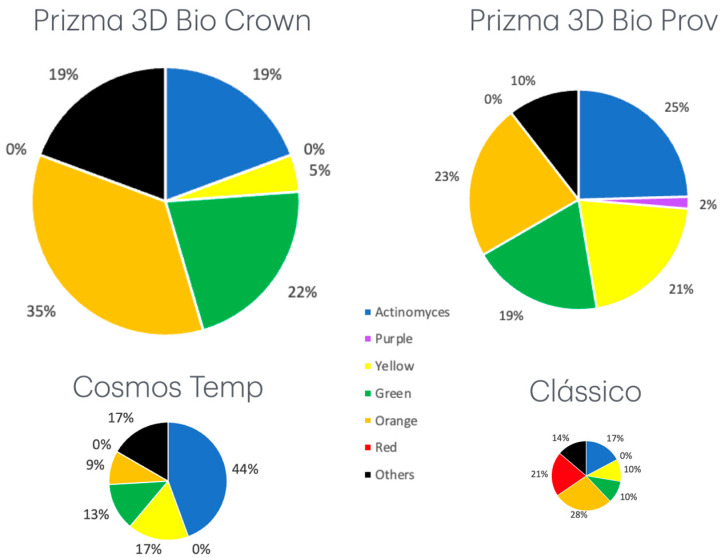
本研究评估了3d打印树脂基复合材料(prbc)牙龈下多物种生物膜的微生物生长情况。96孔细胞板培养与牙周炎相关的39种生物膜7天。高12mm,直径3mm的圆柱形试样由PRBC组(Cosmos Temp-Yller;Prizma 3D生物冠;Prizma 3D bioprov)和丙烯酸树脂作为对照。此外,将这些标本浸泡在孔板中以形成生物膜。培养7 d后,用比色法测定代谢生物膜活性,用DNA-DNA杂交法测定微生物谱。Kruskal-Wallis和Mann-Whitney测试评估了每个细菌数量和复杂组。与丙烯酸树脂相比,PRBC基团形成的生物膜更大。PRBC的微生物特征与较低致病性的生物膜有关,缺少红色复合物。丙烯酸树脂的生物膜生长缓慢,但生物膜分布与牙周病有关,以红色复合体细菌为特征。选择PRBC可能比丙烯酸树脂更有效地维持牙周健康。
This study evaluated the microbial growth profile of subgingival multispecies biofilm on 3D-printable resin-based composites (PRBCs). A 96-well cell plate cultivated a 39-species biofilm associated with periodontitis over 7 days. Cylindrical specimens with 12 mm high and 3 mm diameters were prepared by the PRBC group (Cosmos Temp-Yller; Prizma 3D Bio Crown; Prizma 3D Bio Prov) and an acrylic resin as control. Further, these specimens were immersed in the well plate to allow biofilm formation. After growing for 7 days, the metabolic biofilm activity was evaluated by colorimetric assay and the microbial profile by DNA-DNA hybridization. Kruskal-Wallis and Mann-Whitney tests evaluated each bacteria count and complex group. A greater biofilm formation was observed on PRBC groups than on acrylic resin. The microbiological profile of PRBC was associated with a less pathogenic biofilm, with an absence of a red complex. Acrylic resin showed low biofilm growth, but the biofilm profile was related to periodontal disease, characterized by red-complex bacteria. The selection of PRBC may contribute more effectively to maintaining periodontal health than acrylic resin.
期刊介绍:
Journal of Functional Biomaterials (JFB, ISSN 2079-4983) is an international and interdisciplinary scientific journal that publishes regular research papers (articles), reviews and short communications about applications of materials for biomedical use. JFB covers subjects from chemistry, pharmacy, biology, physics over to engineering. The journal focuses on the preparation, performance and use of functional biomaterials in biomedical devices and their behaviour in physiological environments. Our aim is to encourage scientists to publish their results in as much detail as possible. Therefore, there is no restriction on the length of the papers. The full experimental details must be provided so that the results can be reproduced. Several topical special issues will be published. Scope: adhesion, adsorption, biocompatibility, biohybrid materials, bio-inert materials, biomaterials, biomedical devices, biomimetic materials, bone repair, cardiovascular devices, ceramics, composite materials, dental implants, dental materials, drug delivery systems, functional biopolymers, glasses, hyper branched polymers, molecularly imprinted polymers (MIPs), nanomedicine, nanoparticles, nanotechnology, natural materials, self-assembly smart materials, stimuli responsive materials, surface modification, tissue devices, tissue engineering, tissue-derived materials, urological devices.





 京公网安备 11010802042870号
京ICP备2023020795号-1
京公网安备 11010802042870号
京ICP备2023020795号-1

 分享
分享
 求助内容:
求助内容: 应助结果提醒方式:
 扫码关注我们
