Zhengmin Lian, Yuan Zhao, Wei Wen, Zhenbang Zhu, Wenqiang Wang, Zhendong Zhang, Panrao Liu, Herman W Favoreel, Xiangdong Li
{"title":"糖皮质激素对神经元样细胞和上皮细胞伪狂犬病毒感染的不同影响。","authors":"Zhengmin Lian, Yuan Zhao, Wei Wen, Zhenbang Zhu, Wenqiang Wang, Zhendong Zhang, Panrao Liu, Herman W Favoreel, Xiangdong Li","doi":"10.1128/jvi.01472-24","DOIUrl":null,"url":null,"abstract":"<p><p>Pseudorabies virus (PRV) is a porcine neurotropic alphaherpesvirus that infects peripheral tissues of its host, spreads into the nervous system, and establishes a life-long latency in neuronal cells. During productive infection, PRV replicates rapidly and causes pseudorabies or Aujeszky's disease. Reactivation from latent infection in the nervous system may lead to anterograde axonal transport of progeny virions, leading to recurrent infection of the epithelial layer and virus spread. Dexamethasone (DEX), a member of the glucocorticoid family that is widely used in clinical treatment as a high-efficiency glucocorticoid receptor (GR) agonist, is known to trigger reactivation of alphaherpesviruses like PRV and the closely related bovine alphaherpesvirus 1. In the current study, two cell type-dependent distinct regulatory mechanisms of glucocorticoid during PRV infection are described. In neuron-like cells, DEX upregulates expression of PRV IE180 and promotes viral productive infection. In addition, we found that GR activates the IE180 promoter by binding multiple GR response elements. The amino acids A465, P631, and I634 in GR were found to be critical for IE180 promoter activation. The impact of DEX on PRV productive infection in epithelial cells was also investigated. Interestingly, DEX was found to downregulate IE180 expression and suppress PRV infection in epithelial cells. Mechanistically, in epithelial cells, activation of the IE180 promoter by the VP16/Oct-1 (octamer-binding transcription factor 1) complex was suppressed by DEX-mediated degradation of Oct-1 in epithelial cells. In summary, our work reveals two distinct, cell type-dependent biological functions of glucocorticoid during PRV infection in neuron-like and epithelial cells, respectively.IMPORTANCEPseudorabies virus (PRV) can infect mucosal epithelium and the peripheral nervous system of its host, resulting in acute infection in epithelial cells and neuronal cells. In this study, we describe that glucocorticoid promotes PRV replication in neuron-like cells while it suppresses productive infection in epithelial cells through distinct regulations of the viral transactivator IE180, thereby revealing a cell type-dependent regulatory mechanism of glucocorticoid on PRV infection. Therefore, our findings provide a new perspective on the role of glucocorticoids during PRV infection.</p>","PeriodicalId":17583,"journal":{"name":"Journal of Virology","volume":" ","pages":"e0147224"},"PeriodicalIF":4.1000,"publicationDate":"2025-02-25","publicationTypes":"Journal Article","fieldsOfStudy":null,"isOpenAccess":false,"openAccessPdf":"https://www.ncbi.nlm.nih.gov/pmc/articles/PMC11852744/pdf/","citationCount":"0","resultStr":"{\"title\":\"Distinct effects of glucocorticoid on pseudorabies virus infection in neuron-like and epithelial cells.\",\"authors\":\"Zhengmin Lian, Yuan Zhao, Wei Wen, Zhenbang Zhu, Wenqiang Wang, Zhendong Zhang, Panrao Liu, Herman W Favoreel, Xiangdong Li\",\"doi\":\"10.1128/jvi.01472-24\",\"DOIUrl\":null,\"url\":null,\"abstract\":\"<p><p>Pseudorabies virus (PRV) is a porcine neurotropic alphaherpesvirus that infects peripheral tissues of its host, spreads into the nervous system, and establishes a life-long latency in neuronal cells. During productive infection, PRV replicates rapidly and causes pseudorabies or Aujeszky's disease. Reactivation from latent infection in the nervous system may lead to anterograde axonal transport of progeny virions, leading to recurrent infection of the epithelial layer and virus spread. Dexamethasone (DEX), a member of the glucocorticoid family that is widely used in clinical treatment as a high-efficiency glucocorticoid receptor (GR) agonist, is known to trigger reactivation of alphaherpesviruses like PRV and the closely related bovine alphaherpesvirus 1. In the current study, two cell type-dependent distinct regulatory mechanisms of glucocorticoid during PRV infection are described. In neuron-like cells, DEX upregulates expression of PRV IE180 and promotes viral productive infection. In addition, we found that GR activates the IE180 promoter by binding multiple GR response elements. The amino acids A465, P631, and I634 in GR were found to be critical for IE180 promoter activation. The impact of DEX on PRV productive infection in epithelial cells was also investigated. Interestingly, DEX was found to downregulate IE180 expression and suppress PRV infection in epithelial cells. Mechanistically, in epithelial cells, activation of the IE180 promoter by the VP16/Oct-1 (octamer-binding transcription factor 1) complex was suppressed by DEX-mediated degradation of Oct-1 in epithelial cells. In summary, our work reveals two distinct, cell type-dependent biological functions of glucocorticoid during PRV infection in neuron-like and epithelial cells, respectively.IMPORTANCEPseudorabies virus (PRV) can infect mucosal epithelium and the peripheral nervous system of its host, resulting in acute infection in epithelial cells and neuronal cells. In this study, we describe that glucocorticoid promotes PRV replication in neuron-like cells while it suppresses productive infection in epithelial cells through distinct regulations of the viral transactivator IE180, thereby revealing a cell type-dependent regulatory mechanism of glucocorticoid on PRV infection. Therefore, our findings provide a new perspective on the role of glucocorticoids during PRV infection.</p>\",\"PeriodicalId\":17583,\"journal\":{\"name\":\"Journal of Virology\",\"volume\":\" \",\"pages\":\"e0147224\"},\"PeriodicalIF\":4.1000,\"publicationDate\":\"2025-02-25\",\"publicationTypes\":\"Journal Article\",\"fieldsOfStudy\":null,\"isOpenAccess\":false,\"openAccessPdf\":\"https://www.ncbi.nlm.nih.gov/pmc/articles/PMC11852744/pdf/\",\"citationCount\":\"0\",\"resultStr\":null,\"platform\":\"Semanticscholar\",\"paperid\":null,\"PeriodicalName\":\"Journal of Virology\",\"FirstCategoryId\":\"3\",\"ListUrlMain\":\"https://doi.org/10.1128/jvi.01472-24\",\"RegionNum\":2,\"RegionCategory\":\"医学\",\"ArticlePicture\":[],\"TitleCN\":null,\"AbstractTextCN\":null,\"PMCID\":null,\"EPubDate\":\"2025/1/24 0:00:00\",\"PubModel\":\"Epub\",\"JCR\":\"Q2\",\"JCRName\":\"VIROLOGY\",\"Score\":null,\"Total\":0}","platform":"Semanticscholar","paperid":null,"PeriodicalName":"Journal of Virology","FirstCategoryId":"3","ListUrlMain":"https://doi.org/10.1128/jvi.01472-24","RegionNum":2,"RegionCategory":"医学","ArticlePicture":[],"TitleCN":null,"AbstractTextCN":null,"PMCID":null,"EPubDate":"2025/1/24 0:00:00","PubModel":"Epub","JCR":"Q2","JCRName":"VIROLOGY","Score":null,"Total":0}
Distinct effects of glucocorticoid on pseudorabies virus infection in neuron-like and epithelial cells.
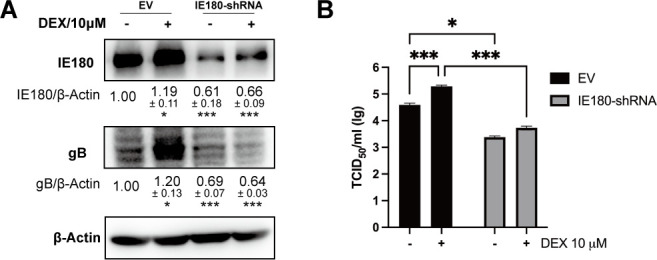
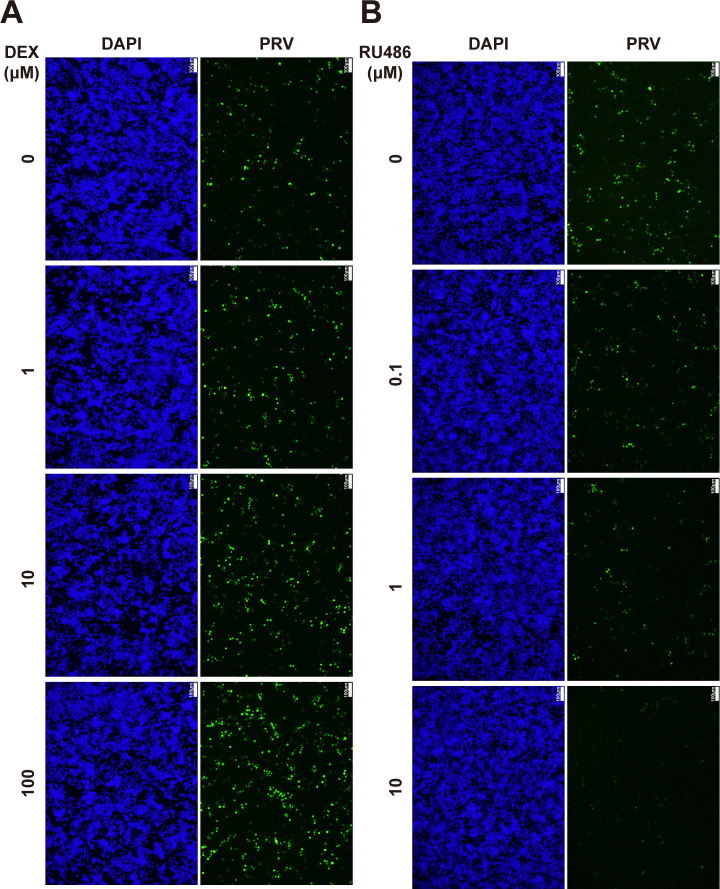
Pseudorabies virus (PRV) is a porcine neurotropic alphaherpesvirus that infects peripheral tissues of its host, spreads into the nervous system, and establishes a life-long latency in neuronal cells. During productive infection, PRV replicates rapidly and causes pseudorabies or Aujeszky's disease. Reactivation from latent infection in the nervous system may lead to anterograde axonal transport of progeny virions, leading to recurrent infection of the epithelial layer and virus spread. Dexamethasone (DEX), a member of the glucocorticoid family that is widely used in clinical treatment as a high-efficiency glucocorticoid receptor (GR) agonist, is known to trigger reactivation of alphaherpesviruses like PRV and the closely related bovine alphaherpesvirus 1. In the current study, two cell type-dependent distinct regulatory mechanisms of glucocorticoid during PRV infection are described. In neuron-like cells, DEX upregulates expression of PRV IE180 and promotes viral productive infection. In addition, we found that GR activates the IE180 promoter by binding multiple GR response elements. The amino acids A465, P631, and I634 in GR were found to be critical for IE180 promoter activation. The impact of DEX on PRV productive infection in epithelial cells was also investigated. Interestingly, DEX was found to downregulate IE180 expression and suppress PRV infection in epithelial cells. Mechanistically, in epithelial cells, activation of the IE180 promoter by the VP16/Oct-1 (octamer-binding transcription factor 1) complex was suppressed by DEX-mediated degradation of Oct-1 in epithelial cells. In summary, our work reveals two distinct, cell type-dependent biological functions of glucocorticoid during PRV infection in neuron-like and epithelial cells, respectively.IMPORTANCEPseudorabies virus (PRV) can infect mucosal epithelium and the peripheral nervous system of its host, resulting in acute infection in epithelial cells and neuronal cells. In this study, we describe that glucocorticoid promotes PRV replication in neuron-like cells while it suppresses productive infection in epithelial cells through distinct regulations of the viral transactivator IE180, thereby revealing a cell type-dependent regulatory mechanism of glucocorticoid on PRV infection. Therefore, our findings provide a new perspective on the role of glucocorticoids during PRV infection.
期刊介绍:
Journal of Virology (JVI) explores the nature of the viruses of animals, archaea, bacteria, fungi, plants, and protozoa. We welcome papers on virion structure and assembly, viral genome replication and regulation of gene expression, genetic diversity and evolution, virus-cell interactions, cellular responses to infection, transformation and oncogenesis, gene delivery, viral pathogenesis and immunity, and vaccines and antiviral agents.





 京公网安备 11010802042870号
京ICP备2023020795号-1
京公网安备 11010802042870号
京ICP备2023020795号-1

 分享
分享
 求助内容:
求助内容: 应助结果提醒方式:
 扫码关注我们
