Natan Diego Alves de Freitas, Lucas José Macedo Freire, Suely Ruth Silva, Nilton Guedes do Nascimento, Pedro Cordeiro-Estrela
{"title":"巴西东北部城市地区犬内脏利什曼病的空间分析和社会环境决定因素。","authors":"Natan Diego Alves de Freitas, Lucas José Macedo Freire, Suely Ruth Silva, Nilton Guedes do Nascimento, Pedro Cordeiro-Estrela","doi":"10.3390/tropicalmed10010006","DOIUrl":null,"url":null,"abstract":"<p><p>The urbanization process has led to significant changes in the landscape, shifting the epidemiological profile of the visceral leishmaniasis (VL) in Brazil. Dogs are considered the main urban reservoir of VL, whose infections precede cases in humans. In order to understand the socio-environmental determinants associated with canine visceral leishmaniasis (CVL), we conducted a spatial analysis of CVL cases in northeastern Brazil from 2013 to 2015, georeferencing 3288 domiciled dogs. We used linear mixed models to understand the ecoepidemiological determinants of CVL spatial relative risk (CVL SRR). Our findings indicate heterogeneity in CVL distribution, with 1 km diameter clusters potentially connected within an estimated 4.9 km diameter by the Ripley-K statistic. In our best-fit model, the CVL SRR was positively correlated with the proportion of households with literate heads, with trees, and with open sewage, but negatively correlated with vegetation phenology and mean income of the census sector. Here, we discuss the potential maintenance source of urban CVL clusters on a One Health framework. These findings highlight the complex interplay of socioeconomic and environmental factors in shaping the spatial distribution of CVL.</p>","PeriodicalId":23330,"journal":{"name":"Tropical Medicine and Infectious Disease","volume":"10 1","pages":""},"PeriodicalIF":2.6000,"publicationDate":"2024-12-26","publicationTypes":"Journal Article","fieldsOfStudy":null,"isOpenAccess":false,"openAccessPdf":"https://www.ncbi.nlm.nih.gov/pmc/articles/PMC11769515/pdf/","citationCount":"0","resultStr":"{\"title\":\"Spatial Analysis and Socio-Environmental Determinants of Canine Visceral Leishmaniasis in an Urban Area in Northeastern Brazil.\",\"authors\":\"Natan Diego Alves de Freitas, Lucas José Macedo Freire, Suely Ruth Silva, Nilton Guedes do Nascimento, Pedro Cordeiro-Estrela\",\"doi\":\"10.3390/tropicalmed10010006\",\"DOIUrl\":null,\"url\":null,\"abstract\":\"<p><p>The urbanization process has led to significant changes in the landscape, shifting the epidemiological profile of the visceral leishmaniasis (VL) in Brazil. Dogs are considered the main urban reservoir of VL, whose infections precede cases in humans. In order to understand the socio-environmental determinants associated with canine visceral leishmaniasis (CVL), we conducted a spatial analysis of CVL cases in northeastern Brazil from 2013 to 2015, georeferencing 3288 domiciled dogs. We used linear mixed models to understand the ecoepidemiological determinants of CVL spatial relative risk (CVL SRR). Our findings indicate heterogeneity in CVL distribution, with 1 km diameter clusters potentially connected within an estimated 4.9 km diameter by the Ripley-K statistic. In our best-fit model, the CVL SRR was positively correlated with the proportion of households with literate heads, with trees, and with open sewage, but negatively correlated with vegetation phenology and mean income of the census sector. Here, we discuss the potential maintenance source of urban CVL clusters on a One Health framework. These findings highlight the complex interplay of socioeconomic and environmental factors in shaping the spatial distribution of CVL.</p>\",\"PeriodicalId\":23330,\"journal\":{\"name\":\"Tropical Medicine and Infectious Disease\",\"volume\":\"10 1\",\"pages\":\"\"},\"PeriodicalIF\":2.6000,\"publicationDate\":\"2024-12-26\",\"publicationTypes\":\"Journal Article\",\"fieldsOfStudy\":null,\"isOpenAccess\":false,\"openAccessPdf\":\"https://www.ncbi.nlm.nih.gov/pmc/articles/PMC11769515/pdf/\",\"citationCount\":\"0\",\"resultStr\":null,\"platform\":\"Semanticscholar\",\"paperid\":null,\"PeriodicalName\":\"Tropical Medicine and Infectious Disease\",\"FirstCategoryId\":\"3\",\"ListUrlMain\":\"https://doi.org/10.3390/tropicalmed10010006\",\"RegionNum\":4,\"RegionCategory\":\"医学\",\"ArticlePicture\":[],\"TitleCN\":null,\"AbstractTextCN\":null,\"PMCID\":null,\"EPubDate\":\"\",\"PubModel\":\"\",\"JCR\":\"Q2\",\"JCRName\":\"INFECTIOUS DISEASES\",\"Score\":null,\"Total\":0}","platform":"Semanticscholar","paperid":null,"PeriodicalName":"Tropical Medicine and Infectious Disease","FirstCategoryId":"3","ListUrlMain":"https://doi.org/10.3390/tropicalmed10010006","RegionNum":4,"RegionCategory":"医学","ArticlePicture":[],"TitleCN":null,"AbstractTextCN":null,"PMCID":null,"EPubDate":"","PubModel":"","JCR":"Q2","JCRName":"INFECTIOUS DISEASES","Score":null,"Total":0}
Spatial Analysis and Socio-Environmental Determinants of Canine Visceral Leishmaniasis in an Urban Area in Northeastern Brazil.
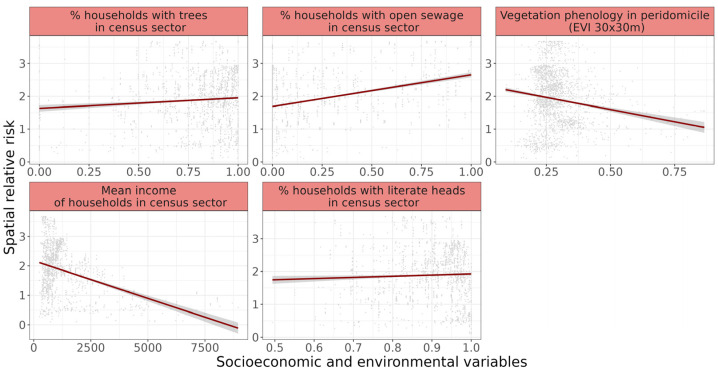
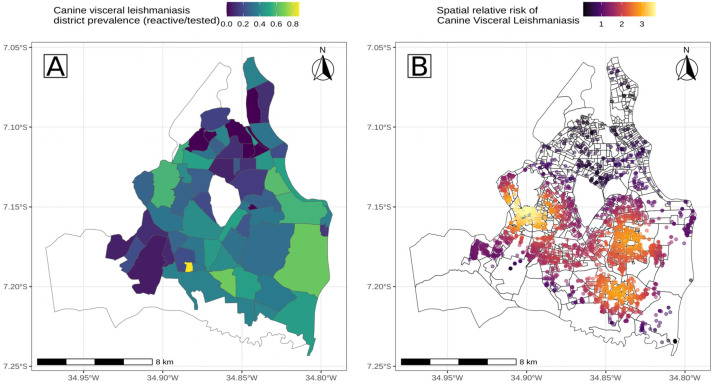
The urbanization process has led to significant changes in the landscape, shifting the epidemiological profile of the visceral leishmaniasis (VL) in Brazil. Dogs are considered the main urban reservoir of VL, whose infections precede cases in humans. In order to understand the socio-environmental determinants associated with canine visceral leishmaniasis (CVL), we conducted a spatial analysis of CVL cases in northeastern Brazil from 2013 to 2015, georeferencing 3288 domiciled dogs. We used linear mixed models to understand the ecoepidemiological determinants of CVL spatial relative risk (CVL SRR). Our findings indicate heterogeneity in CVL distribution, with 1 km diameter clusters potentially connected within an estimated 4.9 km diameter by the Ripley-K statistic. In our best-fit model, the CVL SRR was positively correlated with the proportion of households with literate heads, with trees, and with open sewage, but negatively correlated with vegetation phenology and mean income of the census sector. Here, we discuss the potential maintenance source of urban CVL clusters on a One Health framework. These findings highlight the complex interplay of socioeconomic and environmental factors in shaping the spatial distribution of CVL.






 京公网安备 11010802042870号
京ICP备2023020795号-1
京公网安备 11010802042870号
京ICP备2023020795号-1

 分享
分享
 求助内容:
求助内容: 应助结果提醒方式:
 扫码关注我们
