{"title":"IL-4激活的组织巨噬细胞的遗传变异在表观遗传学上决定了菌株对LPS的特异性协同反应","authors":"Mingming Zhao, Dragana Jankovic, Verena M. Link, Camila Oliveira Silva Souza, Katherine M. Hornick, Oyebola Oyesola, Yasmine Belkaid, Justin Lack, Png Loke","doi":"10.1038/s41467-025-56379-8","DOIUrl":null,"url":null,"abstract":"<p>How macrophages in the tissue environment integrate multiple stimuli depends on the genetic background of the host, but this is still poorly understood. We investigate IL-4 activation of male C57BL/6 and BALB/c strain specific in vivo tissue-resident macrophages (TRMs) from the peritoneal cavity. C57BL/6 TRMs are more transcriptionally responsive to IL-4 stimulation, with induced genes associated with more super enhancers, induced enhancers, and topologically associating domains (TAD) boundaries. IL-4-directed epigenomic remodeling reveals C57BL/6 specific enrichment of NF-κB, IRF, and STAT motifs. Additionally, IL-4-activated C57BL/6 TRMs demonstrate an augmented synergistic response upon in vitro lipopolysaccharide (LPS) exposure, despite naïve BALB/c TRMs displaying a more robust transcriptional response to LPS. Single-cell RNA sequencing (scRNA-seq) analysis of mixed bone marrow chimeras indicates that transcriptional differences and synergy are cell intrinsic within the same tissue environment. Hence, genetic variation alters IL-4-induced cell intrinsic epigenetic reprogramming resulting in strain specific synergistic responses to LPS exposure.</p>","PeriodicalId":19066,"journal":{"name":"Nature Communications","volume":"29 1","pages":""},"PeriodicalIF":18.1000,"publicationDate":"2025-01-25","publicationTypes":"Journal Article","fieldsOfStudy":null,"isOpenAccess":false,"openAccessPdf":"","citationCount":"0","resultStr":"{\"title\":\"Genetic variation in IL-4 activated tissue resident macrophages determines strain-specific synergistic responses to LPS epigenetically\",\"authors\":\"Mingming Zhao, Dragana Jankovic, Verena M. Link, Camila Oliveira Silva Souza, Katherine M. Hornick, Oyebola Oyesola, Yasmine Belkaid, Justin Lack, Png Loke\",\"doi\":\"10.1038/s41467-025-56379-8\",\"DOIUrl\":null,\"url\":null,\"abstract\":\"<p>How macrophages in the tissue environment integrate multiple stimuli depends on the genetic background of the host, but this is still poorly understood. We investigate IL-4 activation of male C57BL/6 and BALB/c strain specific in vivo tissue-resident macrophages (TRMs) from the peritoneal cavity. C57BL/6 TRMs are more transcriptionally responsive to IL-4 stimulation, with induced genes associated with more super enhancers, induced enhancers, and topologically associating domains (TAD) boundaries. IL-4-directed epigenomic remodeling reveals C57BL/6 specific enrichment of NF-κB, IRF, and STAT motifs. Additionally, IL-4-activated C57BL/6 TRMs demonstrate an augmented synergistic response upon in vitro lipopolysaccharide (LPS) exposure, despite naïve BALB/c TRMs displaying a more robust transcriptional response to LPS. Single-cell RNA sequencing (scRNA-seq) analysis of mixed bone marrow chimeras indicates that transcriptional differences and synergy are cell intrinsic within the same tissue environment. Hence, genetic variation alters IL-4-induced cell intrinsic epigenetic reprogramming resulting in strain specific synergistic responses to LPS exposure.</p>\",\"PeriodicalId\":19066,\"journal\":{\"name\":\"Nature Communications\",\"volume\":\"29 1\",\"pages\":\"\"},\"PeriodicalIF\":18.1000,\"publicationDate\":\"2025-01-25\",\"publicationTypes\":\"Journal Article\",\"fieldsOfStudy\":null,\"isOpenAccess\":false,\"openAccessPdf\":\"\",\"citationCount\":\"0\",\"resultStr\":null,\"platform\":\"Semanticscholar\",\"paperid\":null,\"PeriodicalName\":\"Nature Communications\",\"FirstCategoryId\":\"103\",\"ListUrlMain\":\"https://doi.org/10.1038/s41467-025-56379-8\",\"RegionNum\":1,\"RegionCategory\":\"综合性期刊\",\"ArticlePicture\":[],\"TitleCN\":null,\"AbstractTextCN\":null,\"PMCID\":null,\"EPubDate\":\"\",\"PubModel\":\"\",\"JCR\":\"Q1\",\"JCRName\":\"MULTIDISCIPLINARY SCIENCES\",\"Score\":null,\"Total\":0}","platform":"Semanticscholar","paperid":null,"PeriodicalName":"Nature Communications","FirstCategoryId":"103","ListUrlMain":"https://doi.org/10.1038/s41467-025-56379-8","RegionNum":1,"RegionCategory":"综合性期刊","ArticlePicture":[],"TitleCN":null,"AbstractTextCN":null,"PMCID":null,"EPubDate":"","PubModel":"","JCR":"Q1","JCRName":"MULTIDISCIPLINARY SCIENCES","Score":null,"Total":0}
Genetic variation in IL-4 activated tissue resident macrophages determines strain-specific synergistic responses to LPS epigenetically
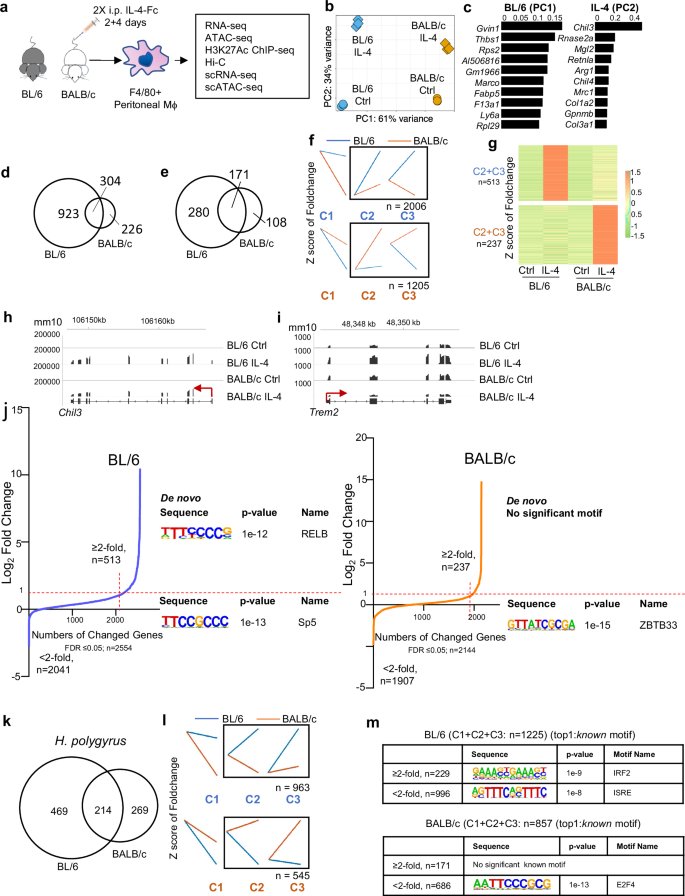
How macrophages in the tissue environment integrate multiple stimuli depends on the genetic background of the host, but this is still poorly understood. We investigate IL-4 activation of male C57BL/6 and BALB/c strain specific in vivo tissue-resident macrophages (TRMs) from the peritoneal cavity. C57BL/6 TRMs are more transcriptionally responsive to IL-4 stimulation, with induced genes associated with more super enhancers, induced enhancers, and topologically associating domains (TAD) boundaries. IL-4-directed epigenomic remodeling reveals C57BL/6 specific enrichment of NF-κB, IRF, and STAT motifs. Additionally, IL-4-activated C57BL/6 TRMs demonstrate an augmented synergistic response upon in vitro lipopolysaccharide (LPS) exposure, despite naïve BALB/c TRMs displaying a more robust transcriptional response to LPS. Single-cell RNA sequencing (scRNA-seq) analysis of mixed bone marrow chimeras indicates that transcriptional differences and synergy are cell intrinsic within the same tissue environment. Hence, genetic variation alters IL-4-induced cell intrinsic epigenetic reprogramming resulting in strain specific synergistic responses to LPS exposure.
期刊介绍:
Nature Communications, an open-access journal, publishes high-quality research spanning all areas of the natural sciences. Papers featured in the journal showcase significant advances relevant to specialists in each respective field. With a 2-year impact factor of 16.6 (2022) and a median time of 8 days from submission to the first editorial decision, Nature Communications is committed to rapid dissemination of research findings. As a multidisciplinary journal, it welcomes contributions from biological, health, physical, chemical, Earth, social, mathematical, applied, and engineering sciences, aiming to highlight important breakthroughs within each domain.




 京公网安备 11010802042870号
京ICP备2023020795号-1
京公网安备 11010802042870号
京ICP备2023020795号-1

 分享
分享
 求助内容:
求助内容: 应助结果提醒方式:
 扫码关注我们
