Aman Khurana, Nathan Chai, Amanda Gibson, Joseph Owen, Ahmed Sobieh, Gregory Hawk, James Lee
{"title":"肝细胞癌外植体病理预后与LR治疗反应类别的关系。","authors":"Aman Khurana, Nathan Chai, Amanda Gibson, Joseph Owen, Ahmed Sobieh, Gregory Hawk, James Lee","doi":"10.1007/s00261-025-04811-4","DOIUrl":null,"url":null,"abstract":"<div><h3>Objectives</h3><p>Liver transplant (LT) is an effective treatment for hepatocellular carcinoma (HCC) in appropriately selected patients. Locoregional therapy (LRT) is often performed to extend a patient’s eligibility for LT. Imaging has a modest sensitivity of approximately 40–77% for detecting pathologically viable HCC in post-LRT patients. The impact on overall survival (OS) and disease-free survival (DFS) is unclear. We hypothesize that Liver Imaging Reporting & Data Systems Treatment Response (LI-RADS TR) category is equivalently correlated with long-term survival and overall disease-free progression when compared to explant pathology findings. We additionally hypothesize that neoadjuvant LRT can improve OS and DFS in LT patients initially within MC.</p><h3>Methods</h3><p>Patients found to have HCC on explant between January 2005 and December 2021 were included. A total of 167 patients were divided into treatment (any pre-LT LRT except for Y-90 therapy) and control (no pre-LT LRT) groups. Of the patients who received pre-LT LRT, imaging studies were reviewed by two abdominal radiologists using 2018 LI-RADS criteria. Statistical analysis was performed using Kaplan-Meier survival curves and Cox proportional hazard models to assess OS and DFS.</p><h3>Results</h3><p>No statistically significant difference in OS or DFS (<i>p</i> = 0.23 and <i>p</i> = 0.22 respectively) was initially found. Given significant difference in age between the groups (<i>p</i> < 0.0001), Cox proportional hazard models were used to adjust for age with statistical significance reached for better OS and DFS in the treatment group (<i>p</i> = 0.05 and <i>p</i> = 0.05 respectively). Contrary to our hypothesis, there was no difference between treatment response groups regarding overall survival or disease-free survival, presumably because of low number of HCC recurrences in our patient population (4%).</p><h3>Conclusion</h3><p>Despite not reaching statistical significance, LI-RADS TR categorization demonstrates a good interreader agreement (Kappa 0.6), helping radiologists feel comfortable that modest sensitivity of the LI-RADS TR treatment response category for detecting pathologically active malignancy does not confer a negative clinical outcome.</p></div>","PeriodicalId":7126,"journal":{"name":"Abdominal Radiology","volume":"50 8","pages":"3488 - 3496"},"PeriodicalIF":2.2000,"publicationDate":"2025-01-25","publicationTypes":"Journal Article","fieldsOfStudy":null,"isOpenAccess":false,"openAccessPdf":"https://www.ncbi.nlm.nih.gov/pmc/articles/PMC12267355/pdf/","citationCount":"0","resultStr":"{\"title\":\"Association of LR treatment response category with outcome of patients with hepatocellular carcinoma on explant pathology\",\"authors\":\"Aman Khurana, Nathan Chai, Amanda Gibson, Joseph Owen, Ahmed Sobieh, Gregory Hawk, James Lee\",\"doi\":\"10.1007/s00261-025-04811-4\",\"DOIUrl\":null,\"url\":null,\"abstract\":\"<div><h3>Objectives</h3><p>Liver transplant (LT) is an effective treatment for hepatocellular carcinoma (HCC) in appropriately selected patients. Locoregional therapy (LRT) is often performed to extend a patient’s eligibility for LT. Imaging has a modest sensitivity of approximately 40–77% for detecting pathologically viable HCC in post-LRT patients. The impact on overall survival (OS) and disease-free survival (DFS) is unclear. We hypothesize that Liver Imaging Reporting & Data Systems Treatment Response (LI-RADS TR) category is equivalently correlated with long-term survival and overall disease-free progression when compared to explant pathology findings. We additionally hypothesize that neoadjuvant LRT can improve OS and DFS in LT patients initially within MC.</p><h3>Methods</h3><p>Patients found to have HCC on explant between January 2005 and December 2021 were included. A total of 167 patients were divided into treatment (any pre-LT LRT except for Y-90 therapy) and control (no pre-LT LRT) groups. Of the patients who received pre-LT LRT, imaging studies were reviewed by two abdominal radiologists using 2018 LI-RADS criteria. Statistical analysis was performed using Kaplan-Meier survival curves and Cox proportional hazard models to assess OS and DFS.</p><h3>Results</h3><p>No statistically significant difference in OS or DFS (<i>p</i> = 0.23 and <i>p</i> = 0.22 respectively) was initially found. Given significant difference in age between the groups (<i>p</i> < 0.0001), Cox proportional hazard models were used to adjust for age with statistical significance reached for better OS and DFS in the treatment group (<i>p</i> = 0.05 and <i>p</i> = 0.05 respectively). Contrary to our hypothesis, there was no difference between treatment response groups regarding overall survival or disease-free survival, presumably because of low number of HCC recurrences in our patient population (4%).</p><h3>Conclusion</h3><p>Despite not reaching statistical significance, LI-RADS TR categorization demonstrates a good interreader agreement (Kappa 0.6), helping radiologists feel comfortable that modest sensitivity of the LI-RADS TR treatment response category for detecting pathologically active malignancy does not confer a negative clinical outcome.</p></div>\",\"PeriodicalId\":7126,\"journal\":{\"name\":\"Abdominal Radiology\",\"volume\":\"50 8\",\"pages\":\"3488 - 3496\"},\"PeriodicalIF\":2.2000,\"publicationDate\":\"2025-01-25\",\"publicationTypes\":\"Journal Article\",\"fieldsOfStudy\":null,\"isOpenAccess\":false,\"openAccessPdf\":\"https://www.ncbi.nlm.nih.gov/pmc/articles/PMC12267355/pdf/\",\"citationCount\":\"0\",\"resultStr\":null,\"platform\":\"Semanticscholar\",\"paperid\":null,\"PeriodicalName\":\"Abdominal Radiology\",\"FirstCategoryId\":\"3\",\"ListUrlMain\":\"https://link.springer.com/article/10.1007/s00261-025-04811-4\",\"RegionNum\":3,\"RegionCategory\":\"医学\",\"ArticlePicture\":[],\"TitleCN\":null,\"AbstractTextCN\":null,\"PMCID\":null,\"EPubDate\":\"\",\"PubModel\":\"\",\"JCR\":\"Q2\",\"JCRName\":\"RADIOLOGY, NUCLEAR MEDICINE & MEDICAL IMAGING\",\"Score\":null,\"Total\":0}","platform":"Semanticscholar","paperid":null,"PeriodicalName":"Abdominal Radiology","FirstCategoryId":"3","ListUrlMain":"https://link.springer.com/article/10.1007/s00261-025-04811-4","RegionNum":3,"RegionCategory":"医学","ArticlePicture":[],"TitleCN":null,"AbstractTextCN":null,"PMCID":null,"EPubDate":"","PubModel":"","JCR":"Q2","JCRName":"RADIOLOGY, NUCLEAR MEDICINE & MEDICAL IMAGING","Score":null,"Total":0}
引用次数: 0
摘要
目的:肝移植是治疗肝细胞癌(HCC)的有效方法。局部治疗(LRT)通常用于延长患者接受LRT的资格。在LRT后患者中,影像学检测病理存活的HCC的灵敏度约为40-77%。对总生存期(OS)和无病生存期(DFS)的影响尚不清楚。我们假设,与外植体病理结果相比,肝脏成像报告和数据系统治疗反应(LI-RADS TR)类别与长期生存和总体无病进展同等相关。此外,我们假设新辅助LRT可以改善肝癌患者的OS和DFS。方法:纳入2005年1月至2021年12月期间发现的外植体HCC患者。167例患者被分为治疗组(除Y-90治疗外的任何lt前LRT)和对照组(无lt前LRT)。在接受lt前LRT的患者中,两名腹部放射科医生使用2018年LI-RADS标准审查了影像学研究。采用Kaplan-Meier生存曲线和Cox比例风险模型进行统计学分析,评估OS和DFS。结果:初始OS和DFS差异无统计学意义(p = 0.23, p = 0.22)。结论:尽管没有达到统计学意义,但LI-RADS TR分类显示出良好的解读一致性(Kappa 0.6),帮助放射科医生感到放心,LI-RADS TR治疗反应分类对检测病理活动性恶性肿瘤的适度敏感性并不会带来负面的临床结果。
Association of LR treatment response category with outcome of patients with hepatocellular carcinoma on explant pathology
Objectives
Liver transplant (LT) is an effective treatment for hepatocellular carcinoma (HCC) in appropriately selected patients. Locoregional therapy (LRT) is often performed to extend a patient’s eligibility for LT. Imaging has a modest sensitivity of approximately 40–77% for detecting pathologically viable HCC in post-LRT patients. The impact on overall survival (OS) and disease-free survival (DFS) is unclear. We hypothesize that Liver Imaging Reporting & Data Systems Treatment Response (LI-RADS TR) category is equivalently correlated with long-term survival and overall disease-free progression when compared to explant pathology findings. We additionally hypothesize that neoadjuvant LRT can improve OS and DFS in LT patients initially within MC.
Methods
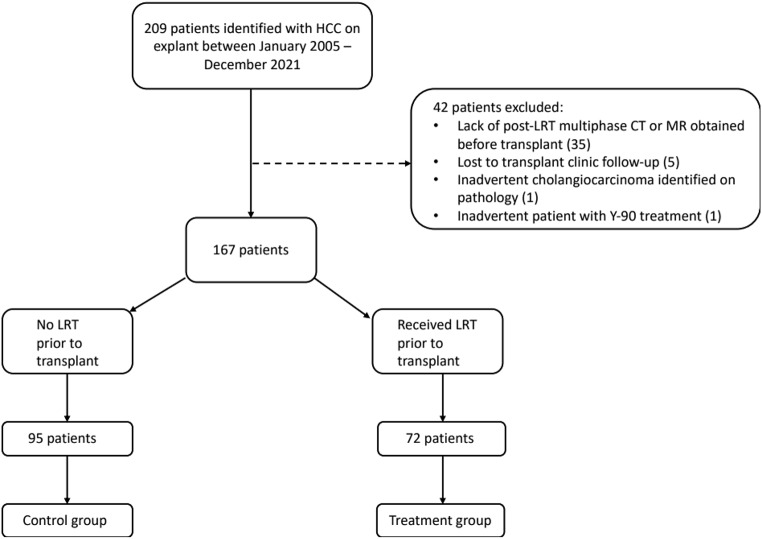
Patients found to have HCC on explant between January 2005 and December 2021 were included. A total of 167 patients were divided into treatment (any pre-LT LRT except for Y-90 therapy) and control (no pre-LT LRT) groups. Of the patients who received pre-LT LRT, imaging studies were reviewed by two abdominal radiologists using 2018 LI-RADS criteria. Statistical analysis was performed using Kaplan-Meier survival curves and Cox proportional hazard models to assess OS and DFS.
Results
No statistically significant difference in OS or DFS (p = 0.23 and p = 0.22 respectively) was initially found. Given significant difference in age between the groups (p < 0.0001), Cox proportional hazard models were used to adjust for age with statistical significance reached for better OS and DFS in the treatment group (p = 0.05 and p = 0.05 respectively). Contrary to our hypothesis, there was no difference between treatment response groups regarding overall survival or disease-free survival, presumably because of low number of HCC recurrences in our patient population (4%).
Conclusion
Despite not reaching statistical significance, LI-RADS TR categorization demonstrates a good interreader agreement (Kappa 0.6), helping radiologists feel comfortable that modest sensitivity of the LI-RADS TR treatment response category for detecting pathologically active malignancy does not confer a negative clinical outcome.
期刊介绍:
Abdominal Radiology seeks to meet the professional needs of the abdominal radiologist by publishing clinically pertinent original, review and practice related articles on the gastrointestinal and genitourinary tracts and abdominal interventional and radiologic procedures. Case reports are generally not accepted unless they are the first report of a new disease or condition, or part of a special solicited section.
Reasons to Publish Your Article in Abdominal Radiology:
· Official journal of the Society of Abdominal Radiology (SAR)
· Published in Cooperation with:
European Society of Gastrointestinal and Abdominal Radiology (ESGAR)
European Society of Urogenital Radiology (ESUR)
Asian Society of Abdominal Radiology (ASAR)
· Efficient handling and Expeditious review
· Author feedback is provided in a mentoring style
· Global readership
· Readers can earn CME credits






 京公网安备 11010802042870号
京ICP备2023020795号-1
京公网安备 11010802042870号
京ICP备2023020795号-1

 分享
分享
 求助内容:
求助内容: 应助结果提醒方式:
 扫码关注我们
