Veronika Sebestyén, Dóra Ujvárosy, Balázs Ratku, Hajnalka Lőrincz, Sára Csiha, Dóra Tari, Gyöngyike Majai, Sándor Somodi, Gabriella Szűcs, Mariann Harangi, Zoltán Szabó
{"title":"炎症生物标志物和脂质参数可能预测系统性硬化症患者心房心律失常的风险增加。","authors":"Veronika Sebestyén, Dóra Ujvárosy, Balázs Ratku, Hajnalka Lőrincz, Sára Csiha, Dóra Tari, Gyöngyike Majai, Sándor Somodi, Gabriella Szűcs, Mariann Harangi, Zoltán Szabó","doi":"10.3390/biomedicines13010220","DOIUrl":null,"url":null,"abstract":"<p><strong>Background/objectives: </strong>Autoimmune inflammation enhances the electrical instability of the atrial myocardium in patients with systemic sclerosis (SSc); thus, atrial arrhythmia risk is increased, which might be predicted by evaluating the P wave interval and dispersion of a 12-lead surface electrocardiogram (ECG).</p><p><strong>Methods: </strong>We examined 26 SSc patients and 36 healthy controls and measured the P wave interval and P wave dispersion of the 12-lead surface ECG in each patient. Furthermore, echocardiography and 24-h Holter ECG were performed and levels of inflammatory laboratory parameters, including serum progranulin (PGRN), sVCAM-1, sICAM-1, leptin and C-reactive protein (CRP), were determined. Lipid parameters, such as Apo A-I, LDL-cholesterol (LDL-C), oxidized LDL (oxLDL) and the LDL and HDL subfractions were also evaluated.</p><p><strong>Results: </strong>The P wave interval showed a significant positive correlation with the levels of Apo A-I, LDL-C, CRP, sVCAM-1, sICAM-1 and leptin. The oxLDL level correlated positively with P wave dispersion. Of note, significant positive correlation was also found between the large HDL percentage and the P wave interval.</p><p><strong>Conclusions: </strong>Our results suggest that PGRN, sVCAM-1, sICAM-1, leptin, CRP, LDL-C and oxLDL, along with LDL and HDL subfractions, might have a role in atrial arrhythmogenesis in patients with SSc.</p>","PeriodicalId":8937,"journal":{"name":"Biomedicines","volume":"13 1","pages":""},"PeriodicalIF":4.5000,"publicationDate":"2025-01-16","publicationTypes":"Journal Article","fieldsOfStudy":null,"isOpenAccess":false,"openAccessPdf":"https://www.ncbi.nlm.nih.gov/pmc/articles/PMC11762971/pdf/","citationCount":"0","resultStr":"{\"title\":\"Inflammatory Biomarkers and Lipid Parameters May Predict an Increased Risk for Atrial Arrhythmias in Patients with Systemic Sclerosis.\",\"authors\":\"Veronika Sebestyén, Dóra Ujvárosy, Balázs Ratku, Hajnalka Lőrincz, Sára Csiha, Dóra Tari, Gyöngyike Majai, Sándor Somodi, Gabriella Szűcs, Mariann Harangi, Zoltán Szabó\",\"doi\":\"10.3390/biomedicines13010220\",\"DOIUrl\":null,\"url\":null,\"abstract\":\"<p><strong>Background/objectives: </strong>Autoimmune inflammation enhances the electrical instability of the atrial myocardium in patients with systemic sclerosis (SSc); thus, atrial arrhythmia risk is increased, which might be predicted by evaluating the P wave interval and dispersion of a 12-lead surface electrocardiogram (ECG).</p><p><strong>Methods: </strong>We examined 26 SSc patients and 36 healthy controls and measured the P wave interval and P wave dispersion of the 12-lead surface ECG in each patient. Furthermore, echocardiography and 24-h Holter ECG were performed and levels of inflammatory laboratory parameters, including serum progranulin (PGRN), sVCAM-1, sICAM-1, leptin and C-reactive protein (CRP), were determined. Lipid parameters, such as Apo A-I, LDL-cholesterol (LDL-C), oxidized LDL (oxLDL) and the LDL and HDL subfractions were also evaluated.</p><p><strong>Results: </strong>The P wave interval showed a significant positive correlation with the levels of Apo A-I, LDL-C, CRP, sVCAM-1, sICAM-1 and leptin. The oxLDL level correlated positively with P wave dispersion. Of note, significant positive correlation was also found between the large HDL percentage and the P wave interval.</p><p><strong>Conclusions: </strong>Our results suggest that PGRN, sVCAM-1, sICAM-1, leptin, CRP, LDL-C and oxLDL, along with LDL and HDL subfractions, might have a role in atrial arrhythmogenesis in patients with SSc.</p>\",\"PeriodicalId\":8937,\"journal\":{\"name\":\"Biomedicines\",\"volume\":\"13 1\",\"pages\":\"\"},\"PeriodicalIF\":4.5000,\"publicationDate\":\"2025-01-16\",\"publicationTypes\":\"Journal Article\",\"fieldsOfStudy\":null,\"isOpenAccess\":false,\"openAccessPdf\":\"https://www.ncbi.nlm.nih.gov/pmc/articles/PMC11762971/pdf/\",\"citationCount\":\"0\",\"resultStr\":null,\"platform\":\"Semanticscholar\",\"paperid\":null,\"PeriodicalName\":\"Biomedicines\",\"FirstCategoryId\":\"5\",\"ListUrlMain\":\"https://doi.org/10.3390/biomedicines13010220\",\"RegionNum\":3,\"RegionCategory\":\"工程技术\",\"ArticlePicture\":[],\"TitleCN\":null,\"AbstractTextCN\":null,\"PMCID\":null,\"EPubDate\":\"\",\"PubModel\":\"\",\"JCR\":\"Q2\",\"JCRName\":\"BIOCHEMISTRY & MOLECULAR BIOLOGY\",\"Score\":null,\"Total\":0}","platform":"Semanticscholar","paperid":null,"PeriodicalName":"Biomedicines","FirstCategoryId":"5","ListUrlMain":"https://doi.org/10.3390/biomedicines13010220","RegionNum":3,"RegionCategory":"工程技术","ArticlePicture":[],"TitleCN":null,"AbstractTextCN":null,"PMCID":null,"EPubDate":"","PubModel":"","JCR":"Q2","JCRName":"BIOCHEMISTRY & MOLECULAR BIOLOGY","Score":null,"Total":0}
引用次数: 0
摘要
背景/目的:自身免疫性炎症增强系统性硬化症(SSc)患者心房心肌电不稳定性;因此,房性心律失常的风险增加,这可以通过评估12导联体表心电图的P波间隔和离散度来预测。方法:对26例SSc患者和36例健康对照进行12导联体表心电图P波间隔和P波离散度的测定。此外,进行超声心动图和24小时动态心电图检查,并检测血清颗粒前蛋白(PGRN)、sVCAM-1、sICAM-1、瘦素和c反应蛋白(CRP)等炎性实验室参数的水平。脂质参数,如载脂蛋白A-I, LDL-胆固醇(LDL- c),氧化LDL (oxLDL)和LDL和HDL亚组分也进行了评估。结果:P波间隔与Apo a - i、LDL-C、CRP、sVCAM-1、sICAM-1、瘦素水平呈显著正相关。oxLDL水平与P波弥散度呈正相关。值得注意的是,高密度脂蛋白百分比与P波间隔之间也存在显著的正相关。结论:我们的研究结果提示PGRN、sVCAM-1、sICAM-1、瘦素、CRP、LDL- c和oxLDL以及LDL和HDL亚部分可能在SSc患者心房心律失常发生中起作用。
Inflammatory Biomarkers and Lipid Parameters May Predict an Increased Risk for Atrial Arrhythmias in Patients with Systemic Sclerosis.
Background/objectives: Autoimmune inflammation enhances the electrical instability of the atrial myocardium in patients with systemic sclerosis (SSc); thus, atrial arrhythmia risk is increased, which might be predicted by evaluating the P wave interval and dispersion of a 12-lead surface electrocardiogram (ECG).
Methods: We examined 26 SSc patients and 36 healthy controls and measured the P wave interval and P wave dispersion of the 12-lead surface ECG in each patient. Furthermore, echocardiography and 24-h Holter ECG were performed and levels of inflammatory laboratory parameters, including serum progranulin (PGRN), sVCAM-1, sICAM-1, leptin and C-reactive protein (CRP), were determined. Lipid parameters, such as Apo A-I, LDL-cholesterol (LDL-C), oxidized LDL (oxLDL) and the LDL and HDL subfractions were also evaluated.
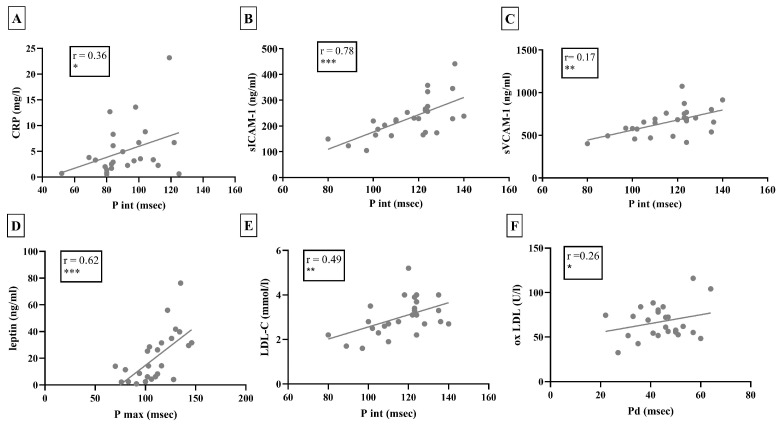
Results: The P wave interval showed a significant positive correlation with the levels of Apo A-I, LDL-C, CRP, sVCAM-1, sICAM-1 and leptin. The oxLDL level correlated positively with P wave dispersion. Of note, significant positive correlation was also found between the large HDL percentage and the P wave interval.
Conclusions: Our results suggest that PGRN, sVCAM-1, sICAM-1, leptin, CRP, LDL-C and oxLDL, along with LDL and HDL subfractions, might have a role in atrial arrhythmogenesis in patients with SSc.
BiomedicinesBiochemistry, Genetics and Molecular Biology-General Biochemistry,Genetics and Molecular Biology
CiteScore
5.20
自引率
8.50%
发文量
2823
审稿时长
8 weeks
期刊介绍:
Biomedicines (ISSN 2227-9059; CODEN: BIOMID) is an international, scientific, open access journal on biomedicines published quarterly online by MDPI.






 京公网安备 11010802042870号
京ICP备2023020795号-1
京公网安备 11010802042870号
京ICP备2023020795号-1

 分享
分享
 求助内容:
求助内容: 应助结果提醒方式:
 扫码关注我们
