{"title":"生物医学用纳米颗粒来源于天然生物分子:单宁酸和精氨酸。","authors":"Mehtap Sahiner, Selin S Suner, Nurettin Sahiner","doi":"10.3390/biomedicines13010209","DOIUrl":null,"url":null,"abstract":"<p><p><b>Background/Objectives</b>: Tannic acid (TA) is a well-known natural phenolic acid composed of ten gallic acids linked to each other with ester bonding possessing excellent antioxidant properties in addition to antimicrobial and anticancer characteristics. Arginine (ARG) is a positively charged amino acid at physiological pH because of nitrogen-rich side chain. <b>Method</b>: Here, poly(tannic acid-co-arginine) (p(TA-co-ARG)) particles at three mole ratios, TA:ARG = 1:1, 1:2, and 1:3, were prepared via a Mannich condensation reaction between TA and ARG by utilizing formaldehyde as a linking agent. <b>Results</b>: The p(TA-co-ARG) particles in 300-1000 nm size range with smooth surfaces visualized via SEM analysis were attained. Abundant numbers of functional groups, -OH, -NH<sub>2</sub>, and -COOH stemming from TA and ARG constituent confirmed by FT-IR analysis. The isoelectric point (IEP) of the particles increased from pH 4.98 to pH 7.30 by increasing the ARG ratios in p(TA-co-ARG) particles. The antioxidant capacity of p(TA-co-ARG) particles via gallic acid (GA) and rosmarinic acid (RA) equivalents tests revealed that particles possess concentration-dependent antioxidant potency and increased by TA content. The α-glucosidase inhibition of p(TA-co-ARG) particles (2 mg/mL) 1:1 and 1:2 mole ratios revealed significant enzyme inhibition ability, e.g., 91.3 ± 3.1% and 77.6 ± 12.0%. Interestingly, p(TA-co-ARG) (1:3 ratio) possessed significant antibacterial effectiveness against <i>Escherichia coli</i> (ATCC 8739) and <i>Staphylococcus aureus</i> (ATCC 6538) bacteria. Furthermore, all p(TA-co-ARG) particles at 1000 mg/mL concentration showed >80% toxicity on L929 fibroblast cells and increased as ARG content of p(TA-co-ARG) particles is increased. <b>Conclusions</b>: p(TA-co-ARG) showed significant potential as natural biomaterials for biomedical use.</p>","PeriodicalId":8937,"journal":{"name":"Biomedicines","volume":"13 1","pages":""},"PeriodicalIF":3.9000,"publicationDate":"2025-01-16","publicationTypes":"Journal Article","fieldsOfStudy":null,"isOpenAccess":false,"openAccessPdf":"https://www.ncbi.nlm.nih.gov/pmc/articles/PMC11762816/pdf/","citationCount":"0","resultStr":"{\"title\":\"Nanoparticles for Biomedical Use Derived from Natural Biomolecules: Tannic Acid and Arginine.\",\"authors\":\"Mehtap Sahiner, Selin S Suner, Nurettin Sahiner\",\"doi\":\"10.3390/biomedicines13010209\",\"DOIUrl\":null,\"url\":null,\"abstract\":\"<p><p><b>Background/Objectives</b>: Tannic acid (TA) is a well-known natural phenolic acid composed of ten gallic acids linked to each other with ester bonding possessing excellent antioxidant properties in addition to antimicrobial and anticancer characteristics. Arginine (ARG) is a positively charged amino acid at physiological pH because of nitrogen-rich side chain. <b>Method</b>: Here, poly(tannic acid-co-arginine) (p(TA-co-ARG)) particles at three mole ratios, TA:ARG = 1:1, 1:2, and 1:3, were prepared via a Mannich condensation reaction between TA and ARG by utilizing formaldehyde as a linking agent. <b>Results</b>: The p(TA-co-ARG) particles in 300-1000 nm size range with smooth surfaces visualized via SEM analysis were attained. Abundant numbers of functional groups, -OH, -NH<sub>2</sub>, and -COOH stemming from TA and ARG constituent confirmed by FT-IR analysis. The isoelectric point (IEP) of the particles increased from pH 4.98 to pH 7.30 by increasing the ARG ratios in p(TA-co-ARG) particles. The antioxidant capacity of p(TA-co-ARG) particles via gallic acid (GA) and rosmarinic acid (RA) equivalents tests revealed that particles possess concentration-dependent antioxidant potency and increased by TA content. The α-glucosidase inhibition of p(TA-co-ARG) particles (2 mg/mL) 1:1 and 1:2 mole ratios revealed significant enzyme inhibition ability, e.g., 91.3 ± 3.1% and 77.6 ± 12.0%. Interestingly, p(TA-co-ARG) (1:3 ratio) possessed significant antibacterial effectiveness against <i>Escherichia coli</i> (ATCC 8739) and <i>Staphylococcus aureus</i> (ATCC 6538) bacteria. Furthermore, all p(TA-co-ARG) particles at 1000 mg/mL concentration showed >80% toxicity on L929 fibroblast cells and increased as ARG content of p(TA-co-ARG) particles is increased. <b>Conclusions</b>: p(TA-co-ARG) showed significant potential as natural biomaterials for biomedical use.</p>\",\"PeriodicalId\":8937,\"journal\":{\"name\":\"Biomedicines\",\"volume\":\"13 1\",\"pages\":\"\"},\"PeriodicalIF\":3.9000,\"publicationDate\":\"2025-01-16\",\"publicationTypes\":\"Journal Article\",\"fieldsOfStudy\":null,\"isOpenAccess\":false,\"openAccessPdf\":\"https://www.ncbi.nlm.nih.gov/pmc/articles/PMC11762816/pdf/\",\"citationCount\":\"0\",\"resultStr\":null,\"platform\":\"Semanticscholar\",\"paperid\":null,\"PeriodicalName\":\"Biomedicines\",\"FirstCategoryId\":\"5\",\"ListUrlMain\":\"https://doi.org/10.3390/biomedicines13010209\",\"RegionNum\":3,\"RegionCategory\":\"工程技术\",\"ArticlePicture\":[],\"TitleCN\":null,\"AbstractTextCN\":null,\"PMCID\":null,\"EPubDate\":\"\",\"PubModel\":\"\",\"JCR\":\"Q2\",\"JCRName\":\"BIOCHEMISTRY & MOLECULAR BIOLOGY\",\"Score\":null,\"Total\":0}","platform":"Semanticscholar","paperid":null,"PeriodicalName":"Biomedicines","FirstCategoryId":"5","ListUrlMain":"https://doi.org/10.3390/biomedicines13010209","RegionNum":3,"RegionCategory":"工程技术","ArticlePicture":[],"TitleCN":null,"AbstractTextCN":null,"PMCID":null,"EPubDate":"","PubModel":"","JCR":"Q2","JCRName":"BIOCHEMISTRY & MOLECULAR BIOLOGY","Score":null,"Total":0}
Nanoparticles for Biomedical Use Derived from Natural Biomolecules: Tannic Acid and Arginine.
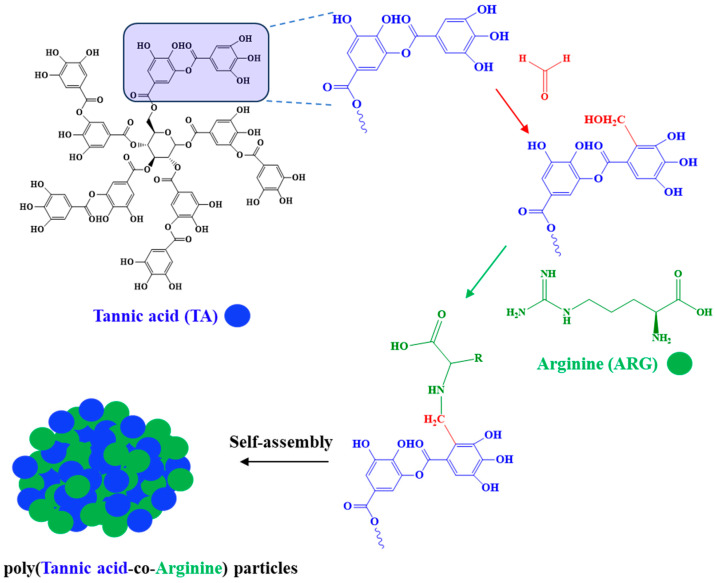
Background/Objectives: Tannic acid (TA) is a well-known natural phenolic acid composed of ten gallic acids linked to each other with ester bonding possessing excellent antioxidant properties in addition to antimicrobial and anticancer characteristics. Arginine (ARG) is a positively charged amino acid at physiological pH because of nitrogen-rich side chain. Method: Here, poly(tannic acid-co-arginine) (p(TA-co-ARG)) particles at three mole ratios, TA:ARG = 1:1, 1:2, and 1:3, were prepared via a Mannich condensation reaction between TA and ARG by utilizing formaldehyde as a linking agent. Results: The p(TA-co-ARG) particles in 300-1000 nm size range with smooth surfaces visualized via SEM analysis were attained. Abundant numbers of functional groups, -OH, -NH2, and -COOH stemming from TA and ARG constituent confirmed by FT-IR analysis. The isoelectric point (IEP) of the particles increased from pH 4.98 to pH 7.30 by increasing the ARG ratios in p(TA-co-ARG) particles. The antioxidant capacity of p(TA-co-ARG) particles via gallic acid (GA) and rosmarinic acid (RA) equivalents tests revealed that particles possess concentration-dependent antioxidant potency and increased by TA content. The α-glucosidase inhibition of p(TA-co-ARG) particles (2 mg/mL) 1:1 and 1:2 mole ratios revealed significant enzyme inhibition ability, e.g., 91.3 ± 3.1% and 77.6 ± 12.0%. Interestingly, p(TA-co-ARG) (1:3 ratio) possessed significant antibacterial effectiveness against Escherichia coli (ATCC 8739) and Staphylococcus aureus (ATCC 6538) bacteria. Furthermore, all p(TA-co-ARG) particles at 1000 mg/mL concentration showed >80% toxicity on L929 fibroblast cells and increased as ARG content of p(TA-co-ARG) particles is increased. Conclusions: p(TA-co-ARG) showed significant potential as natural biomaterials for biomedical use.
BiomedicinesBiochemistry, Genetics and Molecular Biology-General Biochemistry,Genetics and Molecular Biology
CiteScore
5.20
自引率
8.50%
发文量
2823
审稿时长
8 weeks
期刊介绍:
Biomedicines (ISSN 2227-9059; CODEN: BIOMID) is an international, scientific, open access journal on biomedicines published quarterly online by MDPI.






 京公网安备 11010802042870号
京ICP备2023020795号-1
京公网安备 11010802042870号
京ICP备2023020795号-1

 分享
分享
 求助内容:
求助内容: 应助结果提醒方式:
 扫码关注我们
