Qingqing Zhu, Qi Wang, Xi Hu, Xin Dang, Xiaojing Yu, Liye Chen, Hongjie Hu
{"title":"用机器学习支持的纹理分析鉴别早期骶髂炎。","authors":"Qingqing Zhu, Qi Wang, Xi Hu, Xin Dang, Xiaojing Yu, Liye Chen, Hongjie Hu","doi":"10.3390/diagnostics15020209","DOIUrl":null,"url":null,"abstract":"<p><p><b>Objectives:</b> We wished to compare the diagnostic performance of texture analysis (TA) against that of a visual qualitative assessment in identifying early sacroiliitis (nr-axSpA). <b>Methods:</b> A total of 92 participants were retrospectively included at our university hospital institution, comprising 30 controls and 62 patients with axSpA, including 32 with nr-axSpA and 30 with r-axSpA, who underwent MR examination of the sacroiliac joints. MRI at 3T of the lumbar spine and the sacroiliac joint was performed using oblique T1-weighted (W), fluid-sensitive, fat-saturated (Fs) T2WI images. The modified New York criteria for AS were used. Patients were classified into the nr-axSpA group if their digital radiography (DR) and/or CT results within 7 days from the MR examination showed a DR and/or CT grade < 2 for the bilateral sacroiliac joints or a DR and/or CT grade < 3 for the unilateral sacroiliac joint. Patients were classified into the r-axSpA group if their DR and/or CT grade was 2 to 3 for the bilateral sacroiliac joints or their DR and/or CT grade was 3 for the unilateral sacroiliac joint. Patients were considered to have a confirmed diagnosis if their DR or CT grade was 4 for the sacroiliac joints and were thereby excluded. A control group of healthy individuals matched in terms of age and sex to the patients was included in this study. First, two readers independently qualitatively scored the oblique coronal T1WI and FsT2WI non-enhanced sacroiliac joint images. The diagnostic efficacies of the two readers were judged and compared using an assigned Likert score, conducting a Kappa consistency test of the diagnostic results between two readers. Texture analysis models (the T1WI-TA model and the FsT2WI-TA model) were constructed through feature extraction and feature screening. The qualitative and quantitative results were evaluated for their diagnostic performance and compared against a clinical reference standard. <b>Results:</b> The qualitative scores of the two readers could significantly distinguish between the healthy controls and the nr-axSpA group and the nr-axSpA and r-axSpA groups (both <i>p</i> < 0.05). Both TA models could significantly distinguish between the healthy controls and the nr-axSpA group and the nr-axSpA group and the r-axSpA group (both <i>p</i> < 0.05). There was no significant difference in the differential diagnoses of the two TA models between the healthy controls and the nr-axSpA group (AUC: 0.934 vs. 0.976; <i>p</i> = 0.1838) and between the nr-axSpA and r-axSpA groups (AUC: 0.917 vs. 0.848; <i>p</i> = 0.2592). In terms of distinguishing between the healthy control and nr-axSpA groups, both the TA models were superior to the qualitative scores of the two readers (all <i>p</i> < 0.05). In terms of distinguishing between the nr-axSpA and r-axSpA groups, the T1WI-TA model was superior to the qualitative scores of the two readers (<i>p</i> = 0.023 and <i>p</i> = 0.007), whereas there was no significant difference between the fsT2WI-TA model and the qualitative scores of the two readers (<i>p</i> = 0.134 and <i>p</i> = 0.065). <b>Conclusions:</b> Based on MR imaging, the T1WI-TA and fsT2WI-TA models were highly effective for the early diagnosis of sacroiliac joint arthritis. The T1WI-TA model significantly improved the early diagnostic efficacy for sacroiliac arthritis compared to that of the qualitative scores of the readers, while the efficacy of the fsT2WI-TA model was comparable to that of the readers.</p>","PeriodicalId":11225,"journal":{"name":"Diagnostics","volume":"15 2","pages":""},"PeriodicalIF":3.3000,"publicationDate":"2025-01-17","publicationTypes":"Journal Article","fieldsOfStudy":null,"isOpenAccess":false,"openAccessPdf":"https://www.ncbi.nlm.nih.gov/pmc/articles/PMC11763746/pdf/","citationCount":"0","resultStr":"{\"title\":\"Differentiation of Early Sacroiliitis Using Machine-Learning- Supported Texture Analysis.\",\"authors\":\"Qingqing Zhu, Qi Wang, Xi Hu, Xin Dang, Xiaojing Yu, Liye Chen, Hongjie Hu\",\"doi\":\"10.3390/diagnostics15020209\",\"DOIUrl\":null,\"url\":null,\"abstract\":\"<p><p><b>Objectives:</b> We wished to compare the diagnostic performance of texture analysis (TA) against that of a visual qualitative assessment in identifying early sacroiliitis (nr-axSpA). <b>Methods:</b> A total of 92 participants were retrospectively included at our university hospital institution, comprising 30 controls and 62 patients with axSpA, including 32 with nr-axSpA and 30 with r-axSpA, who underwent MR examination of the sacroiliac joints. MRI at 3T of the lumbar spine and the sacroiliac joint was performed using oblique T1-weighted (W), fluid-sensitive, fat-saturated (Fs) T2WI images. The modified New York criteria for AS were used. Patients were classified into the nr-axSpA group if their digital radiography (DR) and/or CT results within 7 days from the MR examination showed a DR and/or CT grade < 2 for the bilateral sacroiliac joints or a DR and/or CT grade < 3 for the unilateral sacroiliac joint. Patients were classified into the r-axSpA group if their DR and/or CT grade was 2 to 3 for the bilateral sacroiliac joints or their DR and/or CT grade was 3 for the unilateral sacroiliac joint. Patients were considered to have a confirmed diagnosis if their DR or CT grade was 4 for the sacroiliac joints and were thereby excluded. A control group of healthy individuals matched in terms of age and sex to the patients was included in this study. First, two readers independently qualitatively scored the oblique coronal T1WI and FsT2WI non-enhanced sacroiliac joint images. The diagnostic efficacies of the two readers were judged and compared using an assigned Likert score, conducting a Kappa consistency test of the diagnostic results between two readers. Texture analysis models (the T1WI-TA model and the FsT2WI-TA model) were constructed through feature extraction and feature screening. The qualitative and quantitative results were evaluated for their diagnostic performance and compared against a clinical reference standard. <b>Results:</b> The qualitative scores of the two readers could significantly distinguish between the healthy controls and the nr-axSpA group and the nr-axSpA and r-axSpA groups (both <i>p</i> < 0.05). Both TA models could significantly distinguish between the healthy controls and the nr-axSpA group and the nr-axSpA group and the r-axSpA group (both <i>p</i> < 0.05). There was no significant difference in the differential diagnoses of the two TA models between the healthy controls and the nr-axSpA group (AUC: 0.934 vs. 0.976; <i>p</i> = 0.1838) and between the nr-axSpA and r-axSpA groups (AUC: 0.917 vs. 0.848; <i>p</i> = 0.2592). In terms of distinguishing between the healthy control and nr-axSpA groups, both the TA models were superior to the qualitative scores of the two readers (all <i>p</i> < 0.05). In terms of distinguishing between the nr-axSpA and r-axSpA groups, the T1WI-TA model was superior to the qualitative scores of the two readers (<i>p</i> = 0.023 and <i>p</i> = 0.007), whereas there was no significant difference between the fsT2WI-TA model and the qualitative scores of the two readers (<i>p</i> = 0.134 and <i>p</i> = 0.065). <b>Conclusions:</b> Based on MR imaging, the T1WI-TA and fsT2WI-TA models were highly effective for the early diagnosis of sacroiliac joint arthritis. The T1WI-TA model significantly improved the early diagnostic efficacy for sacroiliac arthritis compared to that of the qualitative scores of the readers, while the efficacy of the fsT2WI-TA model was comparable to that of the readers.</p>\",\"PeriodicalId\":11225,\"journal\":{\"name\":\"Diagnostics\",\"volume\":\"15 2\",\"pages\":\"\"},\"PeriodicalIF\":3.3000,\"publicationDate\":\"2025-01-17\",\"publicationTypes\":\"Journal Article\",\"fieldsOfStudy\":null,\"isOpenAccess\":false,\"openAccessPdf\":\"https://www.ncbi.nlm.nih.gov/pmc/articles/PMC11763746/pdf/\",\"citationCount\":\"0\",\"resultStr\":null,\"platform\":\"Semanticscholar\",\"paperid\":null,\"PeriodicalName\":\"Diagnostics\",\"FirstCategoryId\":\"3\",\"ListUrlMain\":\"https://doi.org/10.3390/diagnostics15020209\",\"RegionNum\":3,\"RegionCategory\":\"医学\",\"ArticlePicture\":[],\"TitleCN\":null,\"AbstractTextCN\":null,\"PMCID\":null,\"EPubDate\":\"\",\"PubModel\":\"\",\"JCR\":\"Q1\",\"JCRName\":\"MEDICINE, GENERAL & INTERNAL\",\"Score\":null,\"Total\":0}","platform":"Semanticscholar","paperid":null,"PeriodicalName":"Diagnostics","FirstCategoryId":"3","ListUrlMain":"https://doi.org/10.3390/diagnostics15020209","RegionNum":3,"RegionCategory":"医学","ArticlePicture":[],"TitleCN":null,"AbstractTextCN":null,"PMCID":null,"EPubDate":"","PubModel":"","JCR":"Q1","JCRName":"MEDICINE, GENERAL & INTERNAL","Score":null,"Total":0}
Differentiation of Early Sacroiliitis Using Machine-Learning- Supported Texture Analysis.
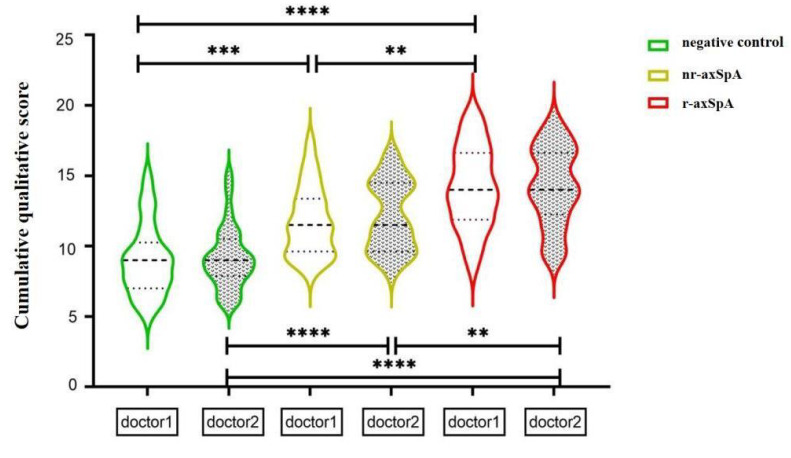
Objectives: We wished to compare the diagnostic performance of texture analysis (TA) against that of a visual qualitative assessment in identifying early sacroiliitis (nr-axSpA). Methods: A total of 92 participants were retrospectively included at our university hospital institution, comprising 30 controls and 62 patients with axSpA, including 32 with nr-axSpA and 30 with r-axSpA, who underwent MR examination of the sacroiliac joints. MRI at 3T of the lumbar spine and the sacroiliac joint was performed using oblique T1-weighted (W), fluid-sensitive, fat-saturated (Fs) T2WI images. The modified New York criteria for AS were used. Patients were classified into the nr-axSpA group if their digital radiography (DR) and/or CT results within 7 days from the MR examination showed a DR and/or CT grade < 2 for the bilateral sacroiliac joints or a DR and/or CT grade < 3 for the unilateral sacroiliac joint. Patients were classified into the r-axSpA group if their DR and/or CT grade was 2 to 3 for the bilateral sacroiliac joints or their DR and/or CT grade was 3 for the unilateral sacroiliac joint. Patients were considered to have a confirmed diagnosis if their DR or CT grade was 4 for the sacroiliac joints and were thereby excluded. A control group of healthy individuals matched in terms of age and sex to the patients was included in this study. First, two readers independently qualitatively scored the oblique coronal T1WI and FsT2WI non-enhanced sacroiliac joint images. The diagnostic efficacies of the two readers were judged and compared using an assigned Likert score, conducting a Kappa consistency test of the diagnostic results between two readers. Texture analysis models (the T1WI-TA model and the FsT2WI-TA model) were constructed through feature extraction and feature screening. The qualitative and quantitative results were evaluated for their diagnostic performance and compared against a clinical reference standard. Results: The qualitative scores of the two readers could significantly distinguish between the healthy controls and the nr-axSpA group and the nr-axSpA and r-axSpA groups (both p < 0.05). Both TA models could significantly distinguish between the healthy controls and the nr-axSpA group and the nr-axSpA group and the r-axSpA group (both p < 0.05). There was no significant difference in the differential diagnoses of the two TA models between the healthy controls and the nr-axSpA group (AUC: 0.934 vs. 0.976; p = 0.1838) and between the nr-axSpA and r-axSpA groups (AUC: 0.917 vs. 0.848; p = 0.2592). In terms of distinguishing between the healthy control and nr-axSpA groups, both the TA models were superior to the qualitative scores of the two readers (all p < 0.05). In terms of distinguishing between the nr-axSpA and r-axSpA groups, the T1WI-TA model was superior to the qualitative scores of the two readers (p = 0.023 and p = 0.007), whereas there was no significant difference between the fsT2WI-TA model and the qualitative scores of the two readers (p = 0.134 and p = 0.065). Conclusions: Based on MR imaging, the T1WI-TA and fsT2WI-TA models were highly effective for the early diagnosis of sacroiliac joint arthritis. The T1WI-TA model significantly improved the early diagnostic efficacy for sacroiliac arthritis compared to that of the qualitative scores of the readers, while the efficacy of the fsT2WI-TA model was comparable to that of the readers.
DiagnosticsBiochemistry, Genetics and Molecular Biology-Clinical Biochemistry
CiteScore
4.70
自引率
8.30%
发文量
2699
审稿时长
19.64 days
期刊介绍:
Diagnostics (ISSN 2075-4418) is an international scholarly open access journal on medical diagnostics. It publishes original research articles, reviews, communications and short notes on the research and development of medical diagnostics. There is no restriction on the length of the papers. Our aim is to encourage scientists to publish their experimental and theoretical research in as much detail as possible. Full experimental and/or methodological details must be provided for research articles.






 京公网安备 11010802042870号
京ICP备2023020795号-1
京公网安备 11010802042870号
京ICP备2023020795号-1

 分享
分享
 求助内容:
求助内容: 应助结果提醒方式:
 扫码关注我们
