{"title":"rhGH联合来曲唑/GnRHa治疗青春期男孩的疗效和安全性。","authors":"Ying Zhang, Xin Yuan, Kenneth McCormick, Xiao-Hong Yang, Shi-Jun Chen, Rui-Min Chen","doi":"10.1186/s12887-025-05408-y","DOIUrl":null,"url":null,"abstract":"<p><strong>Objective: </strong>In boys during puberty who were undergoing recombinant human growth hormone (rhGH) treatment, we compared the therapeutic efficacy on growth, and any adverse reactions, of co-therapy with either letrozole or gonadotropin-releasing hormone analog (GnRHa).</p><p><strong>Methods: </strong>Fifty-six pubertal growth hormone deficiency (GHD) boys were studied, they were treated with the combination of letrozole and rhGH (letrozole group, n = 28) or the combination of GnRHa and rhGH (GnRHa group, n = 28) for at least one year. Eighteen patients in the letrozole group and seventeen patients in the GnRHa group attained final adult height (FAH).</p><p><strong>Results: </strong>The increase in height of the letrozole group was significantly more than the GnRHa group both in the first year [(10.37 ± 2.19) vs. (7.78 ± 1.55) cm] and at two years [(18.82 ± 2.49) vs. (13.84 ± 2.17) cm] (p < 0.05), however, there was no significant group difference in the advancement of bone age (BA) of in the first year or at two years (p > 0.05). The mean FAH in two groups were similar, but the treatment duration of the letrozole group was significantly less than GnRHa group. There was a significant body mass index (BMI) SDS increase in the letrozole vs. GnRHa groups. Of concern, bone mineral density (BMD) decreased in both groups after treatment, but more so in the letrozole cohort.</p><p><strong>Conclusion: </strong>The combination of letrozole/rhGH in pubertal GHD boys was similar to GnRHa/rhGH in terms of the progression of BA and FAH, but the former co-therapy was superior in the gain of height. Disconcertingly, however, this combination may adversely affect BMI and BMD.</p><p><strong>Clinical trial registration number: </strong>ChiCTR2300068405.</p>","PeriodicalId":9144,"journal":{"name":"BMC Pediatrics","volume":"25 1","pages":"59"},"PeriodicalIF":2.3000,"publicationDate":"2025-01-24","publicationTypes":"Journal Article","fieldsOfStudy":null,"isOpenAccess":false,"openAccessPdf":"https://www.ncbi.nlm.nih.gov/pmc/articles/PMC11761712/pdf/","citationCount":"0","resultStr":"{\"title\":\"The efficacy and safety of rhGH treatment combined with letrozole/GnRHa in adolescent boys.\",\"authors\":\"Ying Zhang, Xin Yuan, Kenneth McCormick, Xiao-Hong Yang, Shi-Jun Chen, Rui-Min Chen\",\"doi\":\"10.1186/s12887-025-05408-y\",\"DOIUrl\":null,\"url\":null,\"abstract\":\"<p><strong>Objective: </strong>In boys during puberty who were undergoing recombinant human growth hormone (rhGH) treatment, we compared the therapeutic efficacy on growth, and any adverse reactions, of co-therapy with either letrozole or gonadotropin-releasing hormone analog (GnRHa).</p><p><strong>Methods: </strong>Fifty-six pubertal growth hormone deficiency (GHD) boys were studied, they were treated with the combination of letrozole and rhGH (letrozole group, n = 28) or the combination of GnRHa and rhGH (GnRHa group, n = 28) for at least one year. Eighteen patients in the letrozole group and seventeen patients in the GnRHa group attained final adult height (FAH).</p><p><strong>Results: </strong>The increase in height of the letrozole group was significantly more than the GnRHa group both in the first year [(10.37 ± 2.19) vs. (7.78 ± 1.55) cm] and at two years [(18.82 ± 2.49) vs. (13.84 ± 2.17) cm] (p < 0.05), however, there was no significant group difference in the advancement of bone age (BA) of in the first year or at two years (p > 0.05). The mean FAH in two groups were similar, but the treatment duration of the letrozole group was significantly less than GnRHa group. There was a significant body mass index (BMI) SDS increase in the letrozole vs. GnRHa groups. Of concern, bone mineral density (BMD) decreased in both groups after treatment, but more so in the letrozole cohort.</p><p><strong>Conclusion: </strong>The combination of letrozole/rhGH in pubertal GHD boys was similar to GnRHa/rhGH in terms of the progression of BA and FAH, but the former co-therapy was superior in the gain of height. Disconcertingly, however, this combination may adversely affect BMI and BMD.</p><p><strong>Clinical trial registration number: </strong>ChiCTR2300068405.</p>\",\"PeriodicalId\":9144,\"journal\":{\"name\":\"BMC Pediatrics\",\"volume\":\"25 1\",\"pages\":\"59\"},\"PeriodicalIF\":2.3000,\"publicationDate\":\"2025-01-24\",\"publicationTypes\":\"Journal Article\",\"fieldsOfStudy\":null,\"isOpenAccess\":false,\"openAccessPdf\":\"https://www.ncbi.nlm.nih.gov/pmc/articles/PMC11761712/pdf/\",\"citationCount\":\"0\",\"resultStr\":null,\"platform\":\"Semanticscholar\",\"paperid\":null,\"PeriodicalName\":\"BMC Pediatrics\",\"FirstCategoryId\":\"3\",\"ListUrlMain\":\"https://doi.org/10.1186/s12887-025-05408-y\",\"RegionNum\":3,\"RegionCategory\":\"医学\",\"ArticlePicture\":[],\"TitleCN\":null,\"AbstractTextCN\":null,\"PMCID\":null,\"EPubDate\":\"\",\"PubModel\":\"\",\"JCR\":\"Q2\",\"JCRName\":\"PEDIATRICS\",\"Score\":null,\"Total\":0}","platform":"Semanticscholar","paperid":null,"PeriodicalName":"BMC Pediatrics","FirstCategoryId":"3","ListUrlMain":"https://doi.org/10.1186/s12887-025-05408-y","RegionNum":3,"RegionCategory":"医学","ArticlePicture":[],"TitleCN":null,"AbstractTextCN":null,"PMCID":null,"EPubDate":"","PubModel":"","JCR":"Q2","JCRName":"PEDIATRICS","Score":null,"Total":0}
The efficacy and safety of rhGH treatment combined with letrozole/GnRHa in adolescent boys.
Objective: In boys during puberty who were undergoing recombinant human growth hormone (rhGH) treatment, we compared the therapeutic efficacy on growth, and any adverse reactions, of co-therapy with either letrozole or gonadotropin-releasing hormone analog (GnRHa).
Methods: Fifty-six pubertal growth hormone deficiency (GHD) boys were studied, they were treated with the combination of letrozole and rhGH (letrozole group, n = 28) or the combination of GnRHa and rhGH (GnRHa group, n = 28) for at least one year. Eighteen patients in the letrozole group and seventeen patients in the GnRHa group attained final adult height (FAH).
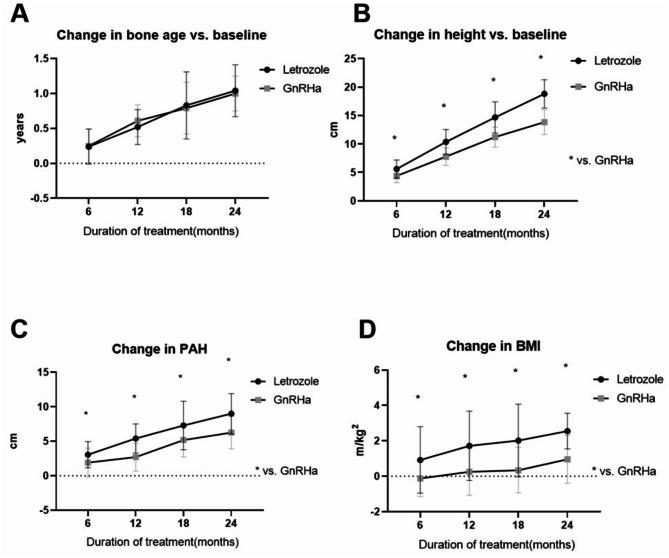
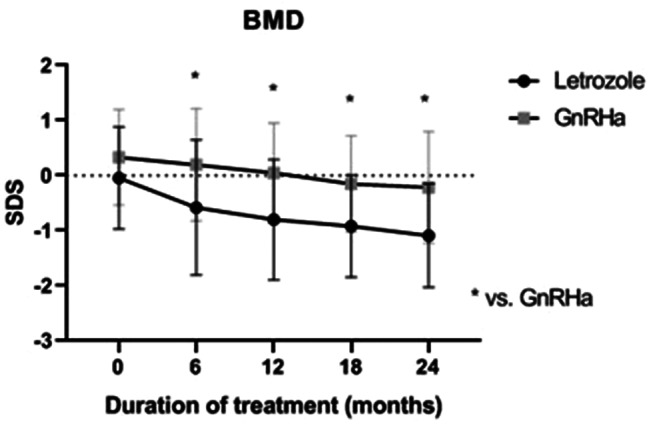
Results: The increase in height of the letrozole group was significantly more than the GnRHa group both in the first year [(10.37 ± 2.19) vs. (7.78 ± 1.55) cm] and at two years [(18.82 ± 2.49) vs. (13.84 ± 2.17) cm] (p < 0.05), however, there was no significant group difference in the advancement of bone age (BA) of in the first year or at two years (p > 0.05). The mean FAH in two groups were similar, but the treatment duration of the letrozole group was significantly less than GnRHa group. There was a significant body mass index (BMI) SDS increase in the letrozole vs. GnRHa groups. Of concern, bone mineral density (BMD) decreased in both groups after treatment, but more so in the letrozole cohort.
Conclusion: The combination of letrozole/rhGH in pubertal GHD boys was similar to GnRHa/rhGH in terms of the progression of BA and FAH, but the former co-therapy was superior in the gain of height. Disconcertingly, however, this combination may adversely affect BMI and BMD.
期刊介绍:
BMC Pediatrics is an open access journal publishing peer-reviewed research articles in all aspects of health care in neonates, children and adolescents, as well as related molecular genetics, pathophysiology, and epidemiology.




 京公网安备 11010802042870号
京ICP备2023020795号-1
京公网安备 11010802042870号
京ICP备2023020795号-1

 分享
分享
 求助内容:
求助内容: 应助结果提醒方式:
 扫码关注我们
