Betül Ayça Yamak, İbrahim Ethem Güven, Mustafa Candemir
{"title":"心电图额位QRS-T角与乳糜泻的存在和病程独立相关","authors":"Betül Ayça Yamak, İbrahim Ethem Güven, Mustafa Candemir","doi":"10.3390/diagnostics15020187","DOIUrl":null,"url":null,"abstract":"<p><p><b>Background:</b> The impact of Celiac Disease (CD) is not only limited to the intestinal system, but extraintestinal manifestations may also be seen. In this context, cardiac manifestations have recently been the focus of attention. This study aimed to evaluate myocardial repolarization properties in CD patients by assessing the frontal QRS-T Angle (fQRS-T) on electrocardiography (ECG). <b>Methods:</b> A total of 302 patients, including 150 CD patients and 152 control group patients, were included in the study. ECG parameters, including fQRS-T, QRS interval, and QTc interval, were calculated for each patient and compared between the groups. In addition, the relationship of these ECG parameters with disease duration was also analyzed. <b>Results:</b> The median disease duration was 38.5 (16 to 96) months in the CD group. Significantly wider QRS interval (92 (86 to 96) vs. 83 (76.3 to 93), <i>p</i> < 0.001) and fQRS-T (23 (13 to 37) vs. 18 (6.3 to 27), <i>p</i> < 0.001) values were observed in the CD group. Among CD patients, those with longer disease duration (>38.5 months) exhibited significantly wider QRS intervals (94 (88 to 98) vs. 88 (84 to 94), <i>p</i> < 0.001) and frontal QRS-T angles (29 (14 to 47) vs. 16 (10 to 25), <i>p</i> < 0.001) compared to those with shorter disease duration. A positive correlation between the disease duration and fQRS-T was also demonstrated (r = 0.478, <i>p</i> < 0.001). Multivariable logistic regression identified QRS interval (OR: 1.060, 95% CI: 1.032-1.088, <i>p</i> < 0.001) and frontal QRS-T angle (OR: 1.028, 95% CI: 1.013-1.043, <i>p</i> < 0.001) as independent predictors of CD. Additionally, the QRS interval (OR: 1.066, 95% CI: 1.012-1.124, <i>p</i> = 0.016) and frontal QRS-T angle (OR: 1.021, 95% CI: 1.003-1.038, <i>p</i> = 0.021) were significant predictors of longer disease duration. A linear regression analysis confirmed that disease duration was a stronger predictor of frontal QRS-T angle widening (B: 0.389, 95% CI: 0.102-0.677, <i>p</i> < 0.001) compared to age (B: 0.184, 95% CI: 0.123-0.245, <i>p</i> = 0.008). <b>Conclusions:</b> In this study, we demonstrated that chronic inflammation secondary to CD may have negative effects on cardiac repolarization and that this effect is closely related to disease duration.</p>","PeriodicalId":11225,"journal":{"name":"Diagnostics","volume":"15 2","pages":""},"PeriodicalIF":3.8000,"publicationDate":"2025-01-15","publicationTypes":"Journal Article","fieldsOfStudy":null,"isOpenAccess":false,"openAccessPdf":"https://www.ncbi.nlm.nih.gov/pmc/articles/PMC11763837/pdf/","citationCount":"0","resultStr":"{\"title\":\"Electrocardiographic Frontal QRS-T Angle Is Independently Associated with the Presence of Celiac Disease and Disease Duration.\",\"authors\":\"Betül Ayça Yamak, İbrahim Ethem Güven, Mustafa Candemir\",\"doi\":\"10.3390/diagnostics15020187\",\"DOIUrl\":null,\"url\":null,\"abstract\":\"<p><p><b>Background:</b> The impact of Celiac Disease (CD) is not only limited to the intestinal system, but extraintestinal manifestations may also be seen. In this context, cardiac manifestations have recently been the focus of attention. This study aimed to evaluate myocardial repolarization properties in CD patients by assessing the frontal QRS-T Angle (fQRS-T) on electrocardiography (ECG). <b>Methods:</b> A total of 302 patients, including 150 CD patients and 152 control group patients, were included in the study. ECG parameters, including fQRS-T, QRS interval, and QTc interval, were calculated for each patient and compared between the groups. In addition, the relationship of these ECG parameters with disease duration was also analyzed. <b>Results:</b> The median disease duration was 38.5 (16 to 96) months in the CD group. Significantly wider QRS interval (92 (86 to 96) vs. 83 (76.3 to 93), <i>p</i> < 0.001) and fQRS-T (23 (13 to 37) vs. 18 (6.3 to 27), <i>p</i> < 0.001) values were observed in the CD group. Among CD patients, those with longer disease duration (>38.5 months) exhibited significantly wider QRS intervals (94 (88 to 98) vs. 88 (84 to 94), <i>p</i> < 0.001) and frontal QRS-T angles (29 (14 to 47) vs. 16 (10 to 25), <i>p</i> < 0.001) compared to those with shorter disease duration. A positive correlation between the disease duration and fQRS-T was also demonstrated (r = 0.478, <i>p</i> < 0.001). Multivariable logistic regression identified QRS interval (OR: 1.060, 95% CI: 1.032-1.088, <i>p</i> < 0.001) and frontal QRS-T angle (OR: 1.028, 95% CI: 1.013-1.043, <i>p</i> < 0.001) as independent predictors of CD. Additionally, the QRS interval (OR: 1.066, 95% CI: 1.012-1.124, <i>p</i> = 0.016) and frontal QRS-T angle (OR: 1.021, 95% CI: 1.003-1.038, <i>p</i> = 0.021) were significant predictors of longer disease duration. A linear regression analysis confirmed that disease duration was a stronger predictor of frontal QRS-T angle widening (B: 0.389, 95% CI: 0.102-0.677, <i>p</i> < 0.001) compared to age (B: 0.184, 95% CI: 0.123-0.245, <i>p</i> = 0.008). <b>Conclusions:</b> In this study, we demonstrated that chronic inflammation secondary to CD may have negative effects on cardiac repolarization and that this effect is closely related to disease duration.</p>\",\"PeriodicalId\":11225,\"journal\":{\"name\":\"Diagnostics\",\"volume\":\"15 2\",\"pages\":\"\"},\"PeriodicalIF\":3.8000,\"publicationDate\":\"2025-01-15\",\"publicationTypes\":\"Journal Article\",\"fieldsOfStudy\":null,\"isOpenAccess\":false,\"openAccessPdf\":\"https://www.ncbi.nlm.nih.gov/pmc/articles/PMC11763837/pdf/\",\"citationCount\":\"0\",\"resultStr\":null,\"platform\":\"Semanticscholar\",\"paperid\":null,\"PeriodicalName\":\"Diagnostics\",\"FirstCategoryId\":\"3\",\"ListUrlMain\":\"https://doi.org/10.3390/diagnostics15020187\",\"RegionNum\":3,\"RegionCategory\":\"医学\",\"ArticlePicture\":[],\"TitleCN\":null,\"AbstractTextCN\":null,\"PMCID\":null,\"EPubDate\":\"\",\"PubModel\":\"\",\"JCR\":\"Q1\",\"JCRName\":\"MEDICINE, GENERAL & INTERNAL\",\"Score\":null,\"Total\":0}","platform":"Semanticscholar","paperid":null,"PeriodicalName":"Diagnostics","FirstCategoryId":"3","ListUrlMain":"https://doi.org/10.3390/diagnostics15020187","RegionNum":3,"RegionCategory":"医学","ArticlePicture":[],"TitleCN":null,"AbstractTextCN":null,"PMCID":null,"EPubDate":"","PubModel":"","JCR":"Q1","JCRName":"MEDICINE, GENERAL & INTERNAL","Score":null,"Total":0}
引用次数: 0
摘要
背景:乳糜泻(Celiac Disease, CD)的影响不仅局限于肠道系统,还可能出现肠外表现。在这种情况下,心脏表现最近已成为关注的焦点。本研究旨在通过心电图(ECG)的QRS-T额角(fQRS-T)评估CD患者心肌复极特性。方法:共纳入302例患者,其中CD患者150例,对照组152例。计算每例患者的心电图参数,包括fQRS-T、QRS间期、QTc间期,并进行组间比较。此外,还分析了这些心电图参数与病程的关系。结果:CD组中位病程为38.5(16 ~ 96)个月。CD组QRS间隔(92 (86 ~ 96)vs. 83 (76.3 ~ 93), p < 0.001)和fQRS-T (23 (13 ~ 37) vs. 18 (6.3 ~ 27), p < 0.001)值明显更宽。在CD患者中,病程较长的患者(>38.5个月)表现出较宽的QRS间隔(94 (88 ~ 98)vs. 88 (84 ~ 94), p < 0.001)和QRS- t正面角(29 (14 ~ 47)vs. 16 (10 ~ 25), p < 0.001)。病程与fQRS-T呈正相关(r = 0.478, p < 0.001)。多变量logistic回归确定QRS区间(OR: 1.060, 95% CI: 1.032-1.088, p < 0.001)和正面QRS- t角(OR: 1.028, 95% CI: 1.013-1.043, p < 0.001)为CD的独立预测因子。此外,QRS区间(OR: 1.066, 95% CI: 1.012-1.124, p = 0.016)和正面QRS- t角(OR: 1.021, 95% CI: 1.003-1.038, p = 0.021)是病程延长的显著预测因子。线性回归分析证实,与年龄(B: 0.184, 95% CI: 0.123-0.245, p = 0.008)相比,病程是额叶QRS-T角变宽的更强预测因子(B: 0.389, 95% CI: 0.102-0.677, p < 0.001)。结论:在本研究中,我们证明了继发于CD的慢性炎症可能对心脏复极有负面影响,并且这种影响与疾病持续时间密切相关。
Electrocardiographic Frontal QRS-T Angle Is Independently Associated with the Presence of Celiac Disease and Disease Duration.
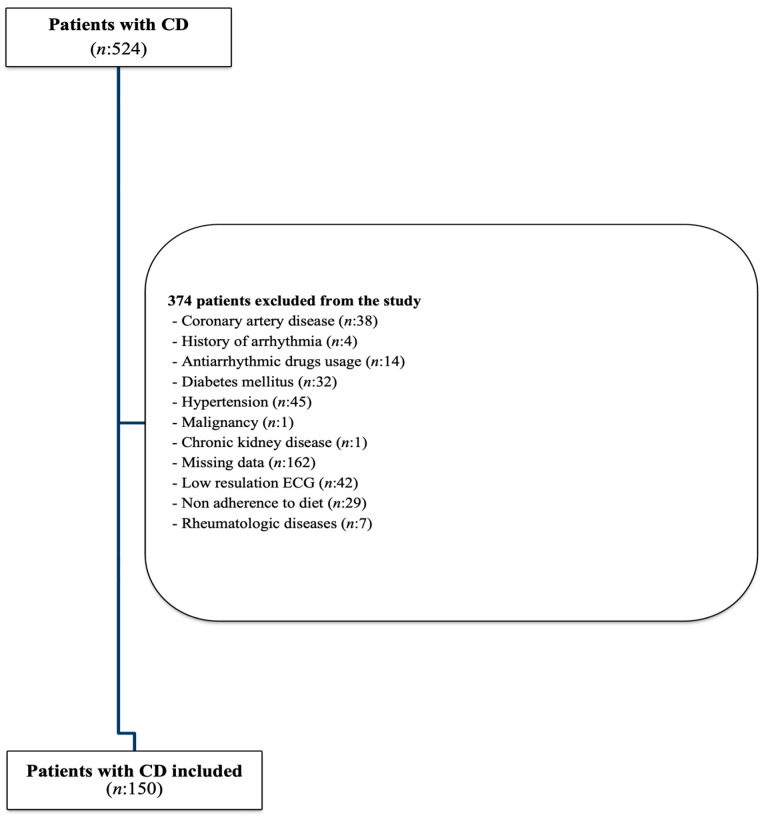
Background: The impact of Celiac Disease (CD) is not only limited to the intestinal system, but extraintestinal manifestations may also be seen. In this context, cardiac manifestations have recently been the focus of attention. This study aimed to evaluate myocardial repolarization properties in CD patients by assessing the frontal QRS-T Angle (fQRS-T) on electrocardiography (ECG). Methods: A total of 302 patients, including 150 CD patients and 152 control group patients, were included in the study. ECG parameters, including fQRS-T, QRS interval, and QTc interval, were calculated for each patient and compared between the groups. In addition, the relationship of these ECG parameters with disease duration was also analyzed. Results: The median disease duration was 38.5 (16 to 96) months in the CD group. Significantly wider QRS interval (92 (86 to 96) vs. 83 (76.3 to 93), p < 0.001) and fQRS-T (23 (13 to 37) vs. 18 (6.3 to 27), p < 0.001) values were observed in the CD group. Among CD patients, those with longer disease duration (>38.5 months) exhibited significantly wider QRS intervals (94 (88 to 98) vs. 88 (84 to 94), p < 0.001) and frontal QRS-T angles (29 (14 to 47) vs. 16 (10 to 25), p < 0.001) compared to those with shorter disease duration. A positive correlation between the disease duration and fQRS-T was also demonstrated (r = 0.478, p < 0.001). Multivariable logistic regression identified QRS interval (OR: 1.060, 95% CI: 1.032-1.088, p < 0.001) and frontal QRS-T angle (OR: 1.028, 95% CI: 1.013-1.043, p < 0.001) as independent predictors of CD. Additionally, the QRS interval (OR: 1.066, 95% CI: 1.012-1.124, p = 0.016) and frontal QRS-T angle (OR: 1.021, 95% CI: 1.003-1.038, p = 0.021) were significant predictors of longer disease duration. A linear regression analysis confirmed that disease duration was a stronger predictor of frontal QRS-T angle widening (B: 0.389, 95% CI: 0.102-0.677, p < 0.001) compared to age (B: 0.184, 95% CI: 0.123-0.245, p = 0.008). Conclusions: In this study, we demonstrated that chronic inflammation secondary to CD may have negative effects on cardiac repolarization and that this effect is closely related to disease duration.
DiagnosticsBiochemistry, Genetics and Molecular Biology-Clinical Biochemistry
CiteScore
4.70
自引率
8.30%
发文量
2699
审稿时长
19.64 days
期刊介绍:
Diagnostics (ISSN 2075-4418) is an international scholarly open access journal on medical diagnostics. It publishes original research articles, reviews, communications and short notes on the research and development of medical diagnostics. There is no restriction on the length of the papers. Our aim is to encourage scientists to publish their experimental and theoretical research in as much detail as possible. Full experimental and/or methodological details must be provided for research articles.






 京公网安备 11010802042870号
京ICP备2023020795号-1
京公网安备 11010802042870号
京ICP备2023020795号-1

 分享
分享
 求助内容:
求助内容: 应助结果提醒方式:
 扫码关注我们
