Zsély Boglárka, Zita Zsombor, Aladár D Rónaszéki, Anna Egresi, Róbert Stollmayer, Marco Himsel, Viktor Bérczi, Ildikó Kalina, Klára Werling, Gabriella Győri, Pál Maurovich-Horvat, Anikó Folhoffer, Krisztina Hagymási, Pál Novák Kaposi
{"title":"复合模型的建立提高定量超声肝脏脂肪含量估计的准确性。","authors":"Zsély Boglárka, Zita Zsombor, Aladár D Rónaszéki, Anna Egresi, Róbert Stollmayer, Marco Himsel, Viktor Bérczi, Ildikó Kalina, Klára Werling, Gabriella Győri, Pál Maurovich-Horvat, Anikó Folhoffer, Krisztina Hagymási, Pál Novák Kaposi","doi":"10.3390/diagnostics15020203","DOIUrl":null,"url":null,"abstract":"<p><p><b>Background:</b> we evaluated regression models based on quantitative ultrasound (QUS) parameters and compared them with a vendor-provided method for calculating the ultrasound fat fraction (USFF) in metabolic dysfunction-associated steatotic liver disease (MASLD). <b>Methods:</b> We measured the attenuation coefficient (AC) and the backscatter-distribution coefficient (BSC-D) and determined the USFF during a liver ultrasound and calculated the magnetic resonance imaging proton-density fat fraction (MRI-PDFF) and steatosis grade (S0-S4) in a combined retrospective-prospective cohort. We trained multiple models using single or various QUS parameters as independent variables to forecast MRI-PDFF. Linear and nonlinear models were trained during five-time repeated three-fold cross-validation in a retrospectively collected dataset of 60 MASLD cases. We calculated the models' Pearson correlation (r) and the intraclass correlation coefficient (ICC) in a prospectively collected test set of 57 MASLD cases. <b>Results:</b> The linear multivariable model (r = 0.602, ICC = 0.529) and USFF (r = 0.576, ICC = 0.54) were more reliable in S0- and S1-grade steatosis than the nonlinear multivariable model (r = 0.492, ICC = 0.461). In S2 and S3 grades, the nonlinear multivariable (r = 0.377, ICC = 0.32) and AC-only (r = 0.375, ICC = 0.313) models' approximated correlation and agreement surpassed that of the multivariable linear model (r = 0.394, ICC = 0.265). We searched a QUS parameter grid to find the optimal thresholds (AC ≥ 0.84 dB/cm/MHz, BSC-D ≥ 105), above which switching from a linear (r = 0.752, ICC = 0.715) to a nonlinear multivariable (r = 0.719, ICC = 0.641) model could improve the overall fit (r = 0.775, ICC = 0.718). <b>Conclusions:</b> The USFF and linear multivariable models are robust in diagnosing low-grade steatosis. Switching to a nonlinear model could enhance the fit to MRI-PDFF in advanced steatosis.</p>","PeriodicalId":11225,"journal":{"name":"Diagnostics","volume":"15 2","pages":""},"PeriodicalIF":3.3000,"publicationDate":"2025-01-17","publicationTypes":"Journal Article","fieldsOfStudy":null,"isOpenAccess":false,"openAccessPdf":"https://www.ncbi.nlm.nih.gov/pmc/articles/PMC11763894/pdf/","citationCount":"0","resultStr":"{\"title\":\"Construction of a Compound Model to Enhance the Accuracy of Hepatic Fat Fraction Estimation with Quantitative Ultrasound.\",\"authors\":\"Zsély Boglárka, Zita Zsombor, Aladár D Rónaszéki, Anna Egresi, Róbert Stollmayer, Marco Himsel, Viktor Bérczi, Ildikó Kalina, Klára Werling, Gabriella Győri, Pál Maurovich-Horvat, Anikó Folhoffer, Krisztina Hagymási, Pál Novák Kaposi\",\"doi\":\"10.3390/diagnostics15020203\",\"DOIUrl\":null,\"url\":null,\"abstract\":\"<p><p><b>Background:</b> we evaluated regression models based on quantitative ultrasound (QUS) parameters and compared them with a vendor-provided method for calculating the ultrasound fat fraction (USFF) in metabolic dysfunction-associated steatotic liver disease (MASLD). <b>Methods:</b> We measured the attenuation coefficient (AC) and the backscatter-distribution coefficient (BSC-D) and determined the USFF during a liver ultrasound and calculated the magnetic resonance imaging proton-density fat fraction (MRI-PDFF) and steatosis grade (S0-S4) in a combined retrospective-prospective cohort. We trained multiple models using single or various QUS parameters as independent variables to forecast MRI-PDFF. Linear and nonlinear models were trained during five-time repeated three-fold cross-validation in a retrospectively collected dataset of 60 MASLD cases. We calculated the models' Pearson correlation (r) and the intraclass correlation coefficient (ICC) in a prospectively collected test set of 57 MASLD cases. <b>Results:</b> The linear multivariable model (r = 0.602, ICC = 0.529) and USFF (r = 0.576, ICC = 0.54) were more reliable in S0- and S1-grade steatosis than the nonlinear multivariable model (r = 0.492, ICC = 0.461). In S2 and S3 grades, the nonlinear multivariable (r = 0.377, ICC = 0.32) and AC-only (r = 0.375, ICC = 0.313) models' approximated correlation and agreement surpassed that of the multivariable linear model (r = 0.394, ICC = 0.265). We searched a QUS parameter grid to find the optimal thresholds (AC ≥ 0.84 dB/cm/MHz, BSC-D ≥ 105), above which switching from a linear (r = 0.752, ICC = 0.715) to a nonlinear multivariable (r = 0.719, ICC = 0.641) model could improve the overall fit (r = 0.775, ICC = 0.718). <b>Conclusions:</b> The USFF and linear multivariable models are robust in diagnosing low-grade steatosis. Switching to a nonlinear model could enhance the fit to MRI-PDFF in advanced steatosis.</p>\",\"PeriodicalId\":11225,\"journal\":{\"name\":\"Diagnostics\",\"volume\":\"15 2\",\"pages\":\"\"},\"PeriodicalIF\":3.3000,\"publicationDate\":\"2025-01-17\",\"publicationTypes\":\"Journal Article\",\"fieldsOfStudy\":null,\"isOpenAccess\":false,\"openAccessPdf\":\"https://www.ncbi.nlm.nih.gov/pmc/articles/PMC11763894/pdf/\",\"citationCount\":\"0\",\"resultStr\":null,\"platform\":\"Semanticscholar\",\"paperid\":null,\"PeriodicalName\":\"Diagnostics\",\"FirstCategoryId\":\"3\",\"ListUrlMain\":\"https://doi.org/10.3390/diagnostics15020203\",\"RegionNum\":3,\"RegionCategory\":\"医学\",\"ArticlePicture\":[],\"TitleCN\":null,\"AbstractTextCN\":null,\"PMCID\":null,\"EPubDate\":\"\",\"PubModel\":\"\",\"JCR\":\"Q1\",\"JCRName\":\"MEDICINE, GENERAL & INTERNAL\",\"Score\":null,\"Total\":0}","platform":"Semanticscholar","paperid":null,"PeriodicalName":"Diagnostics","FirstCategoryId":"3","ListUrlMain":"https://doi.org/10.3390/diagnostics15020203","RegionNum":3,"RegionCategory":"医学","ArticlePicture":[],"TitleCN":null,"AbstractTextCN":null,"PMCID":null,"EPubDate":"","PubModel":"","JCR":"Q1","JCRName":"MEDICINE, GENERAL & INTERNAL","Score":null,"Total":0}
Construction of a Compound Model to Enhance the Accuracy of Hepatic Fat Fraction Estimation with Quantitative Ultrasound.
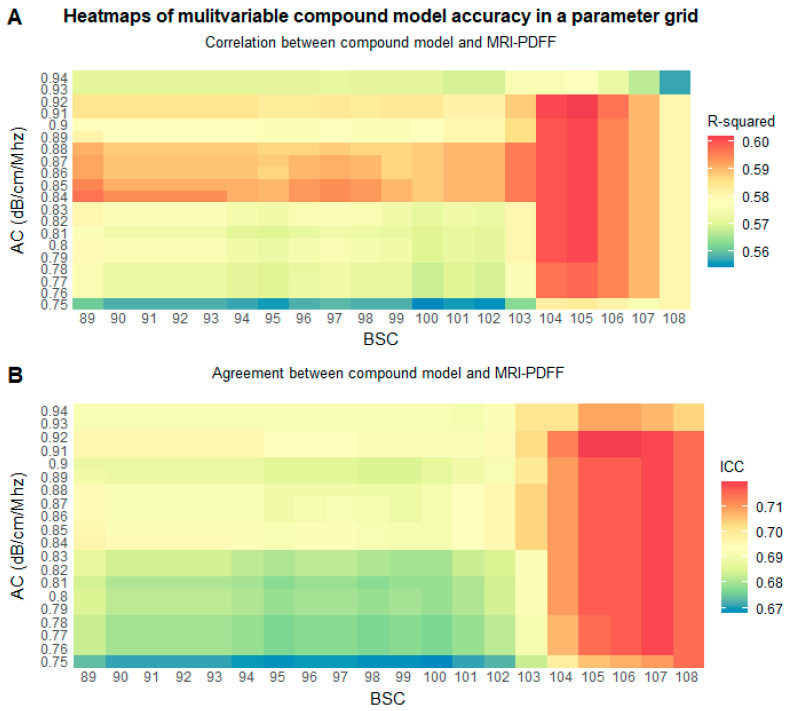
Background: we evaluated regression models based on quantitative ultrasound (QUS) parameters and compared them with a vendor-provided method for calculating the ultrasound fat fraction (USFF) in metabolic dysfunction-associated steatotic liver disease (MASLD). Methods: We measured the attenuation coefficient (AC) and the backscatter-distribution coefficient (BSC-D) and determined the USFF during a liver ultrasound and calculated the magnetic resonance imaging proton-density fat fraction (MRI-PDFF) and steatosis grade (S0-S4) in a combined retrospective-prospective cohort. We trained multiple models using single or various QUS parameters as independent variables to forecast MRI-PDFF. Linear and nonlinear models were trained during five-time repeated three-fold cross-validation in a retrospectively collected dataset of 60 MASLD cases. We calculated the models' Pearson correlation (r) and the intraclass correlation coefficient (ICC) in a prospectively collected test set of 57 MASLD cases. Results: The linear multivariable model (r = 0.602, ICC = 0.529) and USFF (r = 0.576, ICC = 0.54) were more reliable in S0- and S1-grade steatosis than the nonlinear multivariable model (r = 0.492, ICC = 0.461). In S2 and S3 grades, the nonlinear multivariable (r = 0.377, ICC = 0.32) and AC-only (r = 0.375, ICC = 0.313) models' approximated correlation and agreement surpassed that of the multivariable linear model (r = 0.394, ICC = 0.265). We searched a QUS parameter grid to find the optimal thresholds (AC ≥ 0.84 dB/cm/MHz, BSC-D ≥ 105), above which switching from a linear (r = 0.752, ICC = 0.715) to a nonlinear multivariable (r = 0.719, ICC = 0.641) model could improve the overall fit (r = 0.775, ICC = 0.718). Conclusions: The USFF and linear multivariable models are robust in diagnosing low-grade steatosis. Switching to a nonlinear model could enhance the fit to MRI-PDFF in advanced steatosis.
DiagnosticsBiochemistry, Genetics and Molecular Biology-Clinical Biochemistry
CiteScore
4.70
自引率
8.30%
发文量
2699
审稿时长
19.64 days
期刊介绍:
Diagnostics (ISSN 2075-4418) is an international scholarly open access journal on medical diagnostics. It publishes original research articles, reviews, communications and short notes on the research and development of medical diagnostics. There is no restriction on the length of the papers. Our aim is to encourage scientists to publish their experimental and theoretical research in as much detail as possible. Full experimental and/or methodological details must be provided for research articles.






 京公网安备 11010802042870号
京ICP备2023020795号-1
京公网安备 11010802042870号
京ICP备2023020795号-1

 分享
分享
 求助内容:
求助内容: 应助结果提醒方式:
 扫码关注我们
